Explore our top-tier industrial machinery tailored for global building material manufacturing enterprises.
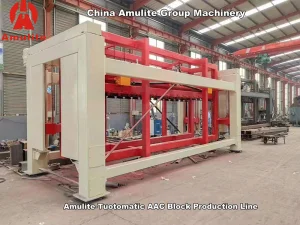
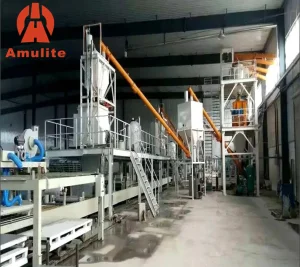
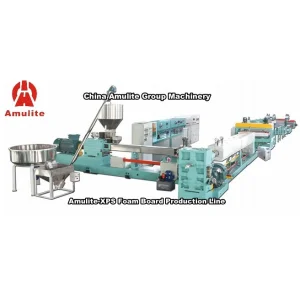
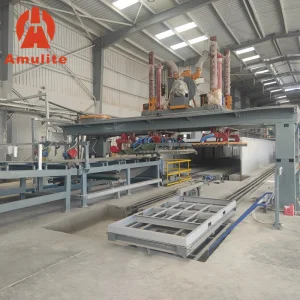
Understanding the technological transformation driving next-generation autoclaved calcium silicate production systems across international markets.
Modern calcium silicate board machines are shifting toward closed-loop steam recovery and high-efficiency hydrothermal crystallization. By optimizing the reaction between silica (SiO2) and lime (CaO) under 1.2–1.5 MPa steam pressure, modern plants achieve 100% Tobermorite crystal matrix formation with 22% lower specific energy consumption per ton of board produced.
Market demand is expanding rapidly for micro-porous, low-density calcium silicate boards (<0.8 g/cm³) engineered for ceiling tiles and passive fireproofing (UL 263 / EN 1364). Advanced slurrying vats incorporate precision foaming injectors and matrix micro-reinforcement technology to yield board flexural strength exceeding 14 MPa without density penalties.
Global environmental mandates strictly enforce 100% asbestos-free production. Modern machinery lines process engineered wood pulp, kraft fibers, synthetic polymer fibers (PVA/PP), and wollastonite needles. Dynamic disc refining systems control fiber freeness (28–35°SR) to optimize wet-web tension during high-speed Hatschek forming.
The manufacturing process relies on a precise stoichiometric reaction between siliceous and calcareous materials. During autoclave curing at 180°C–195°C under saturated steam pressure, amorphous calcium silicate hydrates undergo hydrothermal phase transformation:
5CaO + 6SiO₂ + 5H₂O —[Autoclave: 1.2 MPa, 12h]—> Ca₅Si₆O₁₆(OH)₂·4H₂O (Tobermorite Crystal Phase)
Achieving a uniform Tobermorite crystal structure eliminates moisture expansion, providing near-zero linear shrinkage (<0.08%) and high thermal durability up to 1000°C.
How tier-1 EPC contractors, factory investors, and OEM building material manufacturers evaluate purchasing decisions for calcium silicate board machines.
Global buyers prioritize equipment that seamlessly processes diverse industrial byproducts, such as fly ash from power plants, slag, and local quartz sand (silica content >85%). Efficient wet-ball milling systems reduce raw material preparation power consumption while maintaining fine mesh particle sizing (<8% retained on 200 mesh sieve).
High labor costs in Western Europe, the Middle East, and North America necessitate full line automation. High-speed vacuum robotic de-stackers, continuous edge profiling systems, and automated board accumulation stacks minimize manual handling, maintaining board edge rejection rates below 0.15%.
Procurement teams benchmark total cost of ownership over a 15-year lifecycle. Key metrics evaluated include forming cylinder wire cloth longevity, vacuum pump energy demand, hydraulic press cycle speed (up to 4 strokes/min), and autoclave thermal insulation efficiency.
How advanced Chinese machinery engineering companies combine heavy manufacturing capability with modern industrial automation.
China’s complete industrial ecosystem enables heavy-duty machinery fabricators to source ultra-large forge steel plates, CNC lathe machining for forming cylinders, and ASME-certified pressure vessel autoclaves within a tight geographic radius, cutting equipment lead times by 40% compared to European competitors.
Equipped with Siemens S7-1500 controllers and Schneider power electronics, modern Chinese manufacturing lines feature real-time cloud diagnostic telemetry. Remote engineers can diagnose slurry density variations, monitor autoclave steam valves, and optimize energy use globally.
From initial site civil design and slurry pipe line layout to overseas mechanical erection, wet commission, and raw material chemical formulation adjustments, leading Chinese manufacturers deliver end-to-end operational readiness backed by resident engineering teams.
An engineering analysis of the two dominant forming technologies for calcium silicate and fiber cement board production.
| Technical Parameter | Hatschek Multi-Vat Cylinder Process | Flow-On (Slurry Extrusion) Process |
|---|---|---|
| Primary Target Density | 0.95 – 1.45 g/cm³ (High Strength / Exterior Grade) | 0.75 – 1.10 g/cm³ (Low-Density Ceiling / Insulation) |
| Slurry Solid Concentration | 7% – 12% Low Concentration (Precision Filtering) | 25% – 35% High Concentration Slurry |
| Fiber Orientation & Strength | Multilayered orientation with superior flexural strength (≥16 MPa) | Random isotropic orientation with moderate strength (≥10 MPa) |
| Board Thickness Range | 4 mm – 25 mm (Achieved via continuous cylinder winding) | 5 mm – 15 mm (Extruded sheet forming) |
| Forming Speed | 60 – 110 meters/minute (High Output) | 30 – 55 meters/minute |
| Autoclave Hydrothermal Requirement | 1.2 – 1.5 MPa Saturated Steam, 10-12 Hours | 1.0 – 1.3 MPa Saturated Steam, 8-10 Hours |
Calcium silicate boards manufactured on autoclaved lines fulfill strict fire safety, acoustic, and environmental resistance standards globally.
Autoclaved calcium silicate boards (density ~1.2 g/cm³) provide 2-hour to 4-hour fire ratings (BS 476 Part 22 / UL 263). Non-combustible A1 rating ensures structural integrity in high-rise elevator shafts, fire escape stairwells, and industrial cable duct enclosures.
With an ultra-low moisture absorption coefficient (<10%) and zero dimensional warping under continuous 95% RH environments, low-density perforated and plain calcium silicate ceiling panels are mandatory in pharmaceutical cleanrooms, semiconductor labs, and operating rooms.
Heavy-density autoclaved boards (>1.3 g/cm³) are post-cured and factory-coated with Fluorocarbon (PVDF) or UV paints. They act as high-durability curtain wall backing boards capable of resisting extreme freeze-thaw cycles (-40°C to +80°C) and severe hurricane wind loads.
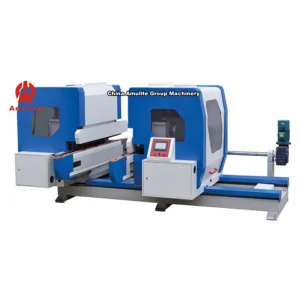
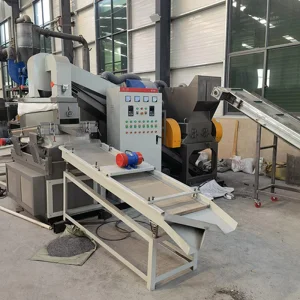
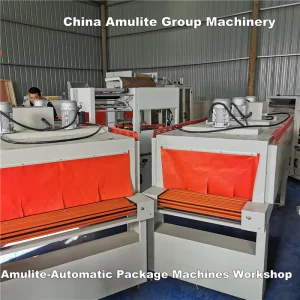
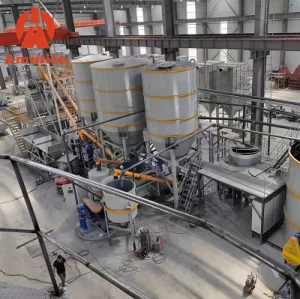
Select from our comprehensive catalog of building material production lines and specialized equipment.
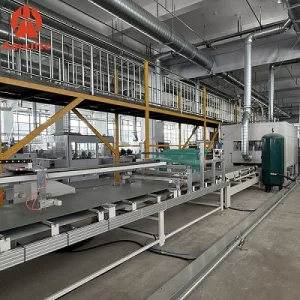
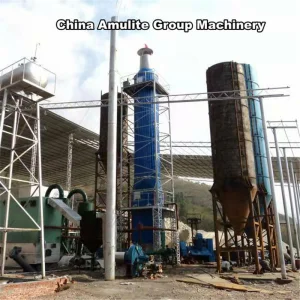
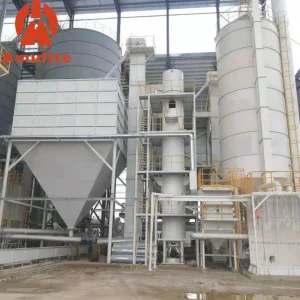
Detailed answers from our lead process engineers regarding equipment selection, commissioning, and raw material formulation.
Consult with our senior process engineers to receive a customized plant layout, utility load profile, and commercial quotation within 24 hours.
Request Engineering Turnkey Proposal