Advanced non-metallic building material machinery engineered for high-throughput architectural and structural panel fabrication.
The global demand for high-performance, energy-efficient, and aesthetically versatile exterior building envelopes has catalyzed a technological shift in continuous wall panel manufacturing. Among modern architectural solutions, Embossed Metal Composite Exterior Insulation and Decorative Panels (frequently designated as BFT panels, PU carved metal insulation boards, or metallic thermal cladding) have emerged as a dominant facade material across commercial, residential, and industrial construction sectors.
An continuous Embossed Metal Composite Exterior Panels Production Line integrates multi-stage precision mechanical operations into a single automated line: coil decoiling, surface metal embossing, roll-forming profile structuring, high-pressure polyurethane (PU) or polyisocyanurate (PIR) core injection, aluminum-foil/glass-fiber backing lamination, continuous double-curing track heating, servo-driven high-speed cutting, and automated stacking. Engineering a line of this complexity requires strict compliance with mechanical tolerances, precise chemical metering, and thermodynamics management to yield panels that meet rigorous international building codes (such as EN 13501-1, ASTM E84, and ISO 9001 quality frameworks).
Modern building envelope regulations in Europe, North America, and East Asia strictly limit thermal transmittance (U-value). Embossed metal composite panels combine an outer weather-resistant metal layer with a closed-cell Rigid Polyurethane foam core ($\lambda \le 0.024\text{ W/m}\cdot\text{K}$), offering up to 40% superior thermal efficiency compared to traditional EPS sandwich panels or wet-plaster EIFS systems of equivalent thickness.
According to industrial manufacturing metrics, the global market for insulated metal panels (IMPs) is projected to grow at a CAGR of 7.2% through 2030. Key regional dynamics shaping equipment acquisition include:
Proven technical excellence, comprehensive quality control systems, and worldwide turnkey project execution.
An overview of the core mechanical stations required to produce premium architectural metal cladding.
Uncoiling of color-coated steel or aluminum coils (0.27–0.5mm thickness). Dual-roll heavy-duty embossing units press decorative textures (brick, stone, wood grain, marble, wave) with hydraulic gap control and hardened alloy rolls.
Multi-pass precision cold roll-forming station establishes female/male shiplap interlocking joints. Infrared pre-heating tunnels elevate sheet temperature to 40°C–45°C to maximize chemical adhesion with the foam core.
Computerized 2-component or 4-component high-pressure polyol/isocyanate mixing equipment. Reciprocating injection nozzle evenly distributes liquid reactant across the moving lower sheet.
A 24 to 36-meter precision continuous conveyor crawler coated with heat-resistant synthetic plates. Maintains uniform pressure and temperature (60°C–70°C) during foam polymerization, ensuring flat panel surface.
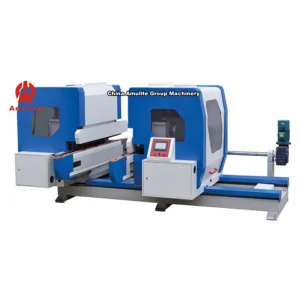
Tracking servo-motor driven circular saw cuts continuous panels into preset lengths (1000mm to 6000mm) without stopping the line. Dust extraction hood vacuums polyisocyanurate residue instantly.
Cooling conveyors stabilize exothermic reaction heat. Vacuum-suction automatic stackers stack finished embossed panels onto pallets, followed by PE stretch-wrapping for export protection.
| Parameter Item | Industrial Standard Value | Amulite High-Speed Custom Line Specs |
|---|---|---|
| Line Working Speed | 6 – 12 m/min | 10 – 25 m/min (Fully Automated) |
| Panel Width Options | 380mm – 450mm (Standard 383mm / 400mm) | Customizable up to 1000mm for wall panels |
| Panel Thickness Range | 14mm – 25mm | 10mm – 50mm Adjustable |
| Outer Metal Sheet Material | Alu-Zinc Coated Steel (Galvalume), Aluminum Sheet | 0.27mm – 0.50mm Pre-painted Coils |
| Core Insulation Layer | Polyurethane (PU) / Polyisocyanurate (PIR) | Density: 35 – 55 kg/m³, B1/B2 Fire Retardant Class |
| Lower Backing Substrate | Waterproof Aluminum Foil Paper / Fiber Fabric | Automatic Tension Uncoiling System |
| Total Installed Power | 120 kW – 180 kW | 150 kW – 260 kW (Energy Saver Inverter Control) |
Engineering solutions tailored to specific regional environmental conditions and building codes.
Widely utilized in light-gauge steel villas, modular containers, and tiny home installations. The lightweight panels (approx. 3.7 to 4.2 kg/m²) minimize structural foundation loads while delivering finished exterior textures (brick/wood pattern) without requiring secondary painting.
For old urban building upgrades in Eastern Europe and North America, these panels install directly over existing masonry via dry-hung aluminum alloy keels. Eliminates structural demolition, reduces renovation timelines by 60%, and drastically lowers winter heating costs.
Engineered for high thermal resistance in northern climates (e.g., Canada, Northern China, Kazakhstan) and moisture resistance in tropical coastal areas. Fluorocarbon (PVDF) paint finishes ensure 30+ years of color stability against UV exposure and salt-spray corrosion.
Detailed technical answers from China Amulite Group's senior mechanical and process engineering department.
Explore our full engineering portfolio of concrete, cement board, gypsum, and insulation panel manufacturing lines.