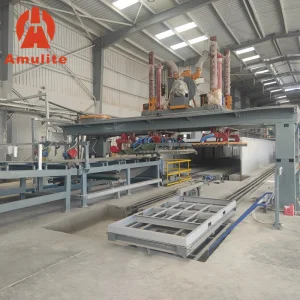
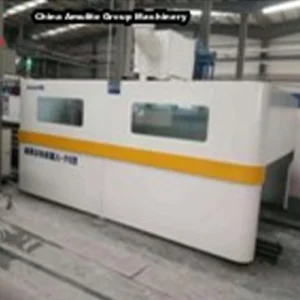
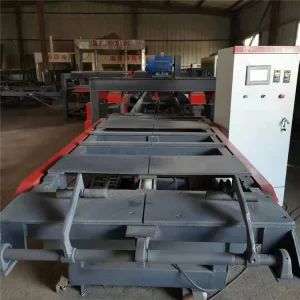
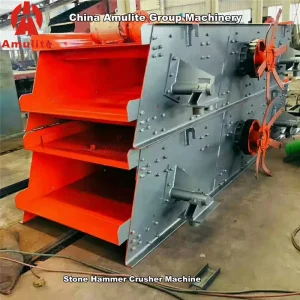
The global demand for high-capacity, energy-optimized Gypsum Board Production Lines has accelerated dramatically over the past decade. Driven by rapid urbanization, strict green building regulations, and a universal shift toward dry-construction wall systems, plasterboard has become the quintessential material for modern commercial and residential partition walls, drop ceilings, and interior lining.
Industrial gypsum manufacturing is undergoing a structural evolution. Regional markets in Southeast Asia, the Middle East, Africa, and Latin America are aggressively transitioning from traditional wet brickwork and labor-intensive masonry toward high-speed dry-wall panel assembly. According to global industrial data, the worldwide gypsum board market size is expanding at a CAGR exceeding 5.8%, creating urgent capital demand for advanced manufacturing lines capable of delivering 2 million to over 30 million square meters of high-density board annually.
Crucial to this growth is the shifting dynamics of raw material supply. While natural rock gypsum ($\text{CaSO}_4 \cdot 2\text{H}_2\text{O}$) remains heavily utilized in regions with abundant mining geology, leading global factories are increasingly upgrading their production lines to utilize FGD (Flue-Gas Desulfurization) Gypsum and Phosphogypsum. Industrial FGD gypsum, a byproduct of coal-fired thermal power plants, offers higher chemical purity ($>92\%$) and significantly lower raw material costs when processed through specialized calciners.
Modern gypsum board plant feasibility hinges on thermal engineering. Over 65% of plant operational costs (OPEX) originate from thermal energy required during calcination and board drying. Modern engineering factories like China Amulite Group incorporate multi-stage heat recovery systems that capture waste dryer exhaust gas to pre-heat combustion air, yielding unprecedented ROI for international investors.
Raw natural or FGD gypsum is ground and converted into Stucco ($\text{CaSO}_4 \cdot 0.5\text{H}_2\text{O}$) inside a fluidized bed calciner or ebullience kiln. Computer-controlled loss-in-weight feeders dose stucco, starch, retarders, micro-fiber glass, and foaming agents with milligram precision.
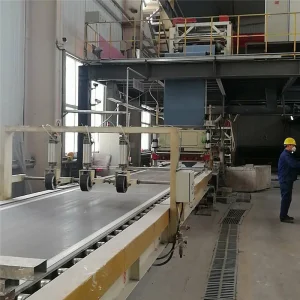
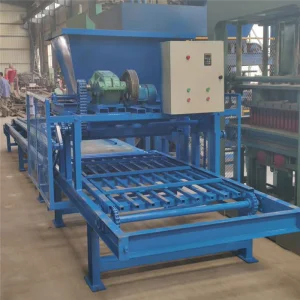
The core continuous mixer homogeneously blends wet slurry and micro-bubbles generated by an automated foam generator. Slurry flows onto the lower heavy duty paper sheet; upper paper is applied, passing through a high-precision forming station for thickness calibration.
The continuous green board travels on a rubber belt belt conveyor (approx. 400 to 800 meters depending on line speed) to allow rehydration ($100\%\text{ hydration reaction}$). An automated rotary knife cuts board into precise standard lengths (e.g., 2400mm / 3000mm).
Converting dihydrate gypsum into high-purity beta-stucco under controlled thermal curves.
Enclosing the cellular gypsum core between high-tensile top and bottom protective paper liners.
Recrystallization of stucco into interlocking gypsum crystal lattices along the setting belt.
Removing free moisture in a multi-zone hot air dryer without blistering board paper.
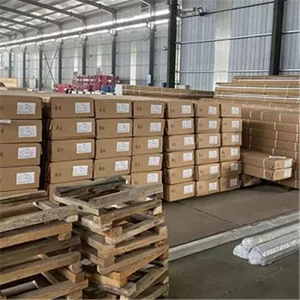
Automated four-edge sawing, stacking, corner wrapping, and shrink-pack staging for shipping.
| Plant Capacity (Annual) | Line Speed Range | Board Thickness Range | Thermal Source Options | Installed Electrical Power | Automation Level |
|---|---|---|---|---|---|
| 2 Million m²/Year | 6 - 12 m/min | 6.5 mm - 15 mm | Conductive Oil / Natural Gas / Coal | ~ 220 kW | Semi-Automated PLC |
| 5 Million m²/Year | 15 - 25 m/min | 8.0 mm - 16 mm | Natural Gas / Heavy Oil / Steam | ~ 480 kW | Fully Automated Siemens S7-1500 |
| 10 Million m²/Year | 30 - 45 m/min | 8.0 mm - 18 mm | Direct Gas Combustion / Steam Heat Exchanger | ~ 850 kW | SCADA + Centralized AI Control Room |
| 20-30 Million m²/Year | 60 - 90 m/min | 6.0 mm - 25 mm | Dual Thermal Oil & Exhaust Waste Heat Recovery | ~ 1,600 kW | Industry 4.0 Closed-Loop System |
Evaluating global machinery suppliers reveals clear competitive differentiators. European equipment suppliers have historically provided high precision but carry exorbitant CAPEX pricing and prohibitively high spare-parts costs. Conversely, standard uncertified suppliers often fall short in mechanical durability, thermal isolation, and automated controls.
China Amulite Group bridge this gap by delivering heavy industrial machinery engineered to international standards at optimal capital investment cost structure:
Located in the heavy machinery manufacturing hub of Hebei, China, Amulite leverages an integrated local supply chain. From high-grade structural steel fabrication to precision CNC machining of forming rollers, every component is manufactured with rigorous metallurgical quality control, drastically reducing production lead times to 90–120 days.
Unlike suppliers who ship dissembled parts directly to site, Amulite pre-assembles critical line segments—including the high-shear pin mixer, wet forming station, cross-cutter, and electrical control cabinets—inside its 100,000 m² heavy assembly bay. Dry-runs are conducted prior to container packing to eliminate site installation surprises.
Our automation engineering teams utilize global standard components (Siemens, Schneider, ABB, Omron). SCADA interface software allows intuitive remote monitoring, recipe management for different board densities, real-time diagnostic reporting, and remote PLC maintenance via encrypted cloud gateways.
A production line is only as reliable as its chemical formulation chemistry. Amulite process engineers analyze local customer raw materials (stucco mineral purity, water hardness, starch viscosity, paper weight) inside our dedicated laboratory to supply turn-key, optimized formulation recipes prior to plant commissioning.
Modern building codes demand multi-functional wallboards. A modular Amulite Gypsum Board Production Line allows plant operators to effortlessly switch between standard plasterboard and high-margin specialty boards simply by adjusting raw material dosing recipes within the SCADA control system:
Application: General interior partition walls & false drop ceilings in residential / commercial construction.
Core Additives: Stucco, foaming agent, corn starch, paper pulp binder.
Application: Fire-rated stairwells, elevator shafts, public commercial corridors (1 to 4 hour fire ratings).
Core Additives: Non-combustible glass fibers ($3\text{mm} - 6\text{mm}$ length), unexpanded vermiculite, silicone fluid.
Application: High-humidity environments including kitchens, bathrooms, basements, and exterior soffits.
Core Additives: Wax emulsion hydrophobic agents, organosilicon water repellents, green facing paper.
Application: Sound attenuation in auditoriums, open office spaces, and music halls.
Processing: Secondary automated punch machine & sound-absorbing non-woven fabric lamination.
As carbon taxation policies expand globally, gypsum board plant operations must prioritize energy efficiency. Technological advancements engineered into modern lines focus on three critical domains:
When planning a greenfield gypsum board manufacturing project, industrial investors must calculate total cost of ownership (TCO) beyond initial machinery hardware costs. Below is a baseline technical consumption guide for a standard 10 Million m²/Year Line (9.5mm board base):
| Resource / Input Utility | Unit Consumption (per m² finished board) | Total Daily Requirement (30,000 m²/day) | Infrastructure Requirement |
|---|---|---|---|
| Stucco Powder | ~ 5.2 - 5.8 kg | 156 - 174 Metric Tons | 2x 300-Ton Storage Silos with Pneumatic Transport |
| Board Facing Paper | ~ 340 - 380 grams (Top + Bottom) | 10.2 - 11.4 Metric Tons | Automated Splicer & Constant Tension Stand |
| Modified Starch | ~ 35 - 45 grams | 1,050 - 1,350 kg | Bulk Bag Unloader & Powder Feeder |
| Process Water | ~ 4.2 - 4.8 Liters | 126 - 144 m³ | Deionized / Filtered Water Tank & Recycling Unit |
| Natural Gas (Thermal Heat) | ~ 0.32 - 0.38 Nm³ | 9,600 - 11,400 Nm³ | Gas Pressure Regulating Station (0.2-0.4 MPa) |
| Electricity | ~ 0.45 - 0.55 kWh | 13,500 - 16,500 kWh | 1250 kVA Transformer & Substation |
A standard 10 Million m²/Year line requires an industrial land footprint of approximately 220 meters in length by 24 meters in width for the main machine line, alongside a minimum clear ceiling height of 7.5 meters. Raw material storage, calcination towers, and finished product warehouses typically require an additional 8,000 to 12,000 m² of covered industrial space.
A typical turnkey execution takes approximately 7 to 10 months. Machinery manufacturing inside China Amulite Group's plant requires 90 to 120 days depending on line scale. Ocean transport takes 20 to 45 days. Site installation, electrical wiring, mechanical erection, and trial commissioning supervised by our senior dispatch engineers require an additional 60 to 90 days on site.
Yes. Amulite designs multi-fuel, dual-feed calcination and feeding systems capable of handling both crushed natural gypsum rock and fine wet FGD synthetic gypsum. Our calcination kilns feature adjustable thermal retention times and variable frequency agitators to accommodate moisture and particle size variations between natural and synthetic raw materials.
Paper bonding failure (delamination) is prevented through dual mechanisms: precise chemical gelatinization of modified starch at the wet pin mixer, and strict multi-zone temperature curve control inside the dryer. By maintaining high humidity in Zone 1, starch migrates toward the paper-core interface and cross-links crystals before free water evaporates, guaranteeing superior peel-strength adhesion.
We standardize on premium tier-1 global components to ensure long-term spare parts availability worldwide: Siemens S7-1500 / S7-1200 PLCs, Siemens WinCC SCADA touch interfaces, Schneider contactors and circuit breakers, ABB VFD frequency inverters, and SEW-Eurodrive gear motors on heavy mechanical drives.
Amulite provides a comprehensive pre-project material audit. Clients send 10-20 kg samples of local stucco, natural rock, FGD powder, and target board paper to our central testing lab in China. We run purity assay, calcination behavior analysis, setting time tests, and strength verification, delivering a full feasibility report before contract finalization.
All Amulite plants come with a 12-month complete warranty on core mechanical structures and main control systems. Our service contract includes on-site operator training, process engineering assistance, 24/7 remote PLC network telemetry diagnostic support, and rapid global dispatch of wearable spare parts (cutter blades, belt rollers, mixer pins).
Partner with China Amulite Group for world-class process engineering, custom machinery fabrication, complete installation supervision, and lifetime formula assistance. Contact our senior technical sales director today to receive a personalized plant proposal and ROI feasibility study.