Explore high-capacity, turn-key manufacturing units engineered for industrial-grade wall materials, autoclaved block production, and advanced building material processing.
Empowering tier-1 building material plants with automated precision, reduced carbon footprint, and maximum thermal efficiency.
The global construction industry is experiencing a profound structural shift toward ultra-lightweight, energy-efficient, and structurally resilient building envelope materials. At the heart of this transformation is Autoclaved Aerated Concrete (AAC). AAC blocks and reinforced AAC structural panels offer an exceptional combination of high compressive strength, lightweight density (typically 300 to 600 kg/m³), superior acoustic insulation, and A1-grade fireproofing. Consequently, evaluating an Automatic AAC Block Production Line Supplier requires evaluating not just individual machines, but full-scale automated ecosystem architectures.
Modern automated AAC production lines have evolved beyond traditional semi-automated mechanical plants. Today's state-of-the-art facilities integrate advanced cyber-physical systems, real-time slurry density telemetry, closed-loop hydrothermal control, and robotic handling systems. Driven by stringent global ESG (Environmental, Social, and Governance) targets, industrial suppliers are prioritizing three core technological vectors:
Real-time moisture sensors and automated mass spectrometry analyze raw materials (silica sand, fly ash, lime, OPC cement, and gypsum) dynamically. Computer-controlled batching systems adjust aluminum powder expansion agents within micro-gram tolerances, optimizing porous matrix formation and preventing slurry collapse or density stratification.
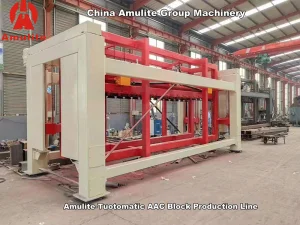
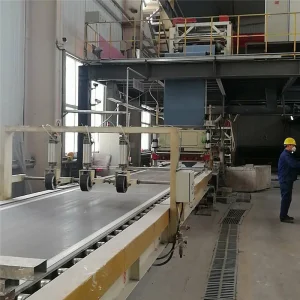
Next-generation longitudinal and transverse cutting machines utilize high-frequency oscillating steel wires and micro-stepper drives. By executing zero-waste double-side trimming prior to autoclaving, green-cake damage is virtually eliminated, keeping dimensional tolerances under ±1.0mm for blocks and ±0.5mm for tongue-and-groove panels.
Autoclave steam management now utilizes multi-stage flash steam heat exchanger networks. Waste steam released during depressurization of completed autoclaving cycles is harnessed to preheat boiler feed water and warm raw slurry vats, reducing total thermal energy consumption by up to 35%.
Enterprise-level buyers—including multinational building materials groups, EPC (Engineering, Procurement, and Construction) contractors, and sovereign infrastructure developers—require rigorous technical due diligence when selecting an Automatic AAC Block Production Line Supplier. Procurement decisions are no longer guided solely by capital expenditure (CapEx); operational durability, yield percentage, raw material versatility, and long-term compliance shape buying behavior.
| Evaluation Parameter | Standard Industry Baseline | Tier-1 Supplier Engineering Benchmark | Enterprise ROI Impact |
|---|---|---|---|
| Cutting Wire Precision | ± 1.5 mm to ± 2.0 mm | ± 0.5 mm to ± 1.0 mm (High-Frequency Oscillation) | Minimizes mortar consumption on job sites, commanding a 12-18% price premium per m³. |
| Green Cake Waste Rate | 3.5% – 5.0% return rate | < 1.2% waste with auto-recycling slurry system | Saves hundreds of tons of raw materials annually, reducing cost per block. |
| Autoclave Cycle Efficiency | 12 – 14 Hours total cycle | 8.5 – 10.5 Hours (Hydrothermal Phase Control) | Increases daily factory throughput by 25-30% without adding pressure vessels. |
| Automation Level (PLC/SCADA) | Manual intervention at demoulding | Full PLC closed-loop + Robotic Packing & Strapping | Reduces factory floor headcounts from 45 workers per shift down to 8-12 operators. |
| Pressure Vessel Safety | Basic national boiler code | ASME Sec VIII, CE-PED 2014/68/EU, EAC Certified | Ensures full compliance with international safety protocols and zero audit delays. |
Understanding the complete material transformation chain—from raw mineral processing to hydrothermal autoclaving.
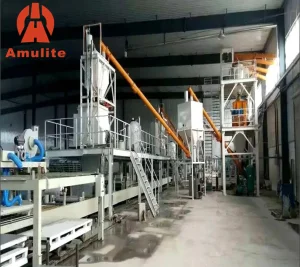
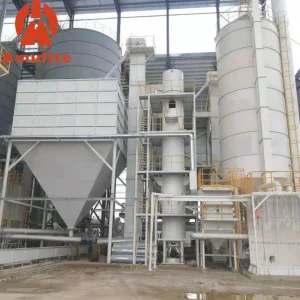
Silica sand or coal fly-ash is fed into a high-capacity wet ball mill along with water to form a finely milled slurry with specific gravity ranging between 1.60 and 1.70 g/cm³. Concurrently, quicklime and Ordinary Portland Cement (OPC) are stored in moisture-sealed silos equipped with pneumatic fluidizing pads and high-precision load cells. Gypsum is added as a chemical retarder to modulate early hydration kinetics.
All dry and liquid components are automatically metered into a high-speed planetary mixer. Aluminum powder suspension is injected in the final seconds of mixing. The homogenized slurry is discharged into pre-heated, oiled steel moulds. Inside the curing chamber (at 40–50°C and 90% humidity), the chemical reaction between aluminum powder and calcium hydroxide generates hydrogen gas, creating millions of uniform micro-voids that expand the cake to its final volume.
Once the cake achieves structural green strength (penetrometer rating of 0.25–0.35 MPa), a 90-degree tilting crane lifts the mould body, turning the block cake vertically onto a heavy-duty cutting cart. The green cake travels through horizontal and vertical cutting frames. Waste tops and bottoms are trimmed by automatic vacuum scrap collectors and instantly pumped back into the slurry system for 100% material recycling.
The cut cakes are loaded on ferry cars and pushed into heavy autoclaves. Operating under saturated steam pressure of 1.2 to 1.3 MPa (12–13 bar) and temperatures reaching 190°C–200°C for 8 to 12 hours, a critical hydrothermal reaction occurs. Calcium silicate hydrates react with quartz sand to synthesize Tobermorite crystalline structures (Ca5Si6O16(OH)2·4H2O), giving AAC its permanent load-bearing strength and low shrinkage property.
Every market presents unique regulatory constraints, raw material characteristics, and regional climate challenges. An experienced Automatic AAC Block Production Line Supplier delivers engineered turnkey solutions tailored to specific regional operating profiles:
Designed for urban high-rise markets requiring smooth-faced, high-precision masonry units. Integrates heavy-duty ball mills with hydro-cyclone classifiers to achieve fine quartz sand slurry (>3500 cm²/g Blaine fineness), resulting in crisp block edges suitable for thin-bed adhesive application.
Tailored for regions situated near coal-fired thermal power stations. Special slurry agitators and anti-settling dosage units effectively handle high-carbon fly ash without compromising aeration stability, enabling thermal plants to transform hazardous industrial ash into green building materials.
Hybrid production lines featuring automated steel mesh cage fabrication, anti-corrosion coating dip tanks, and mesh insertion robots. This configuration enables seamless switching between standard wall blocks and structural floor/wall panels (ALC panels) on a single production line.
Deploying a 300,000 m³ or 600,000 m³ automated AAC manufacturing facility involves complex international logistics, local civil engineering alignment, and strict pressure vessel compliance. Leading manufacturers provide end-to-end support frameworks to ensure seamless equipment integration:
All structural components, high-pressure autoclaves, and electrical control systems are manufactured to comply with EU CE-MD/PED standards, ASME Section VIII Division 1, ISO 9001:2015, and EAC safety mandates, passing third-party non-destructive testing (NDT) such as X-ray and ultrasonic weld inspections.
Senior mechanical, electrical, and chemical engineers are dispatched directly to client sites globally. They oversee civil foundation checks, mechanical alignment, PLC network commissioning, and preliminary raw material recipe formulation using local sand and lime samples.
Modern PLC cabinets are built with secure IoT gateways. In the event of an operational anomaly, remote engineering teams can perform diagnostics, update control logic, and optimize slurry batch curves in real-time, drastically reducing unplanned machine downtime.
The future of AAC block production focuses on ultra-low density formulations, complete factory electrification, and digital twin management. Industry research centers are pioneering ultra-lightweight AAC grades (D250 and D300) that serve as load-bearing thermal insulation layers, reducing the need for additional synthetic insulation materials in modern green architecture.
Simultaneously, AI-driven digital twin models are being integrated into plant SCADA systems. By continuous machine learning across historical batch data, weather humidity levels, and autoclave steam parameters, predictive algorithms automatically adjust raw material dosing in real time. This ensures consistent block strength while reducing cement consumption by 3–5%, representing significant cost savings over annual operational cycles.
Addressing core engineering, operational, and financial inquiries regarding AAC production line investment.
Depending on regional block sales margins, raw material costs, and plant capacity utilization, an automated 300,000 m³/year AAC block plant typically achieves full payback within 18 to 30 months. The higher efficiency of fully automated cutting and packaging lines significantly reduces labor and material scrap costs, accelerating ROI.
A standard 300,000 m³ per year AAC line requires a covered workshop footprint of approximately 12,000 to 18,000 m², along with a raw material storage yard of 10,000 m². Transformer capacity requirement is around 1200 KVA to 1600 KVA, while saturated steam requirement is approximately 8 to 12 tons per hour at 1.3 MPa operating pressure.
Yes, fly ash can serve as the primary siliceous material (accounting for 65% to 70% of the dry mix). However, the unburnt carbon content (loss on ignition, LOI) in fly ash should ideally be under 8%. If LOI exceeds 10%, slight blend ratios with silica sand or adjusted slurry density parameters may be necessary to maintain block compressive strength.
Tilt-cut technology turns the green cake vertical (90 degrees) before cutting, eliminating the bottom bed-plate friction during wire slicing. This prevents cake cracking, enables vertical wire oscillation for precise cuts, and allows zero-waste top/bottom trimming, making it the preferred standard for tier-1 suppliers worldwide.
Before equipment fabrication starts, representative samples of your local sand, fly ash, lime, and cement are shipped to our central chemical laboratory. We conduct full chemical XRF analysis, grindability testing, and trial batching to establish the precise chemical recipe needed for your target block density (e.g., D500, Grade 3.5 MPa).
Routine maintenance includes regular replacing of cutting wires, daily automatic cleaning and oiling of mould frames, checking hydraulic power pack seals, and inspecting autoclave quick-opening door safety interlocks. Suppliers provide fully computerized preventive maintenance schedules integrated into the main SCADA control console.
Discover complementary board, panel, recycling, and finishing lines engineered to expand your building material manufacturing capabilities.