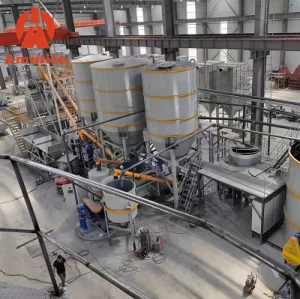
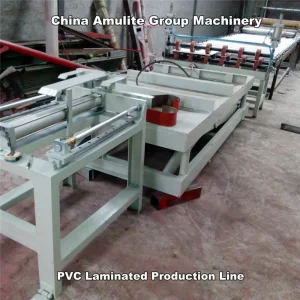
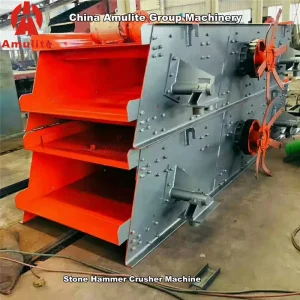
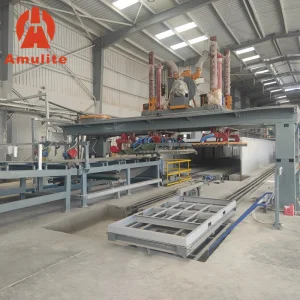
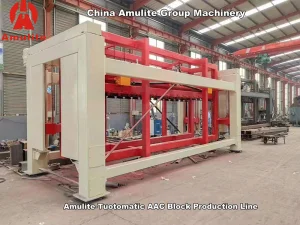
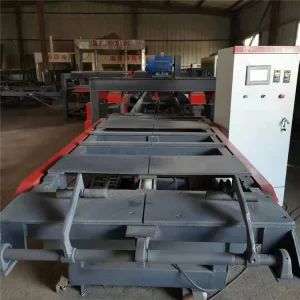
Explore our core engineering catalog featuring state-of-the-art mold oiling systems, cutting machines, and automated block production lines built for heavy industrial usage.
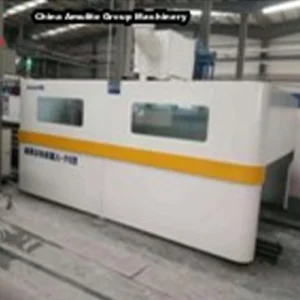
Optimizing Mold Release Dynamics, Preventing Surface Defects, and Maximizing Operational Efficiency in Autoclaved Aerated Concrete Plants
In modern Autoclaved Aerated Concrete (AAC) manufacturing, the quality of the finished block or reinforced panel depends fundamentally on the demolding process. After the slurry of quartz sand (or fly ash), lime, cement, gypsum, and aluminum powder undergoes gas generation and preliminary green cake expansion, the cake must be freed from its steel mold enclosure. Manual oiling or legacy flood-spray systems create severe inconsistencies: uneven oil pooling causes surface pitting, pinholes, and soft spots, whereas localized dry zones lead to cake tearing, corner chipping, and catastrophic structural cracking during side-plate tilting.
An advanced AAC Blocks Automatic Oiling System replaces operator guesswork with precise micro-atomization. Engineered with servo-driven multi-axis gantries, high-frequency pulse nozzles, and real-time optical sensing, these systems apply a micron-thin layer of release agent (typically 0.015 to 0.035 mm thick) across all four inner walls and the base plate of the mold. This controlled application guarantees uniform surface tension, easy separation of the green cake, and minimal residue buildup on mold surfaces.
Utilizes ultra-fine pneumatic nozzles operating at 4 to 6 bar to convert release agents into a homogeneous mist. This prevents fluid runoff, drip marks, and excessive chemical consumption while ensuring 100% surface coverage.
Gantry systems powered by Siemens or Schneider servo drives navigate inside complex 4.2m, 6.0m, or 7.2m molds. Speed profiling dynamically adjusts spray intensity according to corner angles and wall depths.
Integrated reclamation channels capture overspray mist, routing it through dual-stage magnetic and 10-micron particle filtration units to recycle unspent release agent and maintain clean shop-floor air quality.
Evaluating Capital Expenditure (CapEx) against Operational Savings (OpEx) for Tier-1 AAC Manufacturing Facilities
| Performance Parameter | Legacy Manual / Flood Oiling | Amulite Automated Oiling System | Impact on Plant Economics |
|---|---|---|---|
| Oil Consumption per Mold Cycle | 1.2 – 1.8 Liters | 0.45 – 0.65 Liters | 55% - 62% Chemical Cost Reduction |
| Green Cake Edge Defect Rate | 3.5% – 5.0% total yield loss | < 0.3% total yield loss | Recovers up to 15,000 m³ saleable block volume/year |
| Mold Cleaning Downtime | 45 mins per 8-hour shift | 5 mins per 8-hour shift | Increases daily plant throughput by ~8.3% |
| Labor Allocation | 2 dedicated workers per shift | Fully autonomous (0 operator intervention) | Saves 4 to 6 FTE skilled positions annually |
| Environment & VOC Compliance | High overspray puddle, VOC risk | Enclosed mist extraction & recovery | Meets EU REACH & US EPA air quality standards |
For a standard plant operating a 300,000 m³ annual capacity line, transitioning from manual/semi-automatic oiling to an Amulite Automatic Precision Spray System delivers quantifiable financial benefits:
Engineering Specifications of Amulite Multi-Axis Precision Spraying Systems for AAC Molds and Side Plates
Equipped with dual proportional valves and digital fluid pressure transmitters, the oiling system compensates for ambient temperature fluctuations and lubricant viscosity shifts (15 to 45 cSt at 40°C). Air pressure and liquid lines feature independent, pulse-free control to maintain static droplet size distributions across 30 to 50 micron spectrums.
Next-generation models integrate high-speed camera arrays that scan mold walls post-spray. Deep-learning algorithms identify dry spots or liquid pooling in real time, signaling immediate micro-adjustments to specific nozzle banks before the mold receives fresh AAC slurry.
As global environmental regulations tighten, traditional petroleum-based release agents are being phased out in favor of water-in-oil emulsions and pure vegetable oil derivatives. Amulite’s automated oiling systems feature 316 stainless steel fluid channels, anti-clogging self-cleaning nozzle heads, and dynamic shear agitators specifically engineered to prevent phase separation in bio-degradable emulsion release agents.
Enabling Seamless Integration Across Diverse Regional Construction Standards and Environmental Mandates
Strict focus on low VOC emissions, zero-drip working areas, and integration with Industry 4.0 MES/SCADA networks. Amulite machines feature OPC-UA interface protocols and UL/CSA certified electrical control cabinets.
High ambient thermal resistance (up to 55°C operational rating). Fluid cooling jackets and heavy-duty dust sealing prevent thermal degradation of release oil and protect pneumatic solenoid manifolds in desert conditions.
Focus on rapid capacity scaling, robust mechanical reliability, and ease of maintenance. Systems feature intuitive multi-language HMI touchscreens (English, Spanish, Russian, Arabic) for effortless operator onboarding.
In-Depth Answers for Engineering Directors, Plant Procurement Managers, and Machinery Investors
Our standard systems are engineered to handle release agents ranging from 10 cSt up to 68 cSt at 40°C. This includes neat mineral oils, emulsified water-in-oil formulations, and high-viscosity bio-based vegetable oils. For ultra-viscous fluids, optional inline heating manifolds are integrated to maintain fluid consistency before reaching the spray nozzles.
To eliminate nozzle blockages, Amulite spray bars incorporate an automated anti-drip needle-purge mechanism. At the completion of every spray cycle, a high-pressure air purge clears the nozzle orifice. Furthermore, line fluid tanks feature continuous low-shear recirculation and 100-mesh dual stainless steel filters.
Yes. The Amulite oiling cell is designed as a modular turnkey unit. It can interface seamlessly with existing mold circulation conveyors, tilting cranes, and cutting machines engineered by major European and Asian suppliers. Our automation team integrates custom encoder feedback and I/O signals into your plant's existing PLC master system.
A full 3D internal spray cycle for a 6.0-meter mold typically takes between 18 and 28 seconds, depending on gantry traversal speed settings and the required film thickness. This short cycle time easily accommodates high-speed plant cycle rates producing 300,000 to 600,000 m³ annually.
Amulite offers dual-station or multi-axis combined gantry setups. Dedicated spray heads target the removable side plates on the returning side-plate conveyor, while a gantry nozzle tree plunges into the main mold box. Both zones feature independent volumetric dosing controls.
All Amulite machines carry complete CE certification under the EU Machinery Directive 2006/42/EC and Electromagnetic Compatibility Directive 2014/30/EU. Electrical control enclosures adhere to IP54/IP65 ingress protection standards, with optional UL/CSA approval for North American deliveries.
Explore related machinery solutions including recycling equipment, panel production lines, and perlite processing units engineered by China Amulite Group.