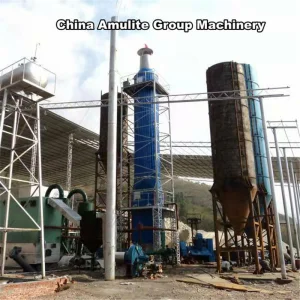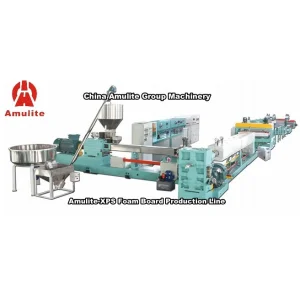
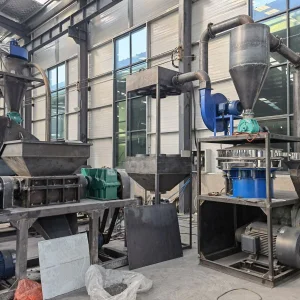
Explore our flagship industrial processing machinery, designed for maximum raw material recovery, high thermal stability, and low energy consumption.
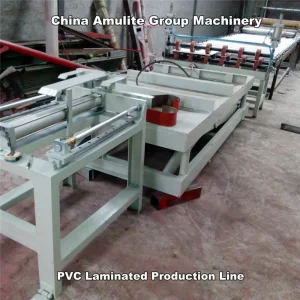
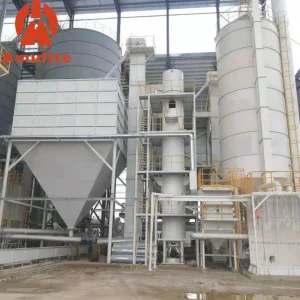
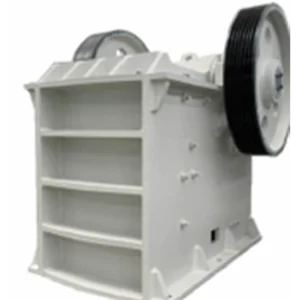
Providing high-yield, zero-emission lithium battery dismantling and black mass recovery systems tailored for global battery manufacturers, recyclers, and ESG compliance mandates.
Utilizing high-purity Nitrogen ($N_2$) blanket technology during two-stage shredding to eliminate thermal runaway risks and fully suppress solvent ignition during cell breach.
Advanced vacuum drying combined with multi-frequency air airflow classification guarantees recovery rates exceeding 98% for Lithium, Nickel, Cobalt, and Manganese powders.
Integrated multi-stage VOC incinerators and wet acid scrubbers neutralize toxic fluorine gas ($HF$) and electrolyte vapours, ensuring strict adherence to EPA and EU air quality standards.
An authoritative technical whitepaper analysis on mechanical recycling, hydrometallurgical pre-treatment, and direct cathode restoration.
The explosive global transition toward electric vehicles (EVs) and stationary energy storage systems (ESS) has created unprecedented demand for critical raw materials including Lithium ($Li$), Nickel ($Ni$), Cobalt ($Co$), and Manganese ($Mn$). As the first generation of mass-produced EV batteries reaches its end-of-life (EOL), industrial-scale Lithium Battery Recycling Equipment must evolve beyond traditional, energy-intensive pyrometallurgical smelting toward intelligent, zero-carbon, highly automated mechanical and hydrometallurgical recycling plants.
Technical Information Gain Notice: Modern recycling lines must handle changing battery chemistry profiles—ranging from high-nickel NMC 811 and LFP (Lithium Iron Phosphate) to upcoming Sodium-ion (Na-ion) and Solid-State batteries—without requiring line overhaul.
Traditional recycling methods posed severe fire hazards due to residual state-of-charge (RoC) in scrap battery packs. Modern plant engineering relies on continuous, high-torque dual-shaft shear shredders operating inside sealed chambers pressurized with technical-grade Nitrogen ($N_2$). This prevents oxygen exposure during mechanical cell destruction.
Following primary shredding, material passes through a continuous low-temperature vacuum pyrolysis rotary kiln operating at $350^\circ\text{C} - 550^\circ\text{C}$. This step thermalizes organic binders such as Polyvinylidene Fluoride (PVDF) and liquid organic carbonates without oxidizing metallic foil substrates, liberating pure cathode and anode active powders from aluminum and copper current collectors.
| Process Benchmark | Traditional Pyrometallurgy | Standard Hydrometallurgy | Advanced Inert Mechanical Shredding (Our Line) |
|---|---|---|---|
| Black Mass Recovery Yield | Low (< 70%) | Moderate (85 - 92%) | Ultra-High (> 98.2%) |
| Direct Lithium Recovery Rate | Slag Loss (< 10%) | 80 - 90% | 95 - 98.5% |
| Energy Consumption per Ton | Extreme (> 4,000 kWh/t) | Moderate (1,200 kWh/t) | Low (< 650 kWh/t) |
| Carbon Footprint ($CO_2$ Equivalent) | High ($3.5\text{ t } CO_2/\text{t}$) | Moderate ($1.8\text{ t } CO_2/\text{t}$) | Minimal (< 0.45\text{ t } CO_2/\text{t}$) |
| Processable Battery Chemistries | NMC, LCO only | NMC, LCO, LFP | Universal (NMC, LFP, LTO, Na-ion, Solid State) |
Before physical shredding, automated module-to-pack (M2P) disassembly systems utilize 3D vision systems and robotic arm end-effectors to unscrew busbars, disconnect BMS wiring harnesses, and isolate prismatic, cylindrical, or pouch cells. Integrated laser-induced breakdown spectroscopy (LIBS) sensors classify battery chemistries in real-time at line speeds exceeding 60 units per minute, ensuring pure input streams for specific hydrometallurgy refining steps.
Leveraging deep industrial ecosystems, vertical integration, and heavy machinery manufacturing power to deliver turnkey recycling lines with uncompromised quality.
From heavy steel plate machining, CNC precision roller fabrication, and electrical PLC control cabinet wiring to pre-shipment dry runs—all critical sub-assemblies are built under one roof in our state-of-the-art Chinese manufacturing facilities. This eliminates supply chain middleman markups and guarantees rapid project execution within 90 to 120 days.
Engineered for continuous $24/7/365$ industrial duty cycles, our hammer mills, air separators, and vibrating screens incorporate high-manganese alloy liners, double-sealed SKF/NSK heavy bearing housings, and explosion-proof Siemens/Schneider drive motors designed to withstand extreme abrasive wear from high-hardness cathode minerals.
Ensuring complete regulatory compliance across Europe, North America, and Southeast Asia with localized commissioning and field service teams.
Our black mass recovery equipment ensures buyers achieve mandatory material recovery targets for 2027/2031 (50% to 80% for Lithium, 90% to 95% for Cobalt, Nickel, and Copper), integrated with automated digital data collection for Battery Passport compliance.
All electrical enclosures, pneumatic actuators, dust collectors, and ducting networks are designed in compliance with ATEX Zone 20/21 dust explosion norms and NFPA 69 explosion prevention standards, featuring automatic rupture discs and high-speed spark suppression systems.
Every installation is backed by real-time cloud SCADA telemetry for predictive maintenance, alongside fully certified multilingual commissioning engineers stationed across Europe, North America, and the Middle East for immediate site installation, trial runs, and operator safety training.
A strategic guide for Procurement Officers, Plant Directors, and EPC Contractors evaluating OEM plant suppliers.
Investing in a commercial-scale lithium-ion battery recycling facility represents a major capital investment ranging from $2M to over $35M depending on annual throughput capacity (e.g., 3,000 TPA to 50,000 TPA). Procurement teams must evaluate prospective machine suppliers against key operational and risk metrics to ensure long-term ROI and operational uptime.
While machine purchase price (CAPEX) is critical, operational expenses (OPEX)—specifically electrical power consumption (kWh per ton of processed scrap), nitrogen gas usage, replaceability of wear parts, and labor automation—determine plant profitability. Equipment featuring energy recovery thermal oxidizers and closed-loop nitrogen recirculation circuits reduce OPEX by up to 35% annually.
Downstream hydrometallurgical refiners pay a premium for black mass with low copper ($Cu$) and aluminum ($Al$) foil contamination (ideally < 0.5% combined wt). Buyers must mandate continuous mechanical magnetic separation, multi-stage zig-zag air classifiers, and ultra-fine dust cyclone collectors in the machinery scope of work.
OEM Sourcing Tip: Always request verified mass-balance flow sheets, particle size distribution curves ($D_{50}, D_{90}$), and actual third-party assay reports of output black mass prior to finalizing procurement contracts.
Addressing core technical, financial, and regulatory questions from enterprise buyers worldwide.
Our multi-stage mechanical shredding, low-temperature vacuum drying, and air classification lines achieve a verified Black Mass recovery yield exceeding 98.2% relative to total cathode/anode active material contained in the feedstock, with metallic copper and aluminum residual impurities under 0.5%.
We employ a fully sealed, positive-pressure Nitrogen ($N_2$) inertization system inside the primary and secondary shredder chambers. Oxygen levels are continuously monitored below 2% using industrial electrochemical sensors, eliminating fire or explosion hazards during cell breach.
Yes. Mechanical physical processing (shredding, drying, copper/aluminum separation) is chemistry-agnostic. However, for maximum economic output value, we offer integrated AI optical and LIBS sorting systems to separate LFP and NMC batteries prior to shredding.
Every plant includes an integrated environmental treatment skid featuring a high-temperature VOC Regenerative Thermal Oxidizer (RTO), alkaline wet scrubber for HF gas absorption, and HEPA dust filtration units, keeping airborne emissions below strict EU and US EPA thresholds.
Standard manufacturing lead time is 90 to 120 days upon layout approval. On-site mechanical installation, civil structure verification, electrical hookup, and commissioning typically require 30 to 45 days managed by our resident field engineers.
Yes. Our 27-member engineering team provides bespoke 3D CAD layout modeling, tailored conveyor lengths, custom electrical panel integration (Siemens S7-1500 or Allen-Bradley PLCs), and specialized footprint adaptations for existing industrial factory halls.
Browse our expanded portfolio of heavy material processing, crushing, board manufacturing, and automated packaging systems.