Next-Generation Automated Magnesium Oxide Board Manufacturing Machinery: Chemistry, Process Optimization, and Global Industry Solutions
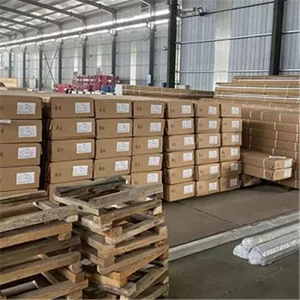
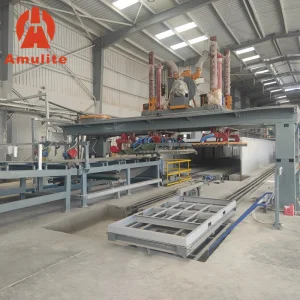
Magnesium Oxide (MGO) board manufacturing has evolved from a niche alternative building material into a cornerstone of contemporary fireproof, sustainable, and high-performance structural engineering. As international building codes enforce stricter zero-flame-spread, anti-microbial, and low-carbon mandates, industrial demand for turnkey MGO Board Production Lines has accelerated across North America, Europe, the Middle East, and Southeast Asia.
Historically, early-generation MGO boards faced performance challenges, specifically hygroscopic chlorine sweating (efflorescence) and corrosion of metallic fasteners caused by unreacted magnesium chloride ($\text{MgCl}_2$). Modern process engineering engineered by leading equipment suppliers has completely overhauled the chemical matrix. Today’s industrial state-of-the-art leverages precise magnesium sulfate ($\text{MgSO}_4$) chemistry or advanced ternary systems ($\text{MgO}-\text{MgCl}_2-\text{H}_2\text{O}$ stabilized with micro-silica and organic modifiers), completely mitigating halogen-induced corrosion while dramatically increasing flexural and tensile strengths.
The commercial shift toward industrial off-site prefabrication, Structural Insulated Panels (SIPs), modular volumetric construction, and high-rise shaft wall assemblies has redefined standard buyer expectations. Factory investors no longer seek simple machinery; they demand integrated turnkey production systems capable of continuous batching, precision thickness control ($\pm 0.2\text{mm}$), inline mesh lamination, dynamic curing environmental control, and automated stack handling.
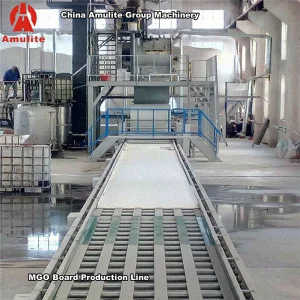
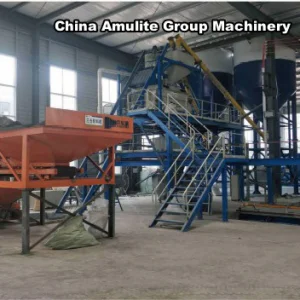
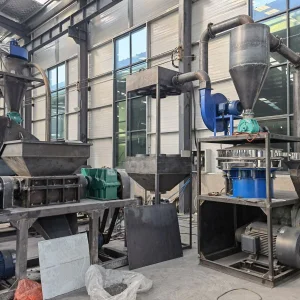
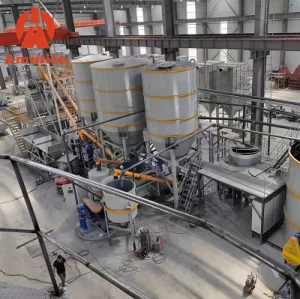
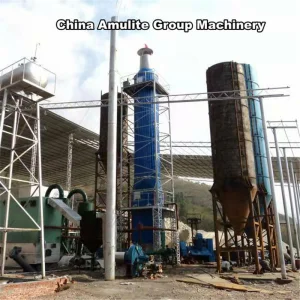
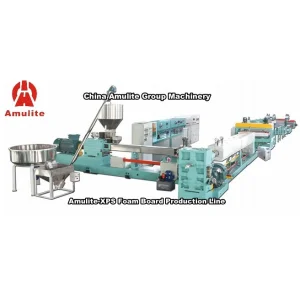
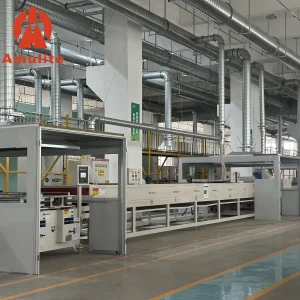
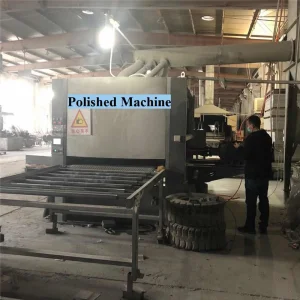
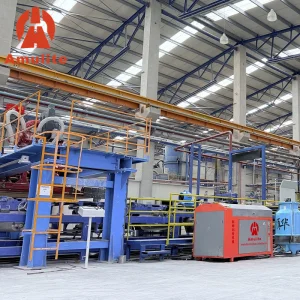
An advanced MGO board production line integrates mechanical, hydraulic, pneumatic, and automated PLC control subsystems to convert bulk raw minerals into high-density cured panels. Evaluating a supplier requires a granular understanding of the five primary operational zones within an automated production facility:
Loss-in-weight gravimetric feeders measure light-burned magnesia ($\text{MgO}$), active chemical salts ($\text{MgSO}_4 / \text{MgCl}_2$), volcanic perlite, wood flour fillers, and inorganic slurry additives. Computer-controlled liquid dosing units adjust water-to-magnesium ratios continuously based on real-time ambient moisture sensors.
Dual-shaft planetary mixers operate under temperature-monitored conditions to prevent premature exothermic reaction of the $\text{MgO}$ matrix. The homogenous slurry is degassed using inline ultrasonic agitators to eliminate structural micro-voids prior to board extrusion.
Slurry is distributed onto heavy-duty PVC or steel templates. Multiple continuous pay-off stations feed alkali-resistant (AR) glass-fiber mesh ($ZrO_2 \ge 16.5\%$) into top and bottom faces, while high-frequency compaction rollers drive out air pockets and set precise target board thickness.
Formed sheets enter automated multi-stage curing tunnels. Stage 1 maintains $35-45^\circ\text{C}$ with relative humidity $>85\%$ for initial crystal network binding (5-1-7 or 3-1-8 phases), followed by automated demoulding and secondary stack curing.
| Line Parameter | Standard Line (Compact) | High-Capacity Industrial | Turnkey Flagship Automated |
|---|---|---|---|
| Annual Output Capacity | 1,000,000 m² – 2,000,000 m² | 3,000,000 m² – 5,000,000 m² | 6,000,000 m² – 10,000,000 m²+ |
| Board Thickness Range | 3 mm – 20 mm | 3 mm – 25 mm | 3 mm – 30 mm (Sanded / Calibrated) |
| Line Operating Speed | 8 – 12 m/min | 15 – 25 m/min | 30 – 45 m/min |
| Automation Level | Semi-Automated (Manual Stack) | Fully Automated (PLC + SCADA) | Industry 4.0 Integrated Robotics |
| Thickness Tolerance | $\pm 0.4 \text{ mm}$ | $\pm 0.2 \text{ mm}$ | $\pm 0.1 \text{ mm}$ (Inline Sanded) |
| Power Consumption | 120 kW – 180 kW | 250 kW – 420 kW | 500 kW – 850 kW |
When global building product manufacturers and investors evaluate MGO line machinery suppliers, China stands as the undisputed center of industrial machinery production and raw mineral processing. Partnering with top-tier Chinese equipment groups like China Amulite Group provides distinct economic, technical, and operational competitive advantages:
China holds over 80% of the world's highest-purity magnesite mineral deposits (specifically in Liaoning Province). Chinese machinery design engineers possess decades of empirical chemical trial data regarding how varying activity grades of $\text{MgO}$ react with salts. Buying machinery from the mineral source origin ensures formula tuning tailored directly to global raw material inputs.
European or North American machinery fabricators charge exorbitant premiums for heavy-duty structural steel frame machining and custom assembly. Chinese OEM supply chains offer robust, heavy-duty industrial lines equipped with premium global electronics (Siemens PLCs, Schneider electrics, SEW drives, Omron sensors) at 40% to 60% lower upfront capital outlay.
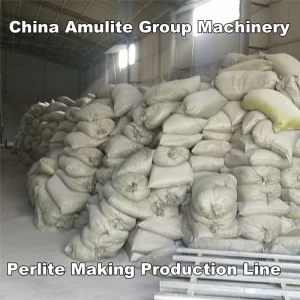
Chinese suppliers do not sell isolated machines; they engineer holistic manufacturing ecosystems. From raw material grinding, expanded perlite production lines, automated board forming, and edge profiling to downstream UV coating and decorative laminating lines—buyers source complete value chains under a unified engineering protocol.
An MGO board production line installed today must deliver engineered boards engineered for vastly different localized installation environments. Equipment flexibility allows operators to dynamically adjust board density ($800 \text{ kg/m}^3$ to $1450 \text{ kg/m}^3$), thickness, and fiber reinforcement layouts to address high-value building applications:
High-density MGO boards ($1100-1300 \text{ kg/m}^3$) replacing standard gypsum plasterboards in elevator shafts and fire-rated stairwells. Compliant with UL 263, ASTM E119, and EN 13501-1 Class A1 fire test ratings.
Heavyweight $18\text{mm}-20\text{mm}$ tongue-and-groove (T&G) MGO panels providing superior flexural strength ($>18\text{ MPa}$), zero floor squeak, and total water moisture immunity for modular housing and apartment subfloors.
Precision-sanded thin MGO sheets ($6\text{mm}-10\text{mm}$) laminated directly to EPS, XPS, or polyurethane foam cores for load-bearing Structural Insulated Panels used in high-efficiency thermal envelopes.
Hydrophobic-treated MGO panels engineered with silicone water-repellent additives, certified for freeze-thaw durability under ASTM C1186 and EN 12467 standards.
As the building products industry transitions toward aggressive decarbonization and digital manufacturing, MGO production technology is undergoing significant technological advancement. Procurement teams evaluating machinery suppliers must analyze prospective manufacturers across key future-proofing indicators:
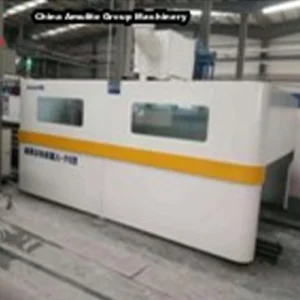
Contact our senior process engineering department today to receive a complete turnkey proposal, including plant layout drawings, raw material formula analysis, utility load figures, and custom CAPEX ROI calculations tailored to your market target.