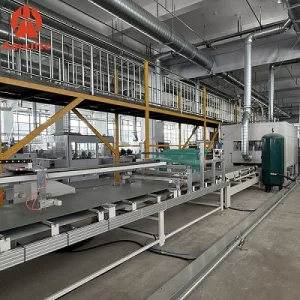
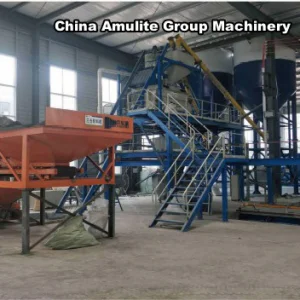
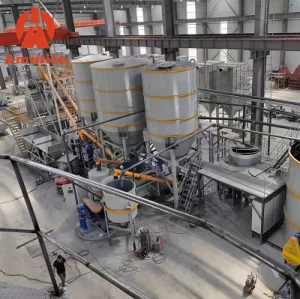
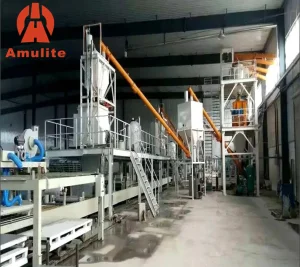
Explore our core engineering catalog of high-capacity board machinery, recycling solutions, and composite panel production equipment engineered for optimal capital deployment.
Analyzing macro-economic vectors, net-zero carbon mandates, and structural demand changes across global commercial building infrastructure.
The global construction sector is undergoing a monumental transition toward industrialized off-site manufacturing (OSM) and modern methods of construction (MMC). Escalating field labor overheads, stringent thermal efficiency mandates (such as EU EPBD directives and US ASHRAE 90.1 standards), and compressed project completion schedules have rendered traditional cast-in-situ wet masonry commercially unviable for large-scale developments.
Sandwich wall panels—specifically lightweight EPS cement sandwich composite panels and PU/Rockwool structural insulated panels (SIPs)—have emerged as the definitive solution for next-generation building envelopes and interior partition grids.
Deploying an OEM sandwich wall panel production line requires a precise understanding of material physics tradeoffs. Lightweight EPS composite cement wall panels utilize a cellular cementitious matrix embedded with expanded polystyrene granules, bounded by high-density non-asbestos fiber cement or calcium silicate face boards.
This dynamic tri-layer composite delivers an unprecedented strength-to-weight ratio, structural rigidity, and self-supporting shear capabilities while reducing deadweight loading on primary structural steel frame or reinforced concrete superstructures by up to 60%.
By replacing standard hollow concrete masonry units (weight ~180-220 kg/m²) with 90mm EPS cement sandwich wall panels (weight ~55-68 kg/m²), structural engineers can optimize foundation pile counts, decrease structural rebar ratios by 12-18%, and achieve seismic response reduction factors essential for high-risk earthquake zones (Zone 4/5 performance).
| Performance Parameter | EPS Cement Sandwich Panel | Autoclaved Aerated Concrete (AAC) | Traditional Clay Hollow Brick |
|---|---|---|---|
| Volumetric Dry Density | 550 – 700 kg/m³ | 500 – 650 kg/m³ | 1200 – 1400 kg/m³ |
| Bending Resistance Factor | 1.5x to 3.0x dead load capacity | Brittle, low tensile shear strength | Requires structural lintels & tie-columns |
| Acoustic Isolation (STC) | 42 – 50 dB (90mm panel) | 36 – 40 dB (100mm block) | 38 – 42 dB (rendered masonry) |
| Installation Velocity | 35 – 50 m²/worker/day | 15 – 20 m²/worker/day | 8 – 12 m²/worker/day |
| Thermal Conductivity (λ) | 0.045 – 0.065 W/(m·K) | 0.11 – 0.16 W/(m·K) | 0.45 – 0.60 W/(m·K) |
An end-to-end breakdown of industrial automation, continuous batching, hydraulic casting, and precision milling sub-systems.
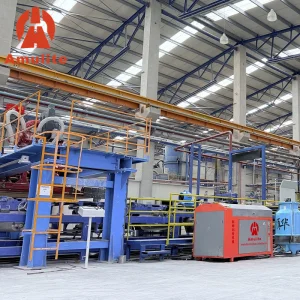
The primary mixing station features automated loss-in-weight gravimetric feeders for Portland cement (Grade 42.5/52.5), fly ash, and mineral micro-fillers. High-shear planetary mixers ensure micro-bubble stabilization, preventing EPS beads from segregating during high-speed fluid transfer into vertical or horizontal gang molds.
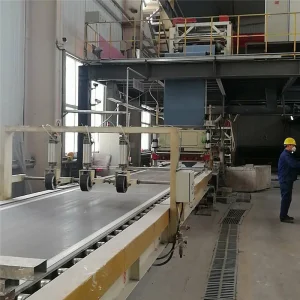
High-precision vacuum suction gantry robots transport fiber cement or calcium silicate face boards directly into precision-aligned hydraulic vertical mold cars. Dual-side hydraulic clamping units feature servo-controlled spatial alignment, guaranteeing strict thickness accuracy within ±0.5mm across a standard 3000mm length.
Utilizing high-pressure slurry displacement pumps, the homogenous EPS-cement matrix is injected under low turbulence into the sealed mold cavities. Secondary steam-assisted or electrical thermal conditioning loops accelerate initial setting times within 90-120 minutes, permitting ultra-fast turnaround cycles.
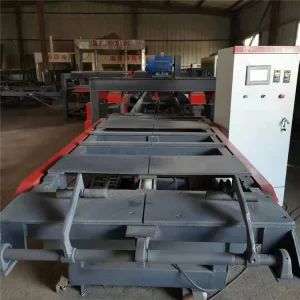
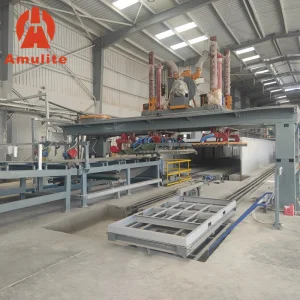
Once initial green strength exceeds 1.5 MPa, automated hydraulic mold cars transition to the demolding bay. Multi-axis heavy-duty robotic arms or pneumatic tilting tables flip panels to vertical orientation, preventing bending moments and flexural micro-cracking prior to final curing yard transfer.
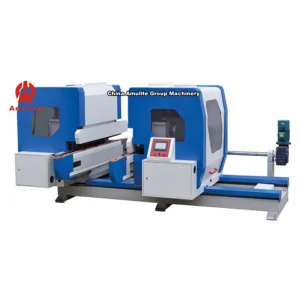
High-speed inline double-end tenoners cut precise tongue-and-groove joint profiles on all four perimeter edges. Precision milling guarantees tight inter-panel interlocking, eliminating thermal bridges and acoustic leak paths during field erection.
Unlocking total cost of ownership (TCO) optimization through industrial integration, specialized component sourcing, and modular engineering.
China's industrial machinery manufacturing base provides an unparalleled strategic advantage for global building material producers. By consolidating heavy structural fabrication, high-precision hydraulic power unit assembly, PLC control cabinet wiring, and pre-commissioning dry testing within standardized regional clusters, OEM manufacturers achieve unmatched economies of scale.
Our supply chain architecture integrates tier-one international automation platforms—including Siemens S7-1500 Series PLCs, Schneider low-voltage switchgear, SEW-Eurodrive geared motors, and Yuken hydraulic valves—with heavy-gauge structural steel frames manufactured under strict ISO 3834 welding quality standards.
Standardized plant blueprints often fail when deployed in international markets with distinct raw material characteristics, local electrical codes, or plant footprint limitations. Our engineering framework supports modular OEM/ODM tailoring:
Engineered performance across high-rise residential, commercial logistics centers, industrial cleanrooms, and modular housing environments.
90mm and 100mm lightweight EPS wall panels provide exceptional space-saving footprints (gaining 3-5% usable interior floor area compared to rendered brick). Rated for STC 45dB acoustic isolation and 3-hour fire endurance under ISO 834 fire tests, making them the standard choice for luxury multi-family towers.
Utilizing high-density polyurethane (PU) or rockwool core sandwich panels with continuous tongue-and-groove joint seals. Zero condensation risk (μ factor > 5000), anti-microbial surface skins, and thermal resistance values optimized for food processing plants, pharmaceutical facilities, and cold logistics hubs.
Self-supporting load-bearing sandwich panels enable rapid structural assembly without heavy crane machinery. Panel units can be pre-cut, pre-drilled for electrical conduits, and factory-finished with decorative textured coatings for immediate field deployment within hours.
Emerging technology vectors shaping the next decade of non-metallic mineral board processing and smart panel automation.
Next-generation OEM lines are integrating near-infrared (NIR) moisture sensors, inline ultrasonic viscosity analyzers, and machine-learning feedback loops. These smart systems continuously optimize water-to-binder ratios and chemical foam injection rates in real-time, counteracting ambient temperature and humidity shifts to maintain uniform dry density within ±1.5% accuracy.
Decarbonization trajectories demand the replacement of energy-intensive Ordinary Portland Cement (OPC) with alkali-activated geopolymers, industrial slag, desulfurization gypsum, and post-consumer recycled glass micro-beads. Future sandwich panel lines will incorporate specialized non-carbonation curing tunnels powered by industrial waste heat recovery loops.
Ensuring compliance with international building directives, pressure vessel codes, and field engineering lifecycle guarantees.
All structural components, electrical panels, and pressure-vessel autoclaves (where applicable) conform strictly to international standards: CE Machinery Directive 2006/42/EC, Low Voltage Directive 2014/35/EU, ISO 9001:2015 Quality Management Systems, and ASME Section VIII Pressure Vessel Code compliance.
Our resident field engineering teams handle civil foundation verification, mechanical installation, electrical wiring, PLC loading, and raw material formulation tuning on-site. We guarantee stable mass production output before contractual final hand-over.
Integrated VPN router hardware in PLC control cabinets enables real-time remote telemetry diagnostics, PLC firmware updates, and predictive sensor fault detection, ensuring plant uptime availability targets exceed 96.5% annually.
Direct answers from our senior plant engineers addressing investment, formulation, utility, and throughput queries.
A standard EPS cement sandwich wall panel production line requires: Ordinary Portland Cement (OPC Grade 42.5 or 52.5), Expanded Polystyrene (EPS) beads (density ~12-16 kg/m³), fine silica sand or fly ash (fineness > 200 mesh), chemical foaming additives/superplasticizers, clean process water, and non-asbestos fiber cement or calcium silicate boards (thickness 4.5mm - 6mm) for outer skins. Our chemical process engineering team assists clients with local raw material testing and custom slurry formulation optimization on site.
Under normal operating conditions and standard regional building panel pricing (average selling price USD $12 - $18 / m² depending on panel thickness 90mm-150mm), plant owners typically achieve full capital payback within 14 to 22 months of continuous operation. Major factors impacting ROI include local cement prices, degree of plant electrical automation, and factory footprint utilization efficiency.
Vertical hydraulic mold car lines require significantly less initial plant floor space (approximately 3,500 - 5,000 m²) and offer fast batch changes for varying panel lengths and thicknesses (60mm to 200mm). They are highly suited for high-mix low-volume structural panels. Continuous horizontal panel lines demand larger factory halls (8,000+ m²) and excel in massive single-specification runs (e.g., standard PU or Rockwool insulation panels) with continuous high-speed cutter integration.
A standard 1,000,000 m²/year vertical mold car line typically requires: Connected Electrical Capacity: 180 kW - 250 kW (3-phase); Compressed Air Demand: 1.5 - 2.5 m³/min at 0.8 MPa; Steam Generation: 1.0 - 2.0 t/h (for EPS bead pre-expansion and thermal curing chambers); Process Water: 15 - 25 m³/day (recirculated where feasible to eliminate liquid discharge).
Yes. Our advanced OEM mold cars can be equipped with custom core inserts for pre-forming vertical/horizontal electrical cable pathways, plumbing channel voids, or embedded structural steel connecting pins. This reduces site labor by eliminating post-installation wall chasing and slotted cutting.
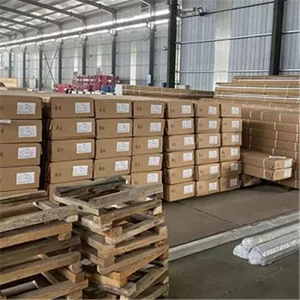
All heavy structural sub-assemblies are sandblasted, anti-corrosive coated, and packaged in ocean-ready heavy-duty wooden cases or framed steel skids suitable for 40ft HQ container loading. A standard complete line requires approximately 8 to 14 containers. Our field service dispatch includes senior mechanical and PLC electrical engineers who oversee installation, wiring, dry testing, and live commissioning on site.
Explore our extended machinery matrix, including automated wall panel lines, edge processing systems, and specialized tile fabrication equipment.