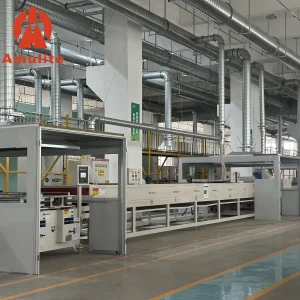
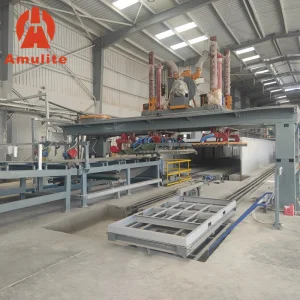
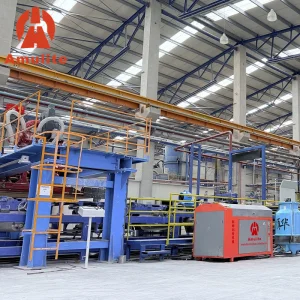
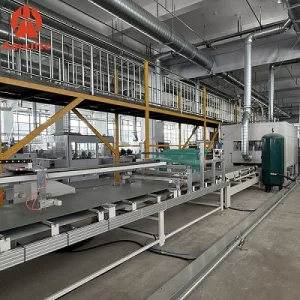
Explore our core engineering catalog engineered for industrial productivity, automated slurry management, and energy-efficient continuous board formation.
An in-depth analysis of processing mechanics, hydrothermal synthesis, and continuous sheet forming technology.
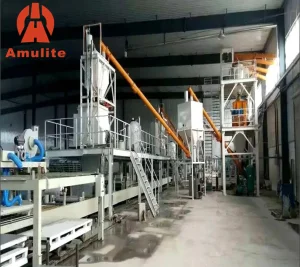
The modern architectural landscape demands building materials that seamlessly unify structural integrity, class-A1 fire resistance, low density, and extreme weatherability. At the core of this industrial evolution are automated fiber board production lines (commonly encompassing fiber cement board, calcium silicate board, and high-density non-asbestos structural board equipment).
Selecting qualified manufacturers and suppliers requires an understanding of advanced wet-process engineering. The predominant industrial method—the Hatschek Process—uses a series of rotating mesh cylinders immersed in dilute aqueous slurries of Portland cement, fine quartz silica powder, cellulose fibers, and specialized rheological modifiers. The thin wet films deposited onto felt belts are continuously wound around a forming roll until the target thickness (ranging from 4mm to 30mm) is precisely built.
Alternatively, high-output industrial setups utilize the Flow-on Process (Slurry Flowing Method), which accommodates higher fiber contents and delivers superior board uniformity across widths exceeding 1,300mm to 1,600mm.
Information Gain Insight: The structural durability of autoclaves in calcium silicate and fiber cement board lines depends directly on silica powder fineness (mesh 200–320) and the mole ratio of $CaO$ to $SiO_2$ (optimized between 0.8 and 1.0). Leading manufacturers engineer closed-loop steam recovery loops that cut factory energy consumption by up to 28% per ton of board produced.
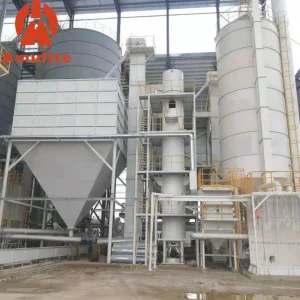
Automated pneumatic weighing of cement, silica, unbleached kraft pulp, and recycled additives into high-shear hydraulic pulpers.
Multi-vat cylinder deposition creating micro-layered green sheets with vacuum dewatering boxes ensuring precise moisture targets.
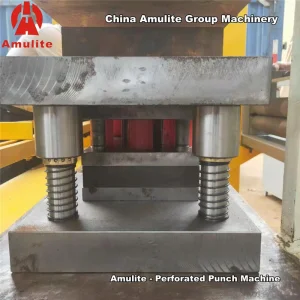
High-tonnage multi-opening presses increase board flexural strength and density while robotic vacuum arms stack sheets onto autoclave cars.
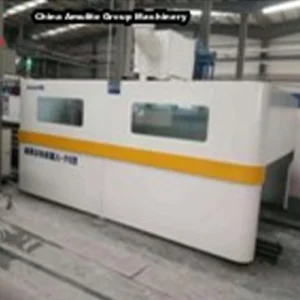
12-hour high-pressure steam reaction followed by automatic trimming, sanding, seal-coating, and palletizing.
Evaluating regional standards, demand drivers, and machinery customization specifications.
Strict focus on zero-asbestos compliance, CE certification, ISO 14001 carbon footprints, and fully automated diagnostic PLC systems (Siemens S7-1500 / Allen Bradley). Buyers prioritize lines integrated with automated UV coating and edge-profiling machinery for exterior rainscreen production.
High demand for heavy-duty, high-output production plants capable of operating continuously in hot, dusty climates. Procurement centers on 10+ million $m^2$/year capacity lines designed for thermal insulation boards, sandwich panels, and fire-rated drywall partition backing.
Rapid urban growth drives demand for cost-effective modular production units. Enterprise purchasers look for flexible machinery capable of utilizing local alternative raw materials—such as rice husk ash, low-grade fly ash, and recycled waste paper pulp—without sacrificing flexural strength.
Why Tier-1 global building material conglomerates choose Chinese machinery original equipment manufacturers (OEMs).
Leading Chinese equipment makers maintain total control over the supply chain. Heavy structural welding, ultra-precision lathe machining of 1.6m forming cylinders, ASME/CE certified pressure-vessel fabrication for autoclaves, and PLC control cabinet wiring are performed under one roof. This minimizes third-party delays and eliminates dimensional errors during field installation.
Modern Chinese fiber board lines integrate real-time SCADA network monitoring, automated online laser thickness compensation, radiation-free slurry density meters, and predictive vibration sensors on main drives. Remote diagnostic gateways allow engineers to troubleshoot software algorithms globally in real time.
Comprehensive comparative analysis for project engineers and procurement decision-makers.
| Performance Specification | Fiber Cement Board Line (Autoclaved) | Calcium Silicate Board Line | Fiber Cement Corrugated Sheet Line |
|---|---|---|---|
| Annual Production Capacity | 3,000,000 – 20,000,000 m² | 2,000,000 – 15,000,000 m² | 2,000,000 – 8,000,000 m² |
| Board Density Range | 1.2 – 1.7 g/cm³ | 0.9 – 1.3 g/cm³ | 1.4 – 1.6 g/cm³ |
| Flexural Strength (Cross/Parallel) | ≥ 16 MPa / ≥ 13 MPa | ≥ 10 MPa / ≥ 8 MPa | ≥ 18 MPa |
| Main Raw Material Mix | Cement (40%), Quartz Sand (40%), Pulp (8-10%) | Lime (30%), Quartz Powder (45%), Pulp (8%), Cement | Portland Cement (75%), Synthetic/Cellulose Fiber (10%) |
| Fire Resistance Class | EN 13501-1 Class A1 Non-combustible | EN 13501-1 Class A1 Non-combustible | Incombustible Structural Roofing |
| Curing Method | Autoclave Curing (180°C, 1.0 MPa, 10-12 hrs) | Autoclave Curing (185°C, 1.1 MPa, 12 hrs) | Air Curing / Warm Water Curing Tunnel |
| Primary Target Application | Exterior Cladding, Facades, High-load Subflooring | Interior Fireproof Ceiling, Drywall Partition | Industrial Roofing & Agricultural Cladding |
Understanding how output from specialized board production lines serves global construction and industrial sectors.
High-density autoclaved fiber cement boards subjected to UV-cured fluorocarbon sanding and coating, providing 30+ year color fastness and impact resilience.
Waterproof, non-swelling calcium silicate boards engineered specifically as tile backer substrate in high-humidity commercial bathrooms and industrial kitchens.
Low-density calcium silicate boards designed for 2 to 4-hour fire-rated shaftwalls, steel structural column wrapping, and ductwork enclosures.
Laminated structural fiber boards combined with EPS/Perlite core lines for rapid assembly off-site container cabins, school projects, and cleanrooms.
Expand your industrial facility with matched machinery for insulation, coating, recycling, and composite panel manufacturing.
Direct answers from our engineering directors regarding line configuration, lead times, raw materials, and commissioning.
While both lines share similar slurry preparation and Hatschek forming systems, their chemical formulations and hydrothermal reactions differ. Fiber Cement Board lines rely heavily on Portland cement, quartz sand, and reinforcement fibers, curing into a dense hydrated matrix. Calcium Silicate Board lines use a precise mix of lime (quicklime) and silica powder; during high-pressure autoclaving (at 180°C), this triggers a hydrothermal reaction that forms tobermorite crystals ($C_5S_6H_5$). This crystal structure makes calcium silicate boards lighter (0.9–1.2 g/cm³) while providing high thermal insulation and zero moisture movement.
Yes. A primary capability of Tier-1 Chinese machinery suppliers is custom process engineering based on raw material testing. Prior to line fabrication, buyers submit samples of local Ordinary Portland Cement (OPC), silica sand, fly ash, lime, and local pulp. Our laboratory conducts slurry rheology, vacuum filterability, and autoclave reaction trials to fine-tune the equipment specs, guaranteeing target flexural strength and density using locally available materials.
Manufacturing of a complete turnkey line (including pulping equipment, sheet machine, hydraulic stacker, autoclaves, and cutter) takes approximately 90 to 120 days. On-site civil foundation verification, mechanical assembly, electrical wiring, and SCADA integration require 60 to 90 days. Final commissioning, formulation tuning, and operator training take 20 to 30 days before full hand-over.
Autoclaves represent the highest CAPEX pressure vessels in the facility. Engineering standards include ASME Section VIII Div 1 or CE PED compliance, equipped with automatic hydraulic safety door interlocks, dual over-pressure relief valves, ultrasonic weld non-destructive testing (NDT), and automated steam temperature cycle management through Siemens PLC interfaces.