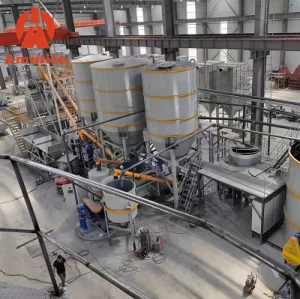
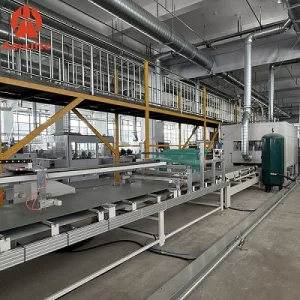
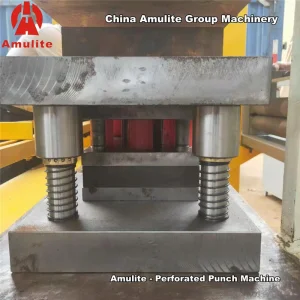
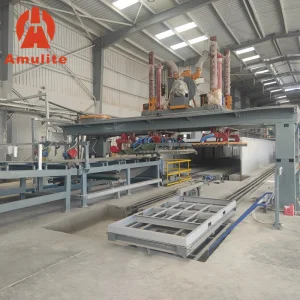
The global construction industry is undergoing an unprecedented structural transition toward modern methods of construction (MMC), prefabricated building systems, and sustainable, fire-resistant non-metallic wall materials. At the epicentre of this transformation is the advanced turnkey cement board production line. Driven by rising urbanisation, stringent fire safety regulations (such as Class A1 non-combustibility mandates), and the demand for energy-efficient building envelopes, cement board manufacturing technology has evolved far beyond legacy mechanical pressing.
As a premier China turnkey cement board production line manufacturer, China Amulite Group integrates deep mechanical engineering expertise, advanced hydrothermal reaction physics, and automated SCADA-driven operational architectures. Today’s industrial cement board manufacturing plants must achieve seamless operational continuity, high raw material flexibility, precise micro-density distribution, and minimal thermodynamic waste.
Information Gain Insight: Modern fiber cement board plants are no longer mere assembly lines; they are integrated biochemical and thermal conversion facilities where slurry rheology, cylinder dewatering vacuum pressure, and 12-bar autoclave crystallization work in algorithmic harmony to produce high-density (1.2–1.7 g/cm³) boards with superior flexural MOR strength.
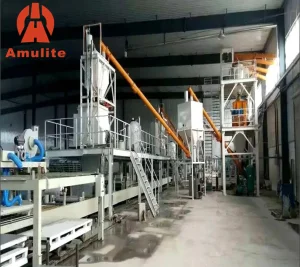
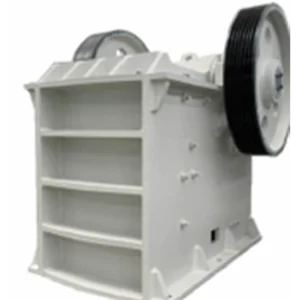
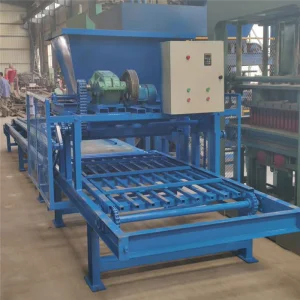
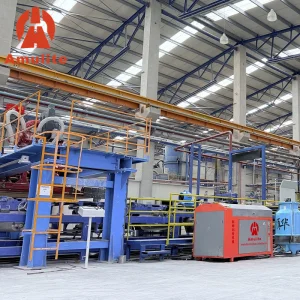
Achieving maximum flexural strength, moisture resistance, and dimensional stability requires an unyielding commitment to precision engineering at every point along the production chain. A complete China turnkey fiber cement board machinery system executed by Amulite Group integrates seven main process modules:
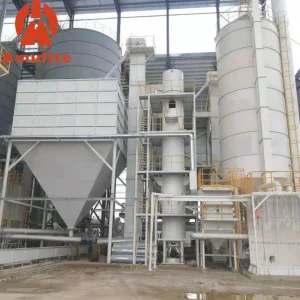
Automated loss-in-weight feeders dosage Portland cement, fine quartz silica sand (mesh 200–325), calcined lime, and matrix fibers (kraft wood pulp or synthetic fibers). Wood pulp undergoes high-consistency hydrapulping and refining to achieve optimal Canadian Standard Freeness (CSF 450–550 ml).
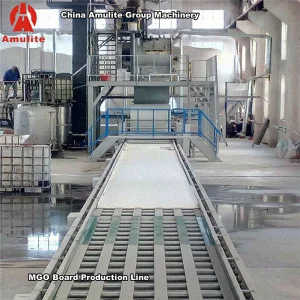
Utilizing multi-vat Hatschek cylinder vats (3 to 5 rotating cylinder vats), uniform slurry film layers (0.2–0.35 mm thickness per revolution) are deposited onto a continuous synthetic felt. Multi-stage high-vacuum suction boxes extract free water down to 25–28% moisture content before sheet winding.
A precision rotary flying shear cuts the continuous green sheet to standard architectural dimensions (e.g., 1220x2440mm). For high-density board grades, a 7,000–10,000 ton hydraulic multi-daylight press squeezes out remaining void spaces, increasing density to >1.5g/cm³ and boosting weatherability.
Green boards enter temperature and humidity-controlled pre-curing tunnels (45°C–55°C, 90% RH) for 6–8 hours to achieve green strength. Robotic suction-cup de-stackers then separate steel templates from the cement boards, recirculating templates back to the forming unit.
Calcium silicate and fiber cement boards enter pressure vessel autoclaves operating at 1.0–1.2 MPa (180°C to 190°C) steam pressure for 10–12 hours. Hydrothermal synthesis converts quartz silica and free lime into crystalline Tobermorite ($C_5S_6H_5$), eliminating efflorescence and curing shrinkage.
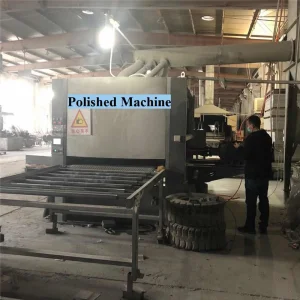
Autoclaved boards are dried, then passed through high-speed heavy-duty calibrating sanders for thickness tolerance (±0.2mm). Integrated CNC double-end tenoners perform square edge trimming, chamfering, or tongue-and-groove profiling for easy architectural jobsite assembly.
| Performance Indicator | Medium Density Line (Non-Autoclaved) | High Density Line (Autoclaved / Tobermorite) | Calcium Silicate Board Line |
|---|---|---|---|
| Annual Capacity Range | 2,000,000 – 10,000,000 m²/year | 3,000,000 – 20,000,000 m²/year | 5,000,000 – 30,000,000 m²/year |
| Board Density Range | 1.0 – 1.3 g/cm³ | 1.3 – 1.7 g/cm³ | 0.8 – 1.2 g/cm³ |
| Flexural Strength (MOR) | ≥ 10 MPa (Saturated) | ≥ 16 – 28 MPa (Dry/Saturated) | ≥ 9 – 14 MPa |
| Thermal Conductivity | 0.20 – 0.25 W/(m·K) | 0.18 – 0.22 W/(m·K) | 0.12 – 0.16 W/(m·K) |
| Autoclave Hydrothermal Cycle | N/A (Air Cured 14-28 Days) | 12 Hours @ 1.2 MPa (189°C) | 10-12 Hours @ 1.0 MPa (183°C) |
| Main Matrix Raw Materials | Cement, Fly Ash, Kraft Fiber | Cement, Quartz Powder, Cellulose | Quicklime, Quartz Sand, Cellulose |
International EPC procurement managers, real estate developers, and factory investors face stringent economic and operational challenges when evaluating line machinery suppliers. Sourcing a turnkey solution from a recognized manufacturer in China is no longer merely a low-CAPEX decision; it is a strategic optimization of operational expenditure (OPEX), material yield rates, and local raw material adaptability.
Capital expenditure on European machinery lines often requires payback periods exceeding 7 to 10 years. China Amulite Group’s turnkey engineered production lines provide high-grade reliability, European-standard component selection (Siemens PLC, SEW Reducers, Schneider Electrics), reducing ROI payback periods to 2.5–4 years.
Local cement, silica sand, or fly ash chemistry varies greatly across regions (Middle East, Southeast Asia, South America, Africa). Our process chemistry laboratory formulates bespoke slurry recipes using local sands and industrial byproducts, lowering raw material costs while keeping flexural strength within ISO 8336 compliance.
With energy costs impacting global manufacturing margins, Amulite turnkey designs feature heat-recovery loops that reuse autoclave blowdown steam into pre-curing heat exchangers. This cuts boiler fuel oil/gas consumption by up to 22% per cubic meter of finished board.
Sustainable production mandates are rapidly evolving from optional market marketing features into statutory regulatory hurdles. Advanced fiber cement sheet machinery manufacturing plants engineered by Amulite Group incorporate holistic environmental protection technology directly into the core process architecture.
In traditional board plants, slurry dewatering runoff carries fine particles and unhydrated cement particles into municipal drainage systems, leading to severe environmental penalties. Amulite lines feature multi-stage cone thickeners, flocculant dosing units, and automated plate-and-frame filter presses. Dewatered process water is recycled 100% back into the raw material hydrapulping vats, eliminating liquid waste output.
The entirety of an Amulite turnkey cement board line is managed through a central control room powered by Siemens S7-1500 PLC networks coupled with WINCC SCADA visualization software. Real-time sensor monitoring tracks slurry concentration, vat liquid levels, felt tension, rotary cutter blade wear, and autoclave temperature-pressure curves. Automated closed-loop adjustments eliminate operator-induced variations, keeping board thickness within microscopic tolerances.
Looking ahead to the next decade of construction technology, turnkey equipment manufacturers are focused on three core engineering pillars: carbon footprint reduction, composite material innovation, and ultra-high-speed automated handling.
To combat cement CO2 emissions, next-gen lines are engineered to handle high-volume clinker substitution using LC3 (Limestone Calcined Clay Cement) and alkali-activated slag geopolymers without compromising early green-strength development during forming.
Integrating lightweight expanded polystyrene (EPS) beads or expanded perlite matrix inside high-speed continuous vertical mold wall panel lines, creating dual-surface fiber cement sandwich panels that deliver R-30 thermal performance and 4-hour fire ratings.
Integration of inline laser displacement sensors and ultrasonic thickness gauge arrays that scan 100% of finished board surfaces at line speeds of up to 100 meters/minute, automatically flagging micro-cracks or density voids prior to palletization.
Buying a turnkey manufacturing plant is a decades-long strategic partnership. China Amulite Group upholds Google's rigorous E-E-A-T (Experience, Expertise, Authoritativeness, and Trustworthiness) principles across every commercial interaction. Our heavy fabrication plant spans 100,000 m², backed by 27 dedicated multi-disciplinary engineering project teams.
From foundation civil work engineering drawings and utility layout planning to on-site mechanical erection, electrical commissioning, and recipe calibration, our resident field service engineers remain on client sites until stable, contract-verified mass production is reached.
All pressure vessels (autoclaves) are designed under ASME Section VIII and CE PED standards. Drive systems, electrical control systems, and mechanical safety guarding strictly comply with EU Machinery Directive standards.
Every control panel features integrated secure VPN routers. Our process automation engineers in headquarters can perform real-time troubleshooting, code updates, and operational analytics for clients globally.
We maintain a stocked global repository of high-wear consumables: synthetic forming felts, stainless mesh cylinders, rotary cutter blades, suction felt strips, and vacuum pump impellers.
Below are technical and commercial responses to common inquiries submitted by prospective investors, factory managers, and civil engineering consultants.