High-precision manufacturing systems designed for zero-carbon building boards, structural panels, and automated industrial recycling.
Analyzing market capitalization, carbon neutrality mandates, and the paradigm shift from traditional gypsum to high-performance magnesium oxide matrices.
The global modern construction ecosystem is undergoing a fundamental structural transformation. Driven by stringent fire safety regulations (such as EN 13501-1 Class A1 and ASTM E119), escalating demands for mold-proof building envelopes, and strict embodied carbon reduction mandates, Magnesium Oxide (MgO) boards have emerged as the premier non-combustible sheathings in architectural engineering. As leading China MgO Board manufacturers scale production, the industry is transitioning from regional niche applications to global infrastructural adoption across North America, Europe, the Middle East, and Australia.
China accounts for over 70% of the world’s high-purity magnesite reserves, centered predominantly in Liaoning and Hebei provinces. This geographical advantage enables Chinese manufacturers to control the entire supply chain—from raw magnesite calcination ($\text{MgCO}_3 \rightarrow \text{MgO} + \text{CO}_2$) to sophisticated automatic board laminating and curing processes. OEM buyers and EPC contractors worldwide leverage China's advanced manufacturing clusters to source customizable, heavy-duty building materials engineered to endure extreme environmental conditions.
Understanding the microstructural phase formations ($5\cdot1\cdot7$ phase vs $3\cdot1\cdot8$ phase) that dictate structural stability, moisture immunity, and corrosion resistance.
Historical challenges associated with early-generation MgO boards—specifically damp-proofing failures, surface "crying/sweating," and chloride leaching that corroded steel fasteners—have been entirely overcome through advanced chemical engineering. Leading Chinese manufacturers now utilize sophisticated Magnesium Oxysulfate ($\text{MgSO}_4$) chemistry alongside stabilized Magnesium Oxychloride ($\text{MgCl}_2$) formulas featuring high-purity modifier additives.
Completely chloride-free chemistry. Eliminates the risk of ferric corrosion on metal studs and fasteners. Maintains dimensional integrity even when permanently submerged or exposed to high-humidity environments.
High-alkali-resistant glass fiber mesh layers are embedded within the core to impart flexural strength (> 15 MPa) and high impact resistance, allowing boards to bend without structural fracture during seismic activity.
Incorporation of phosphoric acid derivatives, nano-silica, and specific polymer slurries ensures complete phase conversion into stable crystalline structures ($5\text{Mg(OH)}_2 \cdot \text{MgSO}_4 \cdot 7\text{H}_2\text{O}$), preventing free ion movement.
Empirical evaluation comparing Magnesium Oxide boards against Fiber Cement, Gypsum, and Calcium Silicate under standardized ASTM/EN test protocols.
| Performance Metric | High-Grade MgO Board ($\text{MgSO}_4$) | Fiber Cement Board | Paper-Faced Gypsum Board | Calcium Silicate Board |
|---|---|---|---|---|
| Fire Resistance (EN 13501-1) | Class A1 Non-Combustible | Class A1 / A2 Non-Combustible | Class B / Non-rated Core | Class A1 Non-Combustible |
| Dry Density ($\text{g/cm}^3$) | 0.95 - 1.15 | 1.30 - 1.55 (Heavy) | 0.65 - 0.85 | 1.00 - 1.25 |
| Flexural Strength (MPa) | 14 - 22 MPa | 9 - 14 MPa | 4 - 7 MPa | 8 - 12 MPa |
| Moisture Absorption & Swelling | < 0.05% Dimensional Change | < 0.15% Linear Expansion | Degrades / Delaminates | < 0.10% Linear Expansion |
| Mold / Fungal Resistance | Zero Growth (ASTM D3273 Grade 10) | Resistant | High Vulnerability | Resistant |
| Embodied Carbon Index | Ultra-Low (Low-temp calcination) | High (Kiln firing of OPC) | Medium | High (Autoclave curing energy) |
From high-rise curtain walls to offsite modular construction: how engineered MgO panel systems solve modern build challenges.
MgO boards serve as the structural subflooring, interior wall lining, and exterior structural insulated panel (SIP) skins in volumetric modular construction. Their lightweight strength accelerates crane operations while fulfilling 1-to-4-hour fire ratings.
In wet rooms, commercial kitchens, saunas, and swimming pools, high-density MgO backerboards provide an unyielding substrate. Unlike gypsum, they maintain total mechanical strength when exposed to steam and direct water spray.
Designing fire barriers in commercial skyscrapers requires slim, highly rated assemblies. 12mm–18mm MgO boards integrated into steel stud framing achieve 2-hour and 4-hour passive fire integrity without thick masonry layers.
The next frontier in Chinese MgO board manufacturing lies in carbon mineralization technology. During the curing phase, ambient carbon dioxide ($\text{CO}_2$) is actively injected into the curing chambers, reacting with magnesium hydroxide to form insoluble magnesium carbonate minerals ($\text{MgCO}_3 \cdot 3\text{H}_2\text{O}$). This process permanently sequesters atmospheric carbon, turning every square meter of manufactured board into a carbon-negative structural asset.
Technical answers addressing quality control, chemical stability, installation guidelines, and export certification.
Surface sweating and fastener corrosion were historically caused by unreacted free chloride ions ($\text{Cl}^-$) in poorly formulated Magnesium Oxychloride board. Premium Chinese factories now implement strict stoichiometric ratio controls using automated PLC dosing, micro-powder silica additions, and phosphoric acid modifiers. Furthermore, top-tier lines utilize Magnesium Oxysulfate ($\text{MgSO}_4$) chemistry, which is 100% chloride-free and poses zero risk to stainless steel or hot-dip galvanized fasteners.
For international export, high-quality boards must comply with ASTM C1325 (Standard Specification for Fiber-Mat Reinforced Cementitious Backer Units), ASTM E119 / UL 263 (Fire Tests of Building Construction Materials), EN 13501-1 (Class A1 Non-combustibility), BS 476 Parts 6 & 7, and ISO 1182. Qualified manufacturers provide full test reports verified by third-party international agencies such as Intertek, SGS, or TUV.
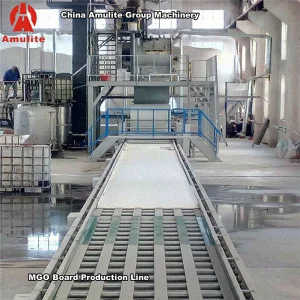
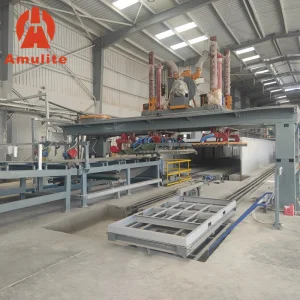
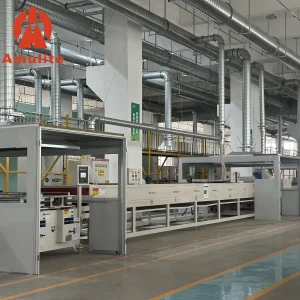
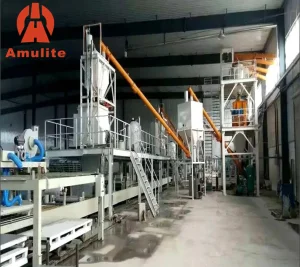
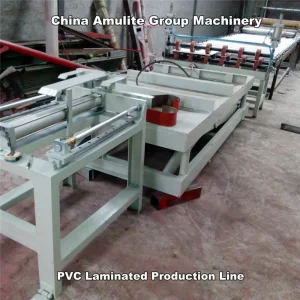
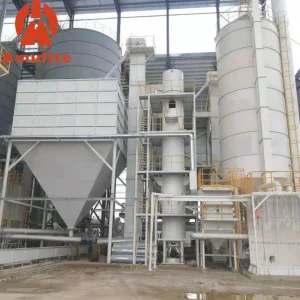
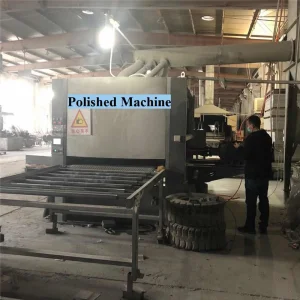
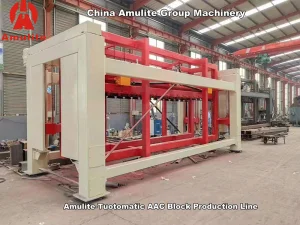
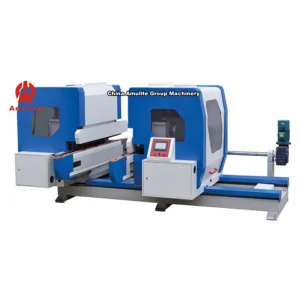
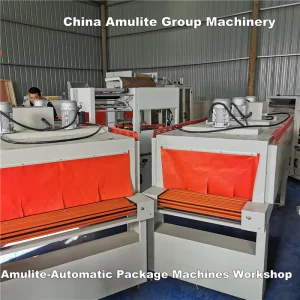
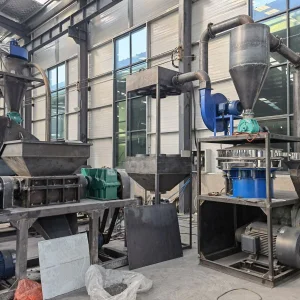
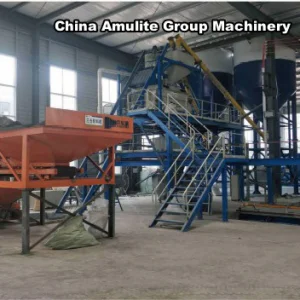
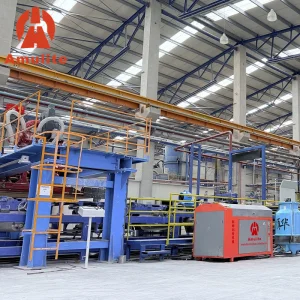
Yes. Leading equipment manufacturers such as China Amulite Group provide complete turnkey production line engineering. This includes automated raw material batching, dynamic high-shear mixing, multi-vat sheet forming, automatic glass mesh laying, tunnel curing kilns, precision board trimming, edge profiling, and automatic stacking systems with annual capacities ranging from 1 to 30 million square meters.
Standard carbide-tipped woodworking blades or diamond-grit saw blades are used to cut MgO boards cleanly. Fasteners should be self-countersinking ribbed screw heads made from coated carbon steel (class 3 or class 4 corrosion resistance) or 304/316 grade stainless steel. Screw spacing typically ranges from 150mm along board edges to 300mm on intermediate studs.
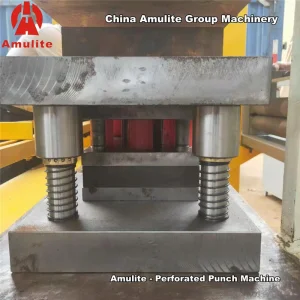
Advanced machinery for specialized surface finishing, board laminating, and sustainable building panel fabrication.