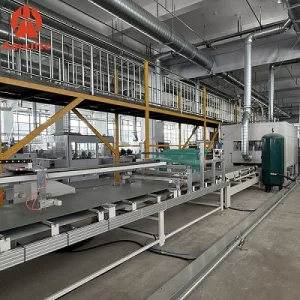
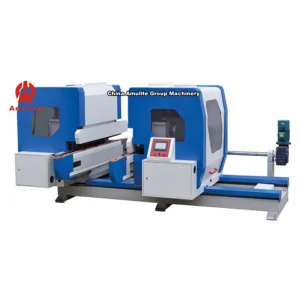
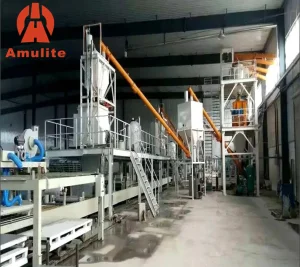
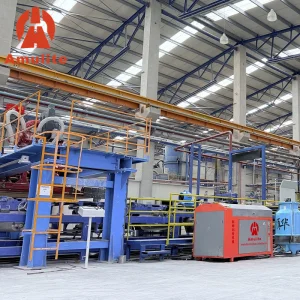
Explore our core manufacturing equipment engineered for high-density, fireproof, and structural building board applications worldwide.
The manufacturing of non-asbestos fiber cement boards and calcium silicate boards represents one of the most sophisticated wet-process engineering disciplines in modern non-metallic building material production. At the heart of high-yield industrial plants worldwide lies the continuous Hatschek sheet-forming process—a wet-spinning and vacuum-dewatering methodology originally adapted from paper manufacturing and perfected over decades of mechanical and chemical engineering evolution.
As global market demand pivots aggressively toward lightweight, A1-fire-rated, water-resistant, and high-impact structural boards for exterior ventilated facades, interior wet-room sub-floors, and ceiling systems, international engineering buyers require robust, automated, and energy-efficient machinery. China’s leading fiber cement equipment manufacturers, exemplified by pioneer engineering outfits like China Amulite Group, have revolutionized the Hatschek process machine architecture. By incorporating servo-driven multi-vat agitation, real-time closed-loop slurry thickness tracking, automated felt-cleaning systems, and high-pressure hydraulic compaction, Chinese machinery suppliers offer global turnkey solutions that bridge the gap between high CAPEX European equipment and low-reliability manual operations.
The evolutionary trajectory of Hatschek fiber cement board machines focuses on three core performance axes: process digitalization, raw material decarbonization, and mechanical throughput maximization. Future-ready manufacturing facilities are transitioning from traditional relay-controlled mechanical lines to fully synchronized cyber-physical production environments.
Modern Hatschek machines utilize multi-vat slurry distribution systems (typically 3 to 8 sieve cylinders). Advanced lines now integrate ultrasonic pulp consistency sensors and online viscosity meters that dynamically adjust paddle agitator speeds and slurry feed rates. This prevents fiber settlement and ensures an optimized, uniform matrix layer transfer onto the synthetic felt at speeds exceeding 70–100 m/min.
Dewatering efficiency directly dictates sheet delamination risk and green-board strength. The technology roadmap integrates multi-chamber variable-frequency vacuum boxes with automated felt-cleansing high-pressure water jets (up to 30 bar). As the thin film (0.2–0.3 mm per layer) winds around the main forming drum, automated laser thickness gauges measure layer accumulation in real time, triggering precision automatic wire cutting at exact target thicknesses (4 mm to 30 mm).
For calcium silicate boards and high-stability autoclaved fiber cement boards, post-press steam curing at 170°C–190°C under 8–12 bar pressure induces the hydrothermal reaction between reactive silica powder and hydrated lime, forming crystalline Tobermorite structures. Next-gen Chinese lines incorporate multi-stage steam re-compression systems (MVR) and thermal flash tanks, cutting steam energy consumption by up to 28%.
Selecting a fiber cement board machinery vendor is fundamentally an evaluation of a nation’s heavy industrial ecosystem. China has consolidated its position as the premier manufacturing hub for non-metallic building material equipment through full-spectrum supply chain integration, superior metallurgical processing, and unrivaled manufacturing scale.
Forming cylinders (1,300 mm to 1,600 mm working width) and accumulator rolls require ultra-precise dynamic balance and anti-corrosive stainless steel mesh wrapping. Chinese machinery manufacturers operate internal multi-axis CNC horizontal lathes and heavy vertical grinding centers, ensuring runout tolerances below 0.02 mm for smooth long-term felt operation.
Leading suppliers like China Amulite Group standardize on globally supported electrical and pneumatic components. Systems integrate Siemens S7-1500 PLC control architectures, Schneider low-voltage switchgear, SEW-Eurodrive geared motors, and Parker/Bosch Rexroth hydraulics—guaranteeing localized spare parts availability worldwide.
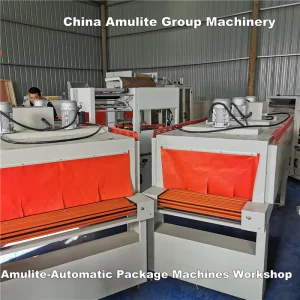
To mitigate commissioning downtime on international customer sites, complete Hatschek machine assemblies—including slurry vats, felt tensioning runs, cutter units, and stackers—undergo full mechanical dry-testing and hydraulic pressure testing within factory workshops prior to export packaging.
When global EPC contractors and building material manufacturers evaluate Hatschek machine suppliers, technical selection spans raw material versatility, structural yield, energy intensity, and final product mechanical properties. Below is the technical performance baseline delivered by modern Chinese automated lines:
| Performance Parameter | Air-Cured Fiber Cement Board Line | Autoclaved Calcium Silicate Board Line | Testing Standard / Benchmark |
|---|---|---|---|
| Annual Capacity Range | 2,000,000 – 10,000,000 m²/year | 3,000,000 – 20,000,000 m²/year | Calculated at 6mm standard thickness |
| Board Density Range | 1.2 – 1.6 g/cm³ | 0.95 – 1.3 g/cm³ | EN 12467 / ASTM C1185 |
| Bending Strength (MOR) | ≥ 16 MPa (Wet Condition) | ≥ 12 MPa (Saturated) | Class 3 – Class 5 Classification |
| Fire Resistance Rating | Non-combustible Class A1 | Non-combustible Class A1 | BS 476 Part 4 / EN 13501-1 |
| Raw Material Matrix | OPC Cement, Cellulose Pulp, Silica, Fly Ash | Lime, Silica Sand / Quartz, Pulp, Cement | Non-Asbestos Chrysotile-Free Formulation |
| Thickness Range | 4 mm – 25 mm | 4 mm – 30 mm | Digital Auto Catcher Control (±0.2mm) |
| Curing System | Pre-curing tunnel + Water/Air aging | Pre-curing + Autoclave (10-12 Hrs @ 180°C) | Hydrothermal Synthesis Phase Transformation |
A major commercial priority for overseas plant investors is minimizing operational expenditure (OPEX) by utilizing local raw materials. High-grade Chinese Hatschek lines are engineered to process diverse fiber reinforcements—including imported kraft cellulose pulp, unbleached softwood fibers, micro-fibrillated cellulose (MFC), and synthetic PP/PVA fibers—while accepting varying grades of local Ordinary Portland Cement (OPC), ground granulated blast-furnace slag (GGBS), and ultra-fine silica sand (SiO₂ > 90%).
Fiber cement and calcium silicate boards produced via automated Hatschek production lines serve multi-sector construction markets. Plant configurations are engineered according to target market application profiles:
High-density compressed boards (density > 1.4 g/cm³) formed under 10,000-ton hydraulic presses exhibit extreme freeze-thaw resistance, weatherability, and mechanical toughness. Lines are complemented with inline sanding, beveling, water-repellent coating, and UV painting systems.
Medium-to-low density calcium silicate boards (density 0.95–1.2 g/cm³) provide thermal insulation and zero smoke toxicity during fires. Widely implemented in commercial skyscrapers, hospitals, subway stations, and data center enclosure walls.
Standard 5mm–8mm fiber cement sheets produced on Hatschek lines serve as high-strength face skins for lightweight EPS sandwich wall panel lines, hollow-core wall panel systems, and decorative metal composite panels.
Deploying a multi-million-dollar building materials factory requires rigorous project governance, civil engineering coordination, and compliance management. Experienced Chinese suppliers operate under a full EPC (Engineering, Procurement, and Construction) turnkey methodology designed to de-risk investment for international buyers.
Equipment is engineered to meet regional electrical and safety codes, including CE directives (Machinery Directive 2006/42/EC and Low Voltage Directive 2014/35/EU), UL/CSA electrical control panel certifications, and ASME/PED pressure vessel compliance for steam autoclaves.
Senior mechanical engineers, electrical automation specialists, and master pulp-formulation chemists are dispatched to customer sites to supervise foundation alignment, mechanical assembly, piping layout, software tuning, and trial batch production.
Operators, maintenance technicians, and QA personnel undergo rigorous classroom and hands-on operational training. Standard operating procedures (SOPs), preventative maintenance schedules, and pulp-refining recipes are handed over to ensure long-term plant self-sufficiency.
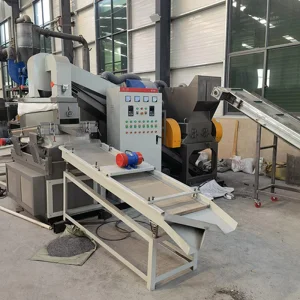
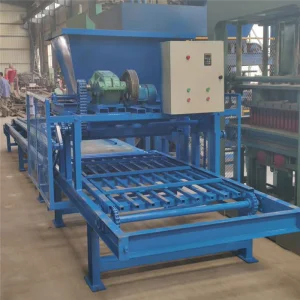
Explore our complete portfolio of downstream cutting, block machinery, recycling plants, and specialized processing equipment.
Direct engineering insight into process parameters, pulp refining, line maintenance, and raw material selection.
For non-asbestos formulations, cellulose pulp must be refined to a Schopper-Riegler freeness level of 45°SR to 60°SR. Proper defibrillation increases specific surface area, allowing fibers to effectively capture fine cement and silica particles in the slurry vat without blinding the synthetic felt or restricting vacuum dewatering efficiency.
Autoclaved calcium silicate board lines use quartz sand (SiO₂) and quicklime (CaO) as primary reactive binders alongside cement and pulp. Curing takes place under high-pressure saturated steam (10–12 bar, 185°C) inside autoclaves for 10–12 hours, forming crystalline Tobermorite for exceptional dimensional stability and low thermal conductivity. Air-cured lines rely primarily on Portland cement hydration and cure in warm humid chambers over 14–28 days.
Sheet delamination is prevented by controlling three variables: (1) maintaining moisture content at 28–32% at the accumulator roll via calibrated vacuum box pressure, (2) applying uniform nip press pressure on the forming drum, and (3) adding flocculant additives (polyacrylamide) to optimize fiber-to-cement mechanical interlocking layer by layer.
Modern woven synthetic felts operate continuously for 25 to 45 days depending on abrasive silica content and continuous high-pressure jet washing efficiency. Stainless steel wire sieve cylinders (typically 60 to 80 mesh) last 6 to 12 months with automated acid-washing and mechanical brush cleaning systems implemented.
Yes. Class F fly ash or ground slag can replace up to 30–40% of Portland cement or silica powder in autoclaved lines. This reduces raw material CAPEX, lowers board weight, and enhances workability while promoting sustainable green building material credentials.
A standard 5 million m²/year plant requires: (1) Installed electrical power of approximately 1,200 kW – 1,500 kW, (2) Steam boiler capacity of 6–8 t/h at 1.25 MPa for autoclave curing, (3) Industrial water supply of 20–30 m³/h with closed-loop water clarification and recycling, and (4) Compressed air capacity of 6–10 m³/min at 0.8 MPa.