The structural transition from traditional masonry to off-site prefabrication is accelerating worldwide, driven by stringent carbon neutrality targets, rising labor costs, and urgent urban expansion.
The global construction industry is undergoing a paradigm shift toward modular, energy-efficient, and rapid assembly building materials. At the epicenter of this modern revolution is the precast lightweight concrete wall panel machine. Industrial real estate developers, EPC contractors, and building material manufacturers are increasingly moving away from site-cast masonry to factory-engineered lightweight precast panels—including EPS (Expanded Polystrene) sandwich cement panels, Autoclaved Aerated Concrete (AAC) panels, fiber cement composite board panels, and vertical hollow core lightweight panels.
According to structural engineering benchmarks, lightweight precast concrete wall panels reduce structural dead loads by up to 40% to 60% compared to traditional solid clay bricks or standard cast-in-place concrete walls. This substantial mass reduction cascadingly lowers foundational requirements, steel rebar tonnage, and seismic vulnerability in high-rise structural design. Consequently, investing in an automated precast lightweight concrete wall panel production line is no longer merely a machinery procurement decision; it is a strategic capital asset investment that dictates a manufacturer's competitive cost structure in modern building systems.
Rapid urbanization and aggressive government mandates for prefabricated construction (targeting 30%+ prefab ratio in new buildings) make APAC the largest consumer and manufacturer of lightweight panel machinery. China dominates core machinery manufacturing and raw material optimization.
In mega-projects across Saudi Arabia (NEOM, Vision 2030) and the UAE, extreme ambient heat demands super-insulated wall envelopes. Precast lightweight EPS cement wall panels provide unmatched thermal resistance (low K-value) and fast erection speed for commercial & residential complexes.
Latin America and Africa focus on affordable housing initiatives requiring low production costs per square meter. In Europe, strict EPBD energy directives drive the demand for low-carbon geopolymer or recycled-aggregate lightweight precast concrete panel machines.
A deep dive into the mechanical components, hydraulic systems, and automated control logic required to produce dimensionally precise lightweight precast wall panels.
Top-tier precast lightweight concrete wall panel machines rely on precise physical micro-foaming and hydro-thermal reaction kinetics. The equipment must uniformly blend Ordinary Portland Cement (OPC), sand/fly ash slurry, lightweight aggregate fillers (EPS granules, expanded perlite, or ceramsite), and chemical admixtures without crushing the delicate micro-balloons or causing density segregation.
Modern machine manufacturers integrate high-shear planetary slurry mixers equipped with frequency-inverter drives. The automated batching system controls water-to-cement ratios to within ±0.5% precision using microwave moisture sensors, ensuring every batch meets exact density targets (ranging from 450 kg/m³ for non-load-bearing insulation panels to 1000 kg/m³ for structural lightweight partitions).
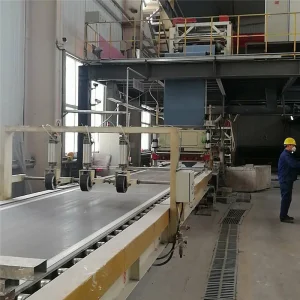
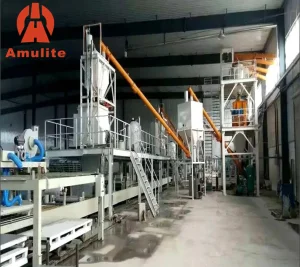
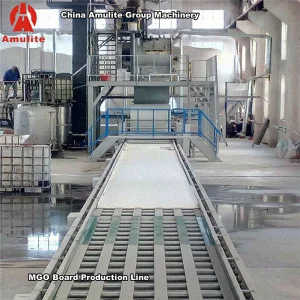
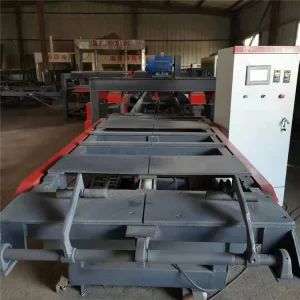
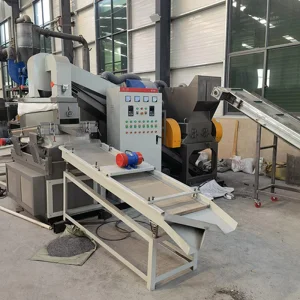
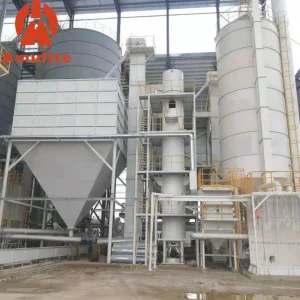
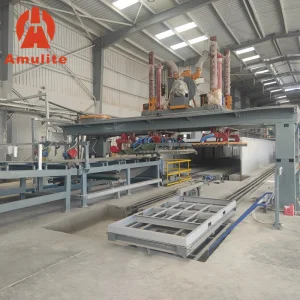
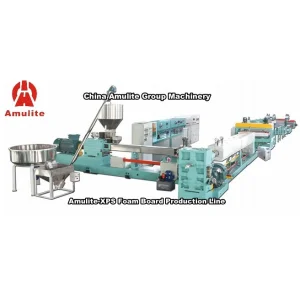
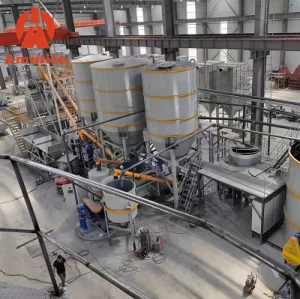
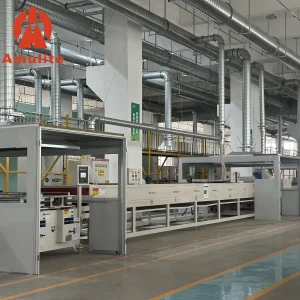
A full turnkey lightweight concrete wall panel production line comprises six synchronized sub-systems:
| Performance Parameter | Standard Mechanical Line | Advanced Automated Line (China OEM / Global Standard) |
|---|---|---|
| Annual Output Capacity | 100,000 m² – 300,000 m² / year | 500,000 m² – 2,000,000 m² / year |
| Panel Density Range | 600 – 900 kg/m³ | 450 – 1200 kg/m³ (Customizable per layer) |
| Dimension Precision | ± 3.0 mm length / thickness | ± 0.5 mm (Controlled by CNC-machined mold plates) |
| Curing Method & Cycle | Ambient air curing (24-48 Hours) | Accelerated Steam / Thermal Pipeline (3.5 Hours) |
| Labor Requirement | 12 - 18 Operators / Shift | 3 - 5 Operators / Shift (Full SCADA Automation) |
| Skin Board Compatibility | Manual insertion of Calcium Silicate / MGO | Auto-feeding & positioning of Fiber Cement / MGO boards |
Why global EPC contractors and building material manufacturers source precast lightweight wall panel machinery directly from leading Chinese OEM manufacturers.
China's heavy machinery manufacturing hubs (such as Hebei and Shandong) house integrated supply chains. Raw steel plates, hydraulic cylinders, precision gearboxes, and PLC cabinets are produced within a 50-kilometer radius, drastically reducing component lead times and assembly costs.
Purchasing a complete automated line from a top-tier Chinese manufacturer yields a 40% to 65% reduction in initial CAPEX compared to European machine builders, without compromising structural durability or key electronic component quality (utilizing Siemens, Schneider, and ABB parts).
Leading Chinese factory suppliers do not just deliver standard hardware. They provide comprehensive raw material matrix testing, matching local cement grades, pozzolans, sand silica ratios, and chemical foams to ensure guaranteed board flexural strength and density output.
Client sends local sand, cement, fly ash, and EPS samples to the manufacturer's lab for density and hydration trial mixes.
Engineers design customized floor plans matching factory dimensions, crane rails, steam boilers, and raw material silos.
Mold plates, vertical mold cars, and core tube structures undergo stress-relieved welding and CNC surface milling.
Chinese engineering teams dispatch overseas to manage mechanical installation, electrical commissioning, and operator training.
How lightweight precast concrete wall panels engineered by automated production lines solve structural, environmental, and financial challenges across distinct global sectors.
In high-rise office towers and luxury apartments, interior partition walls must provide fire resistance, acoustic dampening between units, and low self-weight. Tongue-and-groove joint lightweight EPS cement panels allow rapid dry-wall construction without wet plastering.
For modular housing and rapid social housing development projects, composite lightweight panels act as full thermal-envelope external walls. Using Fiber Cement Board or MGO board as facing layers with an EPS lightweight cement core creates weather-resistant, impact-proof outer envelopes.
Industrial logistics centers and temperature-controlled food distribution hubs require fire-partition boundary walls that extend up to 12 meters in vertical height. Hollow core precast lightweight concrete wall panels, manufactured with continuous extrusion or vertical battery machines, meet rigorous structural wind load and 4-hour fire barrier ratings.
Heavy urban transportation networks deploy specialized lightweight perlite or micro-porous concrete precast panels as sound-absorbing outdoor noise barriers. The production machines incorporate surface texturing molds to cast acoustic wave-trapping patterns directly onto panel faces.
Technological innovations transforming wall panel manufacturing plants into AI-driven, zero-carbon production ecosystems.
With environmental regulations penalizing carbon-heavy OPC cement usage, wall panel machines are rapidly adapting to binder formulations using blast furnace slag, fly ash, and metakaolin activated by alkali solutions. Machinery components now feature specialized anti-corrosion stainless linings and high-torque mixers engineered specifically for viscous geopolymer slurries.
Modern production lines are incorporating computer vision quality gates directly after de-molding stations. Ultrasonic sensors and high-resolution camera arrays inspect panels for internal void defects, surface micro-cracks, and dimensional warpage in real-time, feeding data directly back into the PLC mixer batching system to adjust water ratios dynamically.
To eliminate high civil engineering foundation costs and extended site installation timelines, machinery manufacturers are developing modular, containerized wall panel units. These portable plants can be erected at remote construction project sites within two weeks and relocated upon project completion.
Essential operational and technical evaluation criteria for factory owners, project developers, and procurement executives prior to releasing purchase orders.
When evaluating precast lightweight concrete wall panel machine manufacturers, looking solely at the FOB purchase price often leads to costly operational traps. A comprehensive procurement audit must calculate Total Cost of Ownership across a 10-year lifecycle:
Check off these critical milestones before finalizing your machinery contract:
Expert answers to common engineering, formulation, financial, and operational questions from prospective machinery investors.
Depending on regional market panel prices, local raw material costs, and plant utilization rates, most automated lightweight precast wall panel plants achieve full CAPEX payback within 12 to 18 months of reaching 70% rated production capacity. The high profit margin of lightweight EPS/AAC panels compared to traditional blockwork drives rapid capital recovery.
Yes. Modern multifunctional vertical battery mold cars engineered by top Chinese OEM manufacturers feature interchangeable mold cores and side-locking profiles. By inserting or retracting hydraulic core tubes and swapping outer facing board guides, the line can switch between producing EPS sandwich cement panels, solid lightweight panels, and tongue-and-groove hollow core partition panels within a 2-hour changeover window.
The primary formulation matrix requires Ordinary Portland Cement (OPC Grade 42.5 or 52.5), fine silica sand or Class-F fly ash, Expanded Polystyrene (EPS) beads (density 12-15 g/L), chemical foam stabilizers/water reducers, and outer skin boards (such as 4.5mm - 6mm non-asbestos fiber cement boards or calcium silicate boards).
A standard semi-automated setup with 20 vertical mold cars (each casting 10-12 panels per batch) operating on a single 8-hour shift produces approximately 1,200 m² to 1,500 m² per day. With an automated steam-curing system compressing cycle times to 3.5 hours, a double-shift configuration can exceed 4,000 m² to 6,000 m² per day.
Leading Chinese manufacturers offer comparable production speed, dimensional tolerance (±0.5mm), and PLC SCADA automation by adopting identical core component brands (Siemens, Schneider, Yuken hydraulics). China's advantage lies in its superior supply chain integration, offering up to 60% CAPEX savings and faster delivery timelines (typically 30-45 days vs 6-9 months from Europe).
A standard turnkey production line with an annual capacity of 500,000 m² typically requires a factory footprint of 2,500 to 4,000 square meters with a minimum clear height of 6.0 meters. Additional outdoor yard space of 3,000 m² is recommended for final panel curing, bundle stacking, and raw material aggregate storage silos.
Lightweight concrete panels utilize non-combustible inorganic binders (cement, silica, fly ash) encapsulating the EPS foam beads within a flame-retardant cement matrix. When exposed to extreme temperatures above 1000°C, the outer fiber cement face boards and vitrified core prevent flame passage and structural breakdown, meeting BS EN 1363-1 and ASTM E119 4-hour fire endurance standards.
Reputable machinery manufacturers dispatch a team of senior mechanical engineers, electrical technicians, and concrete process specialists to the buyer's site. They oversee civil foundation checks, equipment positioning, wiring, software debugging, and conduct hands-on operator training until local staff independently produce certified quality wall panels.