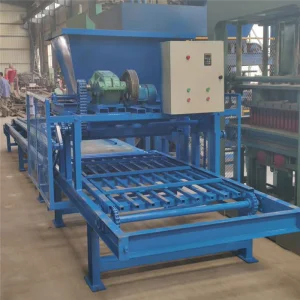
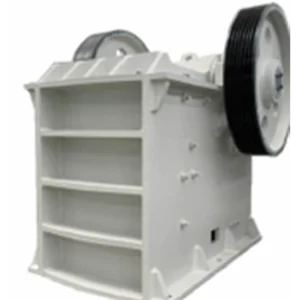
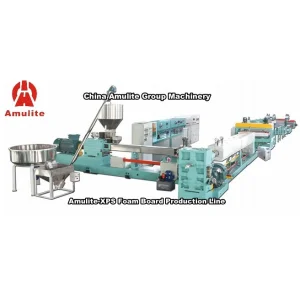
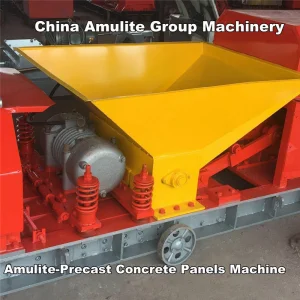
Explore our core machinery ecosystem designed for high-capacity non-metallic building material manufacturing.
A comprehensive examination of green matrix building board machinery, pulp refining mechanics, and global infrastructure demand.
The global demand for non-combustible, high-durability, and lightweight building materials has positioned Paper Pulp Fiber Cement Board Production Lines at the apex of modern industrial construction engineering. Historically dependent on chrysotile fibers, the global fiber cement industry has underwent a seismic paradigm shift toward eco-friendly, non-asbestos formulations. In this modern matrix composition, processed cellulose paper pulp (both unbleached kraft wood pulp and recycled waste paper stock) functions as the primary reinforcement skeletal web prior to hydrothermal matrix setting.
By engineering a synergistic matrix of Portland cement, micro-silica sand (quartz powder), and dispersed cellulose fibers, modern board manufacturers achieve unprecedented flexural tensile strength, fire-rating compliance (Class A1/BS 476 Part 4), and moisture dimensional stability. Selecting the best paper pulp fiber cement board production line supplier requires an in-depth understanding of slurry rheology, wet-process wet sheet forming (Hatschek mechanism vs. flow-on method), high-pressure hydro-thermal autoclaving, and automated downstream finishing lines.
Key technical considerations for industrial buyers, EPC contractors, and building material conglomerates.
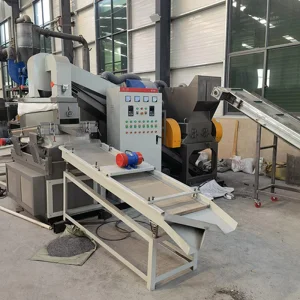
Cellulose fiber preparation is the core foundation of tensile strength. Industrial pulpers must achieve optimal Schopper-Riegler (°SR) freeness values without damaging fiber length.
The Hatschek multi-cylinder forming machine converts low-consistency slurry (3-5% solids) into ultra-thin film layers (0.2mm to 0.3mm per cylinder revolution).
Thermal processing determines final crystal matrix formation, distinguishing low-density ceiling tiles from high-strength external cladding panels.
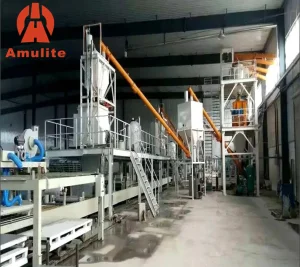
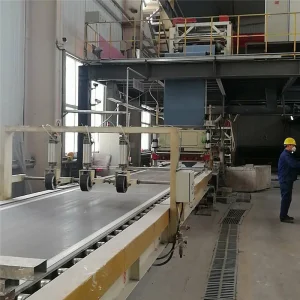
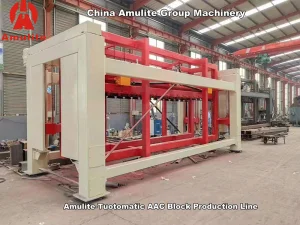
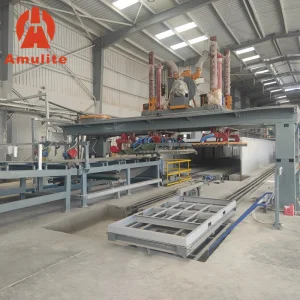
Integrating raw material processing, high-pressure pressing, and intelligent edge trimming into a synchronized industrial line.
Investing in a high-capacity paper pulp fiber cement board line requires robust macro engineering that seamlessly integrates mechanical, chemical, and electrical systems. China Amulite Group provides end-to-end turnkey solutions engineered to transform raw inputs—cement, ground silica sand, unbleached kraft pulp, and recovered paper slurry—into premium building panels compliant with international standards (ASTM C1185, EN 12467, and ISO 8336).
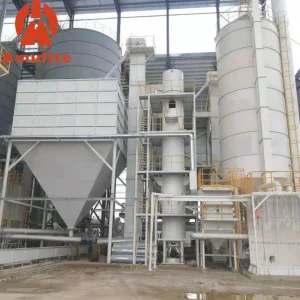
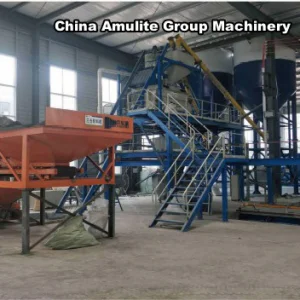
Precision dosing is critical to eliminate batch-to-batch density variances. Modern plants utilize automated loss-in-weight gravimetric feeders for Portland cement, silica flour, and additives. Silica sand is pulverized in continuous wet ball mills until reaching a specific surface area (Blaine fineness) of 3500-4500 cm²/g. This fine micro-silica powder reacts rapidly during autoclave curing to form a crystalline Calcium Silicate Hydrate (C-S-H) matrix.
The Hatschek wet sheet machine is the heart of the paper pulp fiber cement production line. As the slurry flows into separate agitating vats, stainless steel mesh cylinders pick up a uniform fiber-cement film. Vacuum boxes beneath the running felt extract up to 60% of free water, elevating wet sheet solid content before it wraps around the main forming drum. Once the pre-programmed sheet thickness is registered by laser sensors, an automated pneumatic fly-cutter performs clean transverse cutting without stopping the felt drive.
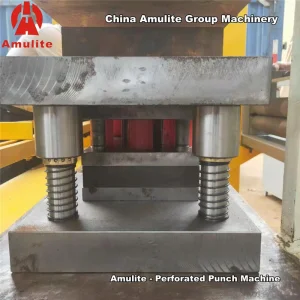
For high-density exterior wall siding and structural floor decks (density > 1.4 g/cm³), an inline multi-daylight hydraulic press exerts up to 10,000 to 16,000 tons of total pressure upon stacked green sheets. This mechanical compaction closes microscopic voids, flattens sheet thickness tolerances, and boosts flexural bending strength (MOD) up to 28 MPa.
Pioneering AI-driven process control, zero-discharge water recycling, and low-carbon composite formulations.
Next-generation lines integrate industrial IoT telemetry across every stage. Inline gamma-ray and laser sensors monitor moisture content, sheet basis weight, and thickness profile in real-time, feeding data directly back into the PLC. Automated slurry valves adjust felt speed and vat agitator RPM to ensure zero deviation across 24/7 continuous operations.
Environmental sustainability is built into modern plant designs. White water collected from vacuum boxes and cylinder vats passes through multi-tier clarification sedimentation tanks and centrifugal separators. 100% of process water and reclaimed pulp fines are recycled back into the pulping circuit, eliminating chemical runoff and cutting raw water consumption per panel by up to 65%.
To reduce dependence on virgin imported wood pulp, our process engineers have optimized hybrid fiber systems. By combining long-staple virgin kraft pulp with pre-treated recycled corrugated waste paper (OCC) and micro-synthetic fibers (PVA/PP), manufacturers lower raw material OPEX while retaining high freeze-thaw and impact resistance.
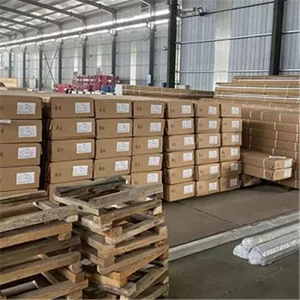
Downstream processing features automated high-speed multi-saw trimming units, vacuum de-stackers, auto-sanding machines, and automated robotic strapping systems. Precision edge alignment and dust-extraction hoods ensure clean operation and instant readiness for export container loading.
Market dynamics, regional capacity trends, and international building code adoption.
The strategic expansion of fiber cement production lines spans rapidly developing urban hubs and mature construction markets alike. According to industrial building material indices, fiber cement panel consumption is expanding at a CAGR of 6.2% globally, propelled by modern off-site modular construction, rapid drywall adoption, and exterior ventilated facade installation.
Strict quality assurance, certified engineering standards, and worldwide lifecycle maintenance.
China Amulite Group enforces a rigorous quality management system certified under ISO 9001:2015 and European CE safety standards. Our global client commitment is anchored on four pillars of industry leadership:
Over two decades of specialized machinery engineering for non-metallic mineral board equipment, having successfully commissioned over 200 production lines in 60+ countries worldwide.
In-house material laboratories analyze your local silica sand purity, cement hydration curves, and waste paper pulp freeness to craft customized chemical formulations before equipment fabrication begins.
From civil foundation design, steel structure layout, and utility piping (steam, compressed air, electricity) to complete equipment installation, dry testing, and full-speed production commissioning.
24/7 remote PLC diagnostics via encrypted cloud gateways, rapid regional spare parts dispatch, and on-site engineering maintenance support throughout the plant lifecycle.
Direct answers to crucial technical questions raised by plant managers, project engineers, and executive investors.
Expand your manufacturing capabilities with our specialized non-metallic building panel systems.