Featured high-yield equipment systems engineered for calcium silicate, fiber cement, and advanced panel manufacturing.
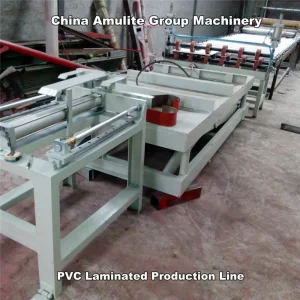
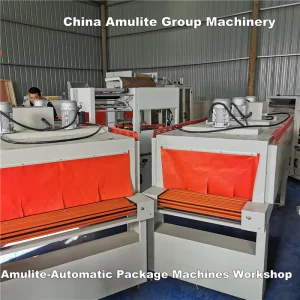
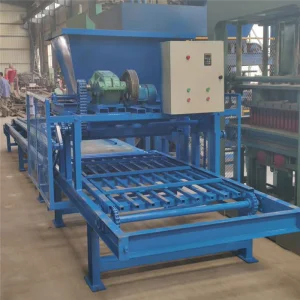
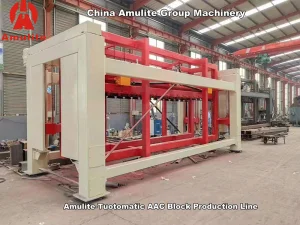
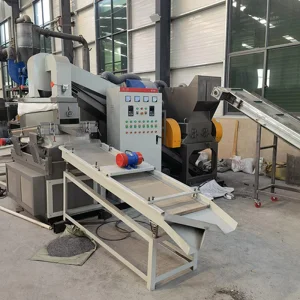
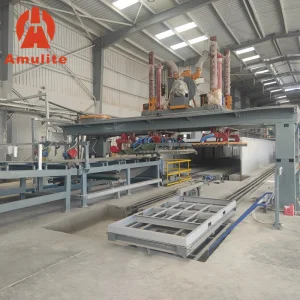
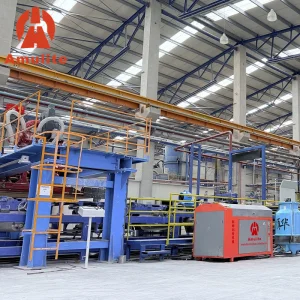
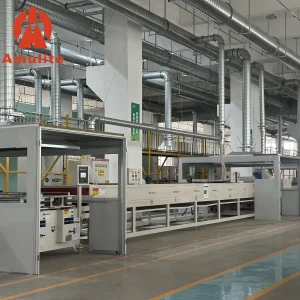
The global demand for high-performance, non-combustible, and light-weight building materials has triggered a seismic shift in modern industrial plant engineering. At the epicenter of this architectural transformation is calcium silicate board manufacturing equipment. Designed to process siliceous and calcareous materials reinforced with natural organic or synthetic fibers, high-end calcium silicate boards offer unparalleled structural integrity, Class A1 fire rating, zero toxicity, superior acoustic attenuation, and extraordinary resistance to thermal deformation.
As commercial development, off-site modular construction, and urban renewal accelerate across the Asia-Pacific region, the Middle East, Europe, and the Americas, modern factory operators are phasing out legacy, energy-intensive wet-process machinery. Today’s market demands high-yield, fully automated, SCADA-integrated production lines capable of continuous 24/7 output with minimal thermal losses and ultra-precise thickness tolerances (±0.2mm).
Selecting the optimal equipment manufacturer requires an intimate understanding of the end-to-end mechanical and chemical engineering pipeline. Amulite Group’s engineering architecture optimizes every phase—from raw slurry dispersion to robotic palletizing.
Silica sand (fineness >325 mesh), lime, Portland cement, and recycled pulp fibers are hydro-pulped and metered. Advanced turbo-mixers ensure a completely homogeneous slurry suspension with automatic viscosity monitoring.
Utilizing multi-cylinder wet-forming (Hatschek technique) or modern Flow-on systems, thin film layers are accumulated continuously onto a making roll under high vacuum dewatering until the designated board thickness (4mm to 30mm) is built.
Automated green board cutters trim edges with millimeter precision. Hydraulic pre-presses compress green sheets under pressures up to 3000–4000 metric tons, drastically increasing density and water resistance.
The core technological step. Green boards undergo saturated steam curing in heavy-wall steel autoclaves at 10–12 bar steam pressure and 180°C–190°C for 10–12 hours to synthesize structural calcium silicate hydrates.
Autoclaved boards are conveyed through multi-pass energy-efficient tunnel dryers. Excess moisture is reduced to below 10%, preventing subsequent dimensional shrinkage or warping during field installation.
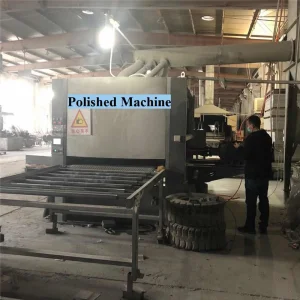
High-speed double-sided sanding machines caliber the board surfaces to razor-thin tolerances. Edge profiling units create ship-lap, square, or bevel edges before automatic robotic stacking and shrink packaging.
Why leading global building material conglomerates partner with top-tier Chinese original equipment manufacturers (OEMs).
China’s heavy machinery manufacturing sector offers unparalleled vertical integration. From raw alloy steel casting to high-precision CNC machining of giant sheet-forming cylinders, Chinese manufacturing clusters eliminate cross-border component delays and lower total capital expenditure (CAPEX) by 35% to 50% compared to Western European counterparts.
Amulite Group leverages Hebei’s world-class metallurgy hubs, integrating certified pressure vessel workshops, Siemens/Schneider electrical system assemblies, and dedicated hydraulic test stands under a single 100,000 m² footprint.
European suppliers typically offer standardized line footprints with rigid specifications. Conversely, top Chinese factories engineer tailor-made plants adapted specifically to local raw materials—such as low-grade fly ash, volcanic ash, or local cellulose fibers—without sacrificing board flexural strength (ASTM C1185 compliant).
Calcium silicate board production lines must be calibrated to meet diverse regional building codes and environmental extreme stress factors across the globe.
In tropical monsoon zones, traditional gypsum board fails due to moisture absorption and sag. Calcium silicate boards produced via high-pressure pressing (density >1.4 g/cm³) exhibit less than 0.15% linear moisture expansion. Machinery configured for these regions includes secondary hydrophobic coating units and specialized UV-curing lines.
Desert climates prioritize fireproof ratings and low thermal conductivity. Industrial-grade low-density calcium silicate equipment produces boards optimized for high-temperature pipe insulation, boiler linings, and structural steel fireproofing capable of enduring continuous temperatures up to 1050°C.
In earthquake-prone regions, exterior cladding must absorb shear stress without structural fracture. Amulite lines incorporate multi-directional fiber mesh insertion systems that raise the Modulus of Rupture (MOR) to over 16 MPa under wet testing protocols.
Modular wall builders require zero-thickness variation and pre-grooved utility channels. High-speed automated edge profiling and CNC routing stations are integrated directly onto the backend of the board drying line to supply ready-to-assemble panels.
Comprehensive comparative metrics across three standard equipment plant tiers engineered by Amulite Group.
| Performance Parameter | Standard Line (Phase 1) | High-Capacity Line | Ultra-Automated Flagship |
|---|---|---|---|
| Annual Capacity Target | 3,000,000 m² / year | 8,000,000 m² / year | 15,000,000 - 30,000,000 m² / year |
| Board Density Range | 0.9 - 1.2 g/cm³ (Low/Medium) | 1.1 - 1.5 g/cm³ (Medium/High) | 0.8 - 1.7 g/cm³ (Full Range) |
| Forming Speed | 35 - 55 m/min | 60 - 90 m/min | Up to 120 m/min |
| Autoclave Specification | 2.0m x 21m (4 Units) | 2.5m x 31m (6 Units) | 2.85m x 42m (8+ Units with Auto-Door) |
| Thickness Tolerance | ±0.3 mm | ±0.2 mm | ±0.1 mm (Laser Guided) |
| Control Automation | Semi-Automated PLC | Full Siemens S7 PLC + HMI | SCADA Cloud Integration + AI QC Vision |
| Energy Recovery System | Condensate Return | Steam Flash Recovery | Closed-Loop Dual Steam Exchanger |
Commissioning a heavy industrial production line requires adherence to stringent global safety and pressure vessel engineering codes. Operating an un-certified autoclave or un-grounded high-voltage electrical rack poses grave operational risks.
All autoclaves engineered by top manufacturers are certified under ASME Pressure Vessel Code or European Pressure Equipment Directive (PED 2014/68/EU), complete with X-ray weld diagnostics and hydrostatic pressure testing at 1.5x design limit.
Electrical control cabinets comply with EN 60204-1 standards, utilizing IP54 rated enclosures, lockable isolators, double-grounding channels, and UL/CE certified safety relays.
Production equipment features closed-loop wastewater recovery systems with zero industrial discharge. All slurry water is clarified through multi-stage settling cones and recycled back to the pulpers.
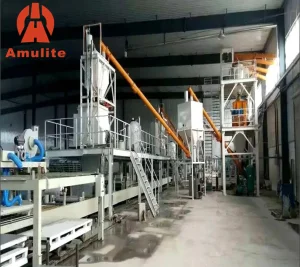
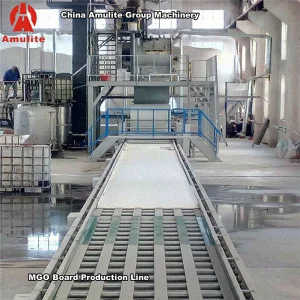
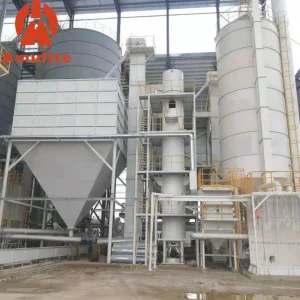
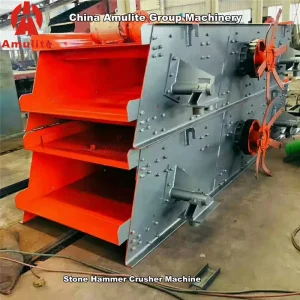
Complete your manufacturing ecosystem with downstream processing, recycling, and block equipment.

In-depth responses to critical procurement, operational, and process engineering queries.
While both processes utilize similar slurry distribution systems, true calcium silicate board equipment requires high-pressure autoclaving (10-12 bar) to synthesize crystalline tobermorite. Fiber cement equipment can rely on air-curing or low-pressure hydration. Autoclaved calcium silicate boards possess significantly higher dimensional stability and fire resistance.
A standard formulation comprises roughly 40-50% Silica Sand (SiO2 content >85%), 30-40% Quicklime (CaO content >85%) and Cement, 8-12% Pulp/Cellulose Fibers, and minimal functional additives. Amulite Group provides custom raw material testing in our laboratory to formulate ideal mixes using your locally sourced minerals.
Delamination occurs when vacuum pressure is insufficient or when slurry freeness drops. Amulite’s modern sheet-forming machines feature multi-stage vacuum dewatering boxes with automatic pressure feedback control and high-pressure nip rollers that bind micro-layers into a monolithic sheet prior to green cutting.
A 5-Million m² line requires approximately 800-1200 kW of installed electrical capacity, 4 to 6 tons of saturated steam per hour for autoclaves, and approximately 1.5-2.0 m³ of water per ton of finished product (95% recycled in closed loop).
Yes. By adjusting the hydraulic pressing force (up to 4000T) and setting green cutter length/width parameters on the HMI touchscreen, a single line can produce 4mm ultra-light ceiling substrates as well as 20mm heavy-density structural facade boards.
Amulite dispatches senior mechanical engineers, electrical technicians, and process chemists to the buyer's site. We manage foundation verification, equipment alignment, cable wiring, cold dry testing, raw material trial runs, and operator safety training until commercial output standards are met.
Whether you are upgrading an existing production facility or constructing a greenfield building material plant, Amulite Group provides end-to-end engineering excellence, transparent pricing, and lifetime technical support.