Explore our core automated production lines engineered for high density, superior thermal performance, and strict international compliance.
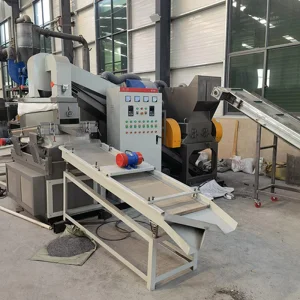
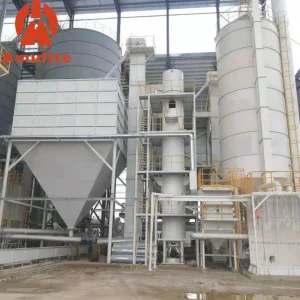
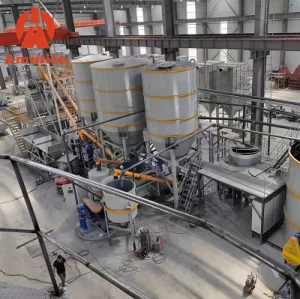
Understanding the macro shifts toward prefabricated modular construction, carbon reduction imperatives, and precision OEM machinery integration.
Global commercial and residential construction sectors are undergoing a structural transition toward Prefabricated Volumetric Construction (PVC) and Modular Panel Systems. Driven by severe skilled-labor shortages, escalating site-safety mandates, and stringent thermal insulation requirements, real estate developers and EPC contractors are abandoning traditional brick-and-mortar masonry.
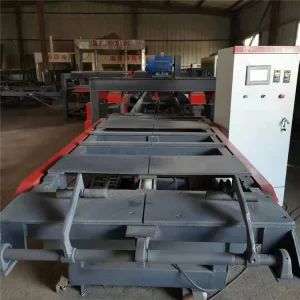
Modern OEM wall and roof panel machines provide automated, high-precision manufacturing of non-combustible fiber cement boards, calcium silicate boards, light-gauge EPS sandwich panels, and AAC (Autoclaved Aerated Concrete) elements. This automation enables rapid structural deployment, achieving up to 60% faster project completion timelines while maintaining strict structural integrity.
With stringent global building codes such as the EU Energy Performance of Buildings Directive (EPBD) and ASHRAE Standard 90.1, the demand for insulated wall cladding and structural roof panels has expanded rapidly. Wall and roof panel machinery suppliers must now deliver multi-layered composite forming lines capable of co-extruding or laminating mineral wool, XPS, and polyurethane (PU) cores with rigid facings.
By producing panels with thermal conductivity ($\lambda$) ratings as low as 0.022 W/m·K, these advanced lines empower commercial builders to construct operational Net-Zero Energy Buildings (NZEB) that significantly curb HVAC power consumption over their lifecycle.
Unlike off-the-shelf equipment, high-performance OEM wall and roof panel machines manufactured by experienced suppliers like China Amulite Group are built with modular flexibilities. Slurry mixing ratios, vacuum dewatering rates, autoclaving pressure curves, and automated four-side trimming systems can be tuned to match locally available raw materials.
Whether utilizing natural pozzolanic ash, silica sand, recycled pulp fiber, or agricultural waste, customized OEM plants enable regional manufacturers to minimize material import tariffs, optimize raw material expenditure, and maintain high flexural strength ($>14 \text{ MPa}$).
Selecting the optimal panel manufacturing machine requires balancing capital expenditure (CAPEX), raw material availability, density parameters, and thermal-fire ratings. Below is an engineering evaluation compiled by China Amulite Group's technical process department.
| Machinery Type | Primary Raw Materials | Product Density Range | Fire Resistance Rating | Key Applications | Automation Level |
|---|---|---|---|---|---|
| Fiber Cement Board Line (Hatschek) | OPC Cement, Quartz Sand, Cellulose Fiber, Additives | 1.2 - 1.7 g/cm³ | Class A1 Non-Combustible | Exterior Cladding, Wet Area Backer, Soffit Panels | Full PLC / SCADA Integrated |
| EPS Sandwich Wall Panel Line | Portland Cement, EPS Beads, Sand, Fly Ash, Facings | 550 - 700 kg/m³ | Up to 4 Hours (100mm) | Internal Partitioning, Light External Walls | Semi to Fully Automatic |
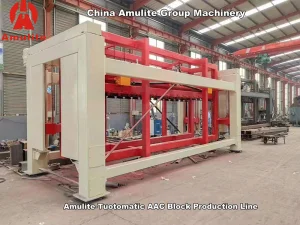
| AAC Block & Panel Line | Silica Sand/Fly Ash, Lime, Cement, Gypsum, Al Powder | 400 - 650 kg/m³ | Class A1 Non-Combustible | Load-Bearing Walls, Floor/Roof Slabs | Heavy-Duty Automated Tilting |
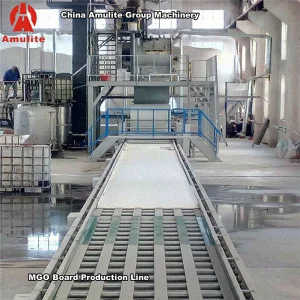
| MGO Fireproof Board Line | Active MGO, MgCl2/MgSO4, Glass Mesh, Wood Chips | 0.9 - 1.1 g/cm³ | Class A1 Fireproof | Fire Doors, Structural Subfloor, Cleanrooms | Continuous Extrusion & Layering |
| Embossed Metal Panel Line | Al-Zn Coated Steel Sheet, PU/XPS Foam, Al Foil | 3.8 - 4.2 kg/m² | Class B1 / A2 Fire Rated | Decorative Exterior Insulated Facades, Roofs | Continuous Roll-Forming & Foaming |
How Wall and Roof Panel Machinery adapts to severe regional weather patterns, seismic constraints, and structural codes worldwide.
Region Target: Northern Europe, North America, Central Asia (e.g., Kazakhstan, Russia, Canada).
In high-latitude sub-zero regions, structural walls and roofs face severe freeze-thaw cycles. Micro-cracking caused by pore water expansion can degrade conventional concrete within years. OEM machines equipped with precision autoclaving modules produce autoclaved fiber cement and calcium silicate panels rich in crystalline Tobermorite phases ($5\text{CaO}\cdot 6\text{SiO}_2\cdot 5\text{H}_2\text{O}$).
These hydrothermal crystalline matrices prevent water absorption, ensuring freeze-thaw resistance over 250 test cycles. Paired with continuous PU/XPS core injection, metal exterior panel lines supply tight tongue-and-groove joint profiles that prevent thermal bridging and ice damming on roof pitches.
Region Target: Southeast Asia, Latin America, Coastal West Africa, Pacific Islands.
Tropical climates require building panels that resist moisture degradation, fungal growth, termite infestation, and airborne salt corrosion. AAC and MGO panel machinery manufactured by China Amulite Group utilizes non-organic binder chemistry.
Fiber cement panels formed via 3 to 8 vat Hatschek sheet cylinders achieve water permeability ratings compliant with ASTM C1185. When deployed as exterior curtain walls or industrial roofing substrates in marine environments, these panels provide non-swelling structural stability with zero risk of rust, rot, or delamination.
Region Target: Middle East, South America (Chile, Peru), Turkey, Indonesia.
Earthquake-prone zones demand low-mass, high-shear structural wall partitions to minimize inertial building forces during seismic events. Lightweight EPS Sandwich Cement Wall Panels (density $550\text{--}650\text{ kg/m}^3$) produced by Amulite equipment weigh less than one-fifth of traditional brick masonry.
Interlocking male-female side grooves allow high-speed dry installation, drastically shortening structural assembly windows in hot, arid regions like Saudi Arabia and Chile where field labor costs and water conservation are paramount considerations.
Next-generation advancements driving smart automation, carbon-neutral curing, and digital twin manufacturing in panel machinery.
Traditional board production relies heavily on manual operator adjustments to balance slurry viscosity, dewatering vacuum pressure, and felt tension. China Amulite Group is pioneering AI-guided closed-loop feedback systems in its Hatschek and AAC lines.
By integrating ultrasonic thickness sensors, near-infrared moisture meters, and inline slurry rheometers with a centralized PLC-SCADA platform, the system continuously adjusts dosing pumps and vacuum levels in real time. This micro-calibration reduces raw material waste by 8.5% and ensures thickness tolerances within $\pm 0.2\text{ mm}$.
As carbon taxes expand globally, board manufacturers must decarbonize their curing processes. The future technology roadmap incorporates direct $\text{CO}_2$ mineralization curing tunnels within fiber cement board and calcium silicate lines.
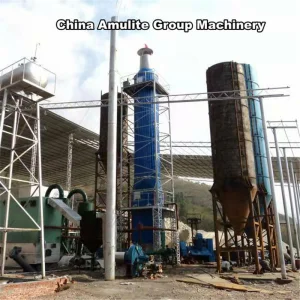
By routing captured industrial flue gas ($\text{CO}_2$) directly into initial pre-curing chambers, the calcium hydroxide ($\text{Ca(OH)}_2$) inside the wet green board reacts rapidly to form durable calcium carbonate ($\text{CaCO}_3$). This process sequesters up to 120kg of $\text{CO}_2$ per ton of board produced while accelerating green-strength development by 40% prior to autoclaving.
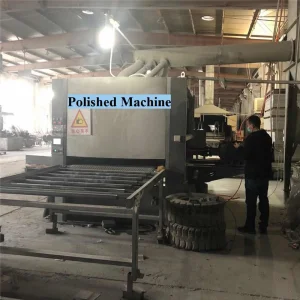
Modern production rates exceeding 10 million $m^2/\text{year}$ require fully autonomous end-of-line handling. Integrated robotic gantry crane systems equipped with multi-vacuum suction cups automatically unstack, trim, sand, inspect, and bundle finished wall and roof panels.
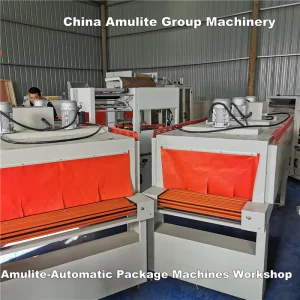
Using vision-guided AI inspection cameras, minor surface defects, corner chips, or dimensional deviations are flagged automatically, routing non-compliant boards to recycling hoppers while passing perfect units directly to automatic wrapping machines.
Why leading global building material conglomerates partner with China Amulite Group for turnkey OEM panel machinery engineering.
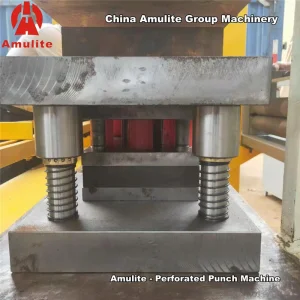
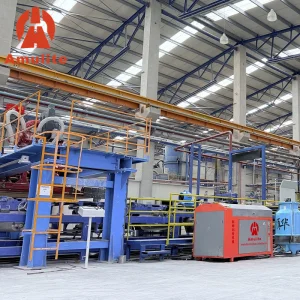
Located in Shijiazhuang, Hebei Province, China Amulite Group operates a 100,000 $m^2$ state-of-the-art manufacturing park. Facilities include heavy structural steel fabrication bays, high-precision CNC horizontal boring centers, automated submerged arc welding systems, and specialized electrical assembly workshops.
By controlling 100% of core equipment fabrication—from forming cylinders and vacuum dewatering boxes to pressure autoclaves and PLC cabinets—Amulite eliminates third-party component markups and mitigates supply chain disruptions, guaranteeing strict quality control across every line built.
China's industrial ecosystem surrounding industrial machinery provides unmatched component availability. Premium raw structural steel, high-grade stainless mesh, pneumatic cylinders, electrical relays, and hydraulic power units are sourced through established local clusters.
Critical international electronics—including Siemens PLC modules, Schneider switches, ABB drives, and SEW reducers—are fully integrated into custom control cabinets. This hybrid supply model pairs world-class electronic reliability with cost-competitive heavy machining.
Successful plant deployment depends on human expertise. China Amulite Group maintains 27 dedicated project engineering teams specializing in civil foundation layout design, mechanical erection, electrical automation, chemical slurry formulation, and operator training.
Our engineers possess hands-on field experience commissioning plants across more than 60 countries. They remain on site until trial runs achieve contractually guaranteed board density, flexural strength, and output capacity target metrics.
Ensuring full alignment with international building codes, pressure vessel safety laws, and environmental regulations.
Every OEM wall and roof panel line designed by Amulite complies strictly with international machinery safety directives and quality assurance protocols:
Before equipment manufacturing begins, China Amulite Group's material scientists conduct chemical and physical testing on raw material samples provided by the customer—such as local Portland cement, sand silica purity, fly ash reactivity, and pulp fiber length.
Our lab formulates tailored mix ratios to ensure that finished boards achieve specific standards including ASTM C1185 (Standard Test Methods for Sampling and Testing Fiber-Cement Flat Sheets) and EN 12467 (Fiber-cement flat sheets product specifications).
To maximize operational uptime, all Amulite production control systems feature encrypted remote connection modules. Our automation engineers in China can perform diagnostic health checks, update PLC software routines, and troubleshoot sensor signals remotely.
Additionally, localized spare-part regional centers and resident service engineers ensure rapid on-site assistance for preventive maintenance, felt replacement, and machine upgrades across Southeast Asia, the Middle East, South America, and Africa.
Addressing buyer search intent, technical specs, operational parameters, and project payback considerations.
Explore auxiliary crushers, recycling plants, surface finishing equipment, and foam board processing machinery.