Explore our heavy-duty industrial plant systems engineered for precise material handling, batching, and automated processing.
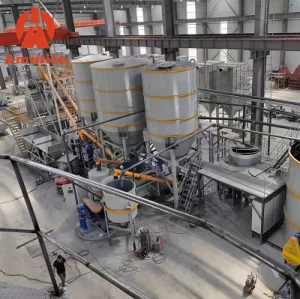
Addressing bulk material flow mechanics, structural stress distributions, dynamic discharge challenges, and multi-sector industrial scaling.
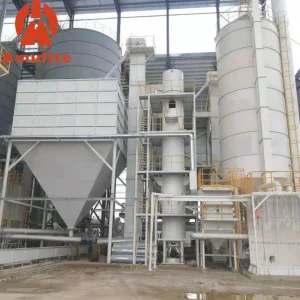
In modern industrial bulk handling, material storage is no longer viewed as a static holding phase—it is a critical control node governing plant productivity, batch accuracy, and operational safety. Conic Bottom Silos (frequently referred to as Hopper Bottom Silos) serve as the primary engineering solution for facilities requiring continuous, total, and rapid gravity-assisted discharge. Unlike flat-bottom silos that rely on mechanical sweep augers or manual cleanout systems, conic bottom designs utilize optimized conical geometry to eliminate stagnant inventory zones, minimize bridging and ratholing, and support complete First-In, First-Out (FIFO) material management.
Core Engineering Advantage: By engineering the cone angle ($\theta_c$) to exceed the angle of internal friction ($\phi$) and wall friction angle ($\phi_w$) of specific bulk materials, custom OEM Conic Bottom Silos guarantee mass flow behavior, eliminating core flow dead zones and preventing cohesive material compression.
The distinction between process success and operational downtime hinges on silo hopper flow dynamics. In improper silo configurations, cohesive powders (such as cement, calcium silicate powders, fly ash, and fine perlite) suffer from ratholing (where only a central vertical core discharges) or stable arching/bridging (where material forms a self-supporting dome over the discharge orifice). OEM customization allows structural engineers to tailor the cone slope (typically 45°, 60°, or 66° depending on cohesive yield strength) and throat diameter to match the material's bulk density ($\rho_b$) and particle size distribution.
| Design Parameter | 45° Standard Conic Bottom | 60° Steep Mass Flow Cone | 66° Ultra-Steep Cohesive Cone |
|---|---|---|---|
| Target Materials | Free-flowing grains, plastic pellets, gravel | Cement, fly ash, gypsum powder, hydrated lime | Sticky materials, fine wet sludges, organic waste |
| Flow Profile | Transition / Funnel Flow | Guaranteed Mass Flow (FIFO) | High-Velocity Accelerated Mass Flow |
| Discharge Assist Needs | Minimal (Gravity default) | Aeration pads / Vibratory bin activators | Fluidization cones & mechanical breakers |
| Structural Substructure | Standard ring beam & leg support | Reinforced skirt or elevated heavy-column frame | High-clearance engineered support frame |
Supplying high-capacity storage infrastructure across infrastructure, mining, chemical, and building material manufacturing sectors worldwide.
The commercial market for industrial conic bottom silos is undergoing rapid expansion driven by global urbanization, automated building material production lines, and stringent environmental regulations governing industrial dust emission. Globally, procurement patterns indicate a sharp shift from field-welded basic tanks to precision-engineered, modular bolted conic bottom silos manufactured under strict OEM quality standards.
In North America and Europe, environmental compliance (EN 1993-4-1 Eurocode 3 for silo structures, ASME Section VIII, and ATEX explosion protection standards) requires manufacturers to supply silos featuring integrated pressure relief valves (PRV), reverse-jet bag filter dust collectors, and certified burst discs. In rapidly developing industrial hubs across Asia-Pacific, Latin America, and the Middle East, emphasis is placed on heavy-duty corrosion resistance, seismic load resilience (Zone 4 structural design), and ultra-fast assembly times to match infrastructure project schedules.
Precision-designed structural components ensuring operational longevity, material integrity, and process integration.
Available in 45°, 60°, and custom 66° hopper slopes engineered specifically around the internal friction angle ($\phi$) of client raw materials, ensuring continuous mass flow without arching.
Fabricated using high-tensile S355JR structural steel, hot-dip galvanizing up to 600g/m² (Z600), or food/chemical-grade 304/316L stainless steel for extreme corrosive environments.
Multi-zone fluidization pads, aeration nozzles, and pneumatic knocker systems installed directly in the hopper cone to lower wall friction and re-energized settled cohesive powders.
Custom OEM leg brackets pre-machined for high-precision shear-beam load cells, coupled with guided wave radar or continuous 3D laser inventory scanners for real-time mass data.
Internal flow insert channels and central discharge tubes designed to prevent particle size segregation during high-speed pneumatic loading of mixed batch formulations.
Tailor-made silo geometries designed for specific material characteristics and environmental demands.
In automated cement wall panel, AAC block, and fiber cement board plants, 60° conic silos serve as primary storage for Portland cement, silica flour, and fly ash. Interfaced with screw conveyors and loss-in-weight feeders, they ensure zero downtime during rapid batching cycles.
Used extensively in expanded perlite and EPS composite processing lines where low bulk density materials must be discharged without compression or bridging. Specially coated hopper cones prevent material static cling and abrasive shell wear.
Installed at ports and inland grain distribution hubs to store wheat, corn, soybeans, and animal feed. Conic bottom clearance permits direct gravity discharge into rail cars, trucks, or high-capacity belt conveyors without requiring energy-intensive sweep augers.
Crafted from polished SS316L stainless steel to avoid polymer contamination. Fully enclosed airtight conic bottom silos protect moisture-sensitive resin pellets, PET flakes, and chemical powders from ambient humidity and dust ingress.
Pioneering intelligent bulk storage systems through material science, sensor fusion, and predictive maintenance.
As manufacturing transitions toward Industry 4.0, OEM Conic Bottom Silo design is evolving beyond traditional structural mechanics. The next generation of industrial storage incorporates smart digital twin sensors embedded along the hopper cone wall. These sensors measure localized stress, material moisture gradient, and wall friction dynamics in real time.
Automated PLC algorithms trigger fluidization pulses only when mass flow speed drops below threshold limits, reducing compressed air power consumption by up to 40% compared to continuous aeration.
Application of ultra-high-molecular-weight polyethylene (UHMW-PE) and abrasion-resistant ceramic tile cone linings to handle highly abrasive mineral ores while reducing wall friction angles to under 15°.
Get immediate, expert answers regarding design choices, OEM customization capabilities, and field installation.
The selection depends on the internal friction angle and flowability of your bulk material. Standard free-flowing materials like whole grains or dry plastic pellets flow efficiently under a 45° cone slope. However, cohesive powders such as cement, fly ash, hydrated lime, or fine minerals require a minimum 60° steep cone to achieve true mass flow (FIFO) and prevent arching or ratholing over the outlet orifice.
Depending on the cohesive strength of the stored bulk solid, we integrate pneumatically operated aeration pads, fluidization cone bottoms, vibratory bin activators, pneumatic knocker systems, and mechanical anti-bridging agitators directly into the hopper section during OEM fabrication.
Yes. Bolted galvanized silos offer massive logistics savings because their modular curved steel plates can be packed flat inside standard 40ft HQ shipping containers. Furthermore, high-tensile galvanized plates (up to Z600 coating) eliminate the need for field welding and painting, ensuring factory-grade corrosion protection, faster site assembly, and lower labor costs.
Every OEM silo design undergoes rigorous Finite Element Analysis (FEA) testing in compliance with Eurocode 3 (EN 1993-4-1) or ANSI/ASME standards. We calculate wind load resistance (up to 160 km/h or higher), seismic accelerations (Zone 4 compliance), and asymmetric bulk pressure distributions to engineer the exact ring beam thickness, support leg column cross-section, and anchor bolt specifications required for your site coordinates.
Complete your facility setup with our line-matched processing machinery, crushing systems, and automated recycling units.