Explore state-of-the-art production systems designed for continuous operation, high volumetric efficiency, and full compliance with international building standards.
The global construction sector is undergoing a structural transition toward lightweight, non-combustible, moisture-resistant, and low-carbon envelope systems. Modern fiber cement board (FCB) plants stand at the intersection of material science and high-speed mechanical automation.
Driven by stringent urban fire codes (such as EN 13501-1 and ASTM E136) and the surging demand for prefabricated modular construction (PMC), building material manufacturers are modernizing legacy facilities or establishing new turnkey fiber cement board factories. Fiber cement board—a composite matrix consisting of Ordinary Portland Cement (OPC), silica flour, cellulose wood pulp, and synthetic reinforcing fibers—delivers exceptional flexural strength (MOR > 14 MPa) and dimensional stability under extreme environmental conditions.
A detailed examination of raw material processing, slurry dewatering, film formation, high-pressure hydraulic pressing, and hydrothermal curing technologies.
Unbleached kraft wood pulp is hydrated and refined in disc refiners to achieve optimal Schopper-Riegler ($\text{°SR}$) freeness levels (30–45°SR). This mechanical fibrillating process maximizes mechanical interlocking with cementitious particles.
Slurry containing 20–30% solids is fed into multi-vat Hatschek cylinder machines. Rotating mesh cylinders form ultra-thin films ($0.2–0.3\text{ mm}$), transferred onto a continuous felt and dewatered via high-vacuum suction boxes.
Accumulated green sheets are subjected to 10,000–16,000 kN hydraulic stack pressing. This step increases density from $1.1\text{ g/cm}^3$ up to $1.7\text{ g/cm}^3$, driving out interstitial air and drastically reducing water absorption.
Choosing between Autoclaved (AAC-style hydrothermal curing) and Non-Autoclaved (Air-cured) plants significantly impacts capital expenditure and regional product compliance:
| Performance Parameter | Autoclaved Fiber Cement Board Line | Air-Cured (Non-Autoclaved) Line |
|---|---|---|
| Primary Raw Materials | OPC + Quartz Sand Flour (SiO2 > 92%) + Pulp | OPC + Fly Ash / Slag + PVA / Polypropylene Fiber |
| Hydrothermal Curing Cycle | 10–12 Hours at 170°C – 190°C (1.0–1.2 MPa saturated steam) | 28 Days ambient curing or 24-hr accelerated steam chamber (65°C) |
| Crystalline Phase | Tobermorite Crystalline Lattice (High structural stability) | Amorphous C-S-H Gel (Slightly higher moisture movement) |
| Moisture Movement | $\le 0.12\%$ (Ideal for exterior cladding) | $\le 0.25\%$ (Best suited for interior partitions) |
| Flexural Strength (MOR) | 16 MPa to 28 MPa (Depending on hydraulic pressing) | 10 MPa to 18 MPa |
| Energy Profile | High Thermal Energy / Low Cement Dosing | Low Thermal Energy / High Cement Dosing |
How Chinese heavy machinery engineering clusters deliver unmatched cost-to-performance ratios, rapid plant commissioning, and robust supply chain integration for international investors.
Building an industrial-scale fiber cement plant requires substantial capital investment and precise procurement coordination. Chinese manufacturing centers—particularly in Hebei, Shandong, and Jiangsu—have integrated the entire equipment fabrication value chain under one ecosystem. From ASME-certified pressure vessel manufacturing for autoclaves to custom CNC machining of 1.6-meter wide stainless steel Hatschek cylinders, China's machinery ecosystem offers key operational advantages:
In-house casting, structural steel welding, and thermal stress-relieving furnaces ensure that heavy components (such as 10,000-ton hydraulic presses and main drive gears) maintain micro-level mechanical alignment over decades of continuous operation.
Integration of international hardware standards (Siemens S7-1500 PLCs, Schneider electronics, ABB drives) with proprietary Chinese SCADA software minimizes software licensing overheads while guaranteeing global spare-part serviceability.
Prior to export shipping, complex machinery modules—including slurry dosing stations, automatic stackers, and edge profiling trimmers—underway dry-run factory testing, reducing overseas field installation time by 35–45%.
Adapting fiber cement board production capabilities to regional climate conditions, building codes, and construction methodologies.
Key Challenge: Extremely high relative humidity, torrential rainfall, and termite infestation.
Engineering Response: Production lines configured for high-density autoclaved boards ($1.4–1.6\text{ g/cm}^3$) with zero organic filler content. Used heavily for ceiling tiles, wet-area tile backer boards, and vented soffits.
Key Challenge: Extreme diurnal temperature swings (0°C to 50°C) causing thermal cracking.
Engineering Response: Autoclaved calcium silicate formulations with optimized silica sand fineness ($>3500\text{ cm}^2/\text{g}$) to achieve negligible thermal expansion coefficients, applied in ventilated exterior curtain wall facades.
Key Challenge: Strict energy efficiency (R-value) mandates and aesthetic architectural demand.
Engineering Response: Integration of post-processing inline UV-coating, wood-grain embossing rollers, and deep-groove sanding systems for premium exterior siding planks and decorative rainscreen panels.
Rigorous mechanical testing protocols and international compliance frameworks governing modern fiber cement machinery and end-product acceptance.
To secure tier-1 commercial construction contracts, fiber cement board products must satisfy international quality metrics. Turnkey machinery lines must be engineered to hold precise tolerance controls during slurry distribution, pressing, and trimming operations.
| Standard Organization | Specification Code | Target Parameter & Test Description |
|---|---|---|
| ASTM International | ASTM C1185 / C1186 | Standard Test Methods for Sampling and Testing Non-Asbestos Fiber-Cement Flat Sheets (Flexural, Density, Water Absorption). |
| European Committee (CEN) | EN 12467 | Fibre-cement flat sheets — Product specification and test methods (Categories A, B, C, D; Classes 1 to 5). |
| ISO Standards | ISO 8336 | Fibre-cement flat sheets — Dimensional tolerances, freeze-thaw resistance, heat-rain durability testing. |
| Fire Safety | EN 13501-1 / ASTM E136 | Reaction to fire performance tests — Non-combustibility certification (Class A1 / A1fl). |
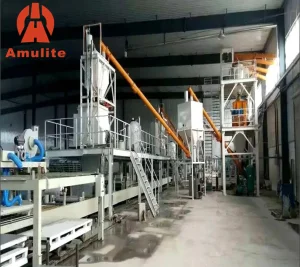
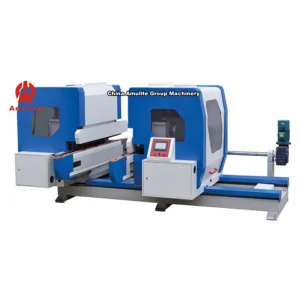
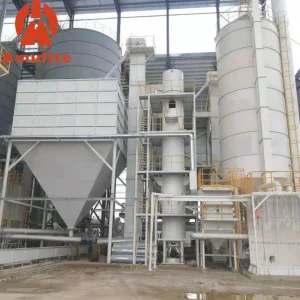
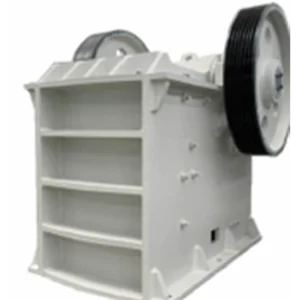
Explore secondary manufacturing systems, processing equipment, and specialized recycling lines engineered for total building material factory integration.
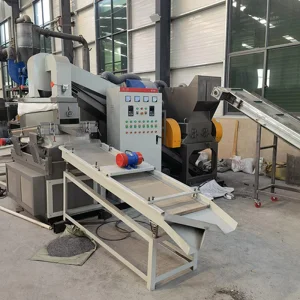
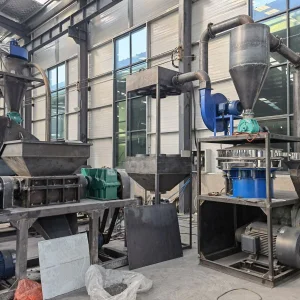
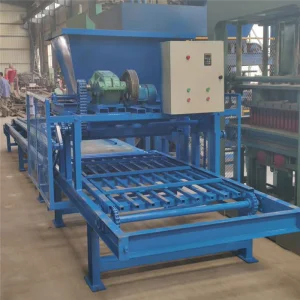
Expert answers addressing critical questions asked by plant managers, investment directors, and civil engineering consultants.
A typical 5-million square meter per annum autoclaved fiber cement board line requires a main production workshop measuring approximately $180\text{ m} \times 24\text{ m}$ (4,320 m²). Total land footprint including raw material silos, pulp storage yard, autoclave curing bays, finished goods warehouse, and boiler house is approximately 25,000 to 35,000 square meters. Electrical connection capacity should be at least 1,600 kVA, with steam requirements around 8 to 12 tons per hour at 1.25 MPa.
Local silica sand can be utilized provided the silicon dioxide ($\text{SiO}_2$) content is above 85% (preferably $>90\%$) and iron oxide ($\text{Fe}_2\text{O}_3$) is under 1.5%. However, to achieve efficient hydrothermal reaction during autoclaving, the raw sand must be wet-milled in a closed-circuit ball mill with a hydrocyclone classifier to achieve a Blaine fineness of $3,500\text{ to }4,500\text{ cm}^2/\text{g}$ (passing 200 mesh at 95%+).
The Hatschek process uses rotating cylinder vats in a thin-layer accumulation method, offering superior control over fiber alignment, sheet density, and flexural strength. It is ideal for high-density exterior cladding and high-grade calcium silicate boards ($4-20\text{ mm}$). The Flow-on process slurries material onto a moving belt continuous filter, suitable for higher volume, medium-density interior boards ($6-12\text{ mm}$) with lower capital machinery expenditure.
Modern Amulite automated lines integrate inline mass flow meters (Coriolis sensors) and nuclear/ultrasonic density gauges within the vat feed channels. The PLC system continuously modulates variable-frequency drive (VFD) dosing pumps and water injection valves, maintaining slurry solids concentration within a tight $\pm 0.5\%$ window to prevent board weight variations.
Emerging technologies transforming fiber cement plant operational efficiency, carbon footprint reduction, and raw material circularity.
As global environmental policies shift toward Net-Zero building materials, fiber cement board plant manufacturers are pioneering critical technological advancements:
Replacing standard OPC with geopolymers, calcined clays, and alkali-activated slag systems reduces embodied carbon ($CO_2/\text{m}^2$) by up to 40% while maintaining Class A1 fire resistance.
Smart steam cascade systems capture residual thermal energy from blow-down cycles, preheating boiler feed water and secondary drying tunnels to lower overall thermal gigajoules per ton.
Inline laser profiling sensors and high-speed optical cameras inspect 100% of finished boards for micro-cracks, edge chipping, and thickness deviations at speeds up to 100 meters per minute.