Explore our flagship automated production lines, continuous pressing systems, and specialized mineral board manufacturing technology engineered for global infrastructure developers.
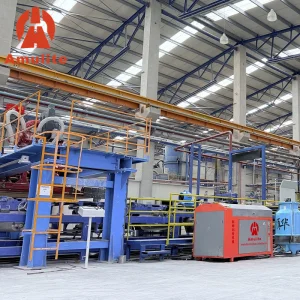
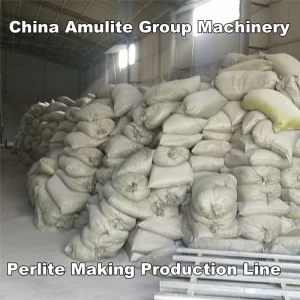
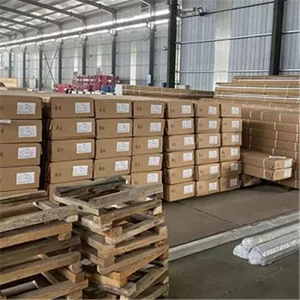
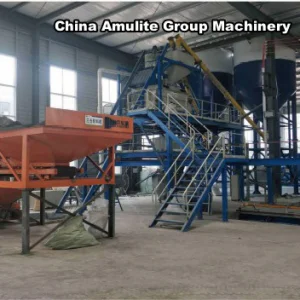
Comprehensive engineering insights into modern fiber cement sheet and calcium silicate board production technologies for global industrial plant operators.
In the contemporary building materials sector, the shift toward sustainable, non-combustible, high-durability prefabricated components has elevated fiber cement sheets and calcium silicate boards into critical architectural infrastructure. A modern Cement Sheets Production Plant relies on complex chemical engineering, mechanical automation, and high-pressure hydrothermal synthesis. Achieving superior flexural strength (MOR > 16 MPa), low water absorption (< 25%), and Class A1 non-combustibility requires precise synergy between raw material preparation, slurry homogenisation, sheet forming, and controlled curing environment.
Historically, fiber cement production relied on asbestos fibers to form the structural matrix. Modern industrial production lines engineered by top manufacturers utilize non-asbestos formulations, incorporating high-purity unbleached Kraft cellulose pulp, synthetic fibers (PVA or PP), Ordinary Portland Cement (OPC Grade 42.5 or 52.5), and reactive micro-silica sand (> 92% SiO₂ content ground to 325 mesh). Understanding the hydration chemistry and physical bonding mechanisms is essential for plant managers to optimize yield, minimize scrap rates, and maintain continuous 24/7 output.
Core Engineering Principle: Under autoclaved curing conditions (1.2–1.5 MPa steam pressure at 180°C–195°C for 10–12 hours), reactive silica sand reacts with calcium hydroxide released from cement hydration to synthesize Tobermorite crystals [Ca₅Si₆O₁₆(OH)₂·4H₂O]. This crystalline lattice provides exceptional dimensional stability, zero moisture expansion, and superior thermal insulation.
Comparative performance metrics based on standard industrial turnkey plant configurations.
| Performance Specification | High-Density Fiber Cement Board Line | Medium-Density Calcium Silicate Board Line | Air-Cured Non-Autoclaved Line |
|---|---|---|---|
| Nominal Density Range | 1.40 – 1.75 g/cm³ | 0.90 – 1.25 g/cm³ | 1.20 – 1.45 g/cm³ |
| Flexural Strength (MOR) | ≥ 16.0 MPa (Wet condition) | ≥ 10.5 MPa (Dry condition) | ≥ 12.0 MPa |
| Curing Methodology | Pre-cure + Autoclave (1.3 MPa steam) | High-pressure Saturated Steam Autoclave | Moisture Curing Tunnel (28 Days Equivalent) |
| Primary Raw Material Mix | Cement + Silica Sand + Cellulose Pulp | Lime + Quartz Sand + Cellulosic Fibers | Portland Cement + Fly Ash + PVA Fiber |
| Fire Resistance Rating | Class A1 Incombustible (EN 13501-1) | Class A1 Non-combustible / 4-Hr Rated | Class A1 / A2 Compliant |
| Thermal Conductivity | 0.24 – 0.30 W/(m·K) | 0.12 – 0.18 W/(m·K) | 0.22 – 0.28 W/(m·K) |
| Annual Line Capacity Range | 3 Million – 10 Million m² / Year | 2 Million – 8 Million m² / Year | 1 Million – 5 Million m² / Year |
Why leading global construction groups partner with Chinese machinery OEMs for large-scale production plant deployment.
China operates the world's most concentrated ecosystem for heavy machinery fabrication. From ultra-large lathe machining of 1,600mm forming cylinders to custom pressure vessel forging for autoclaves, local supply chains reduce equipment manufacturing lead times by over 40% compared to European counterparts.
Modern Chinese plant equipment integrates Siemens S7-1500 PLC systems, Schneider low-voltage electrics, and proprietary SCADA software. Automatic thickness adjustment, laser profiling, and closed-loop slurry consistency controls guarantee less than ±0.15mm board thickness variation.
Capital expenditure required to establish a 5-million m²/year fully automated line in China is 50–60% lower than Western alternatives. This enables international buyers to achieve investment payback within 18 to 24 months while maintaining full CE and ISO compliance.
Analyzing the global shift toward zero-waste, energy-efficient, and AI-assisted building material manufacturing systems.
Environmental regulations mandate complete water recycling. Modern Hatschek lines implement multi-stage cone clarifyers and sediment centrifuges. Process water used during sheet dewatering is treated and fed back into slurry mixing tanks, achieving zero liquid discharge (ZLD).
With global cement production accounting for ~8% of global CO₂ emissions, next-gen lines incorporate high volumes of blast furnace slag (GGBS), fly ash, and calcined clay. Special slurry dispersants maintain wet sheet strength while reducing OPC consumption by up to 35%.
High-speed camera vision inspection modules are positioned post-sanding to detect surface micro-cracks, edge delamination, thickness variances, and color inconsistencies at speeds up to 120 meters/minute, automatically routing defective boards to crushing units.
A detailed step-by-step breakdown of the automated Hatschek forming process inside an enterprise-grade plant.
Cellulose pulp is refined in hydrapulpers to achieve 30-35°SR freeness. Cement, silica sand, and recycled slurry are weighed via automated loss-in-weight feeders with <0.5% tolerance.
Raw components are blended with water in high-shear mixers to form a uniform slurry with 20–25% solid content, preventing fiber agglomeration or solid settlement.
Slurry flows into 3 to 5 vat units. Rotating mesh cylinders transfer ultra-thin micro-layers (0.2mm) onto a continuous felt conveyor belt under controlled vacuum dewatering.
The thin film winds around a precision-machined forming drum until the desired green board thickness (4mm–30mm) is accumulated, where an automatic cutter snaps the sheet free.
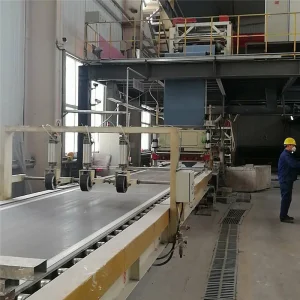
Green sheets are stacked between steel template plates and subjected to a 7,000 to 10,000-ton hydraulic press for 30 minutes, removing excess moisture and increasing sheet density.
Pre-cured green boards enter steam autoclaves at 1.2–1.5 MPa and 190°C for 10–12 hours, accelerating the hydrothermal reaction to form durable Tobermorite crystalline structures.
Autoclaved boards undergo automatic template stripping, high-speed four-side edge milling, and heavy-duty double-sided wide-belt calibration sanding for exact surface smoothness.
Finished cement sheets are visually inspected, inkjet-coded with batch data, stacked on wooden pallets, and wrapped with protective shrink-film by robotic stretch wrappers.
Fiber cement boards and calcium silicate sheets cater to diverse civil, residential, and industrial construction sectors worldwide.
High-density fiber cement sheets (1.5–1.75 g/cm³) coated with UV-resistant acrylic or polyurethane finishes provide storm-resistant, impact-proof curtain walls for commercial towers, schools, and transportation hubs across tropical and arctic zones.
Due to zero water swelling and mold growth resistance, medium-density calcium silicate boards (6mm–12mm) serve as ideal interior walls for hospital operating theaters, pharmaceutical cleanrooms, kitchens, and high-humidity public facilities.
Thick fiber cement boards (18mm–30mm) act as load-bearing structural subfloors in steel-structure buildings, modular container homes, and industrial mezzanines, substituting heavy wet-poured concrete slabs to reduce dead load.
Calcium silicate sheets engineered with vermiculite or expanded perlite aggregates deliver up to 240 minutes of structural fire integrity (BS 476 Part 20/22), safeguarding smoke extraction shafts and electrical cable trays.
Essential benchmarks for international buyers, EPC directors, and investment boards evaluating turnkey plant machinery purchases.
Procuring a complete Fiber Cement Board / Calcium Silicate Board Production Line represents a multi-million-dollar capital commitment spanning land civil engineering, utility connection (steam, electricity, compressed air, water treatment), equipment fabrication, international shipping, on-site commissioning, and continuous operator training. To mitigate technical and operational risks, enterprise procurement teams must evaluate suppliers across four core dimensions:
Verify that pressure vessels (autoclaves) conform to ASME Section VIII or EU PED 2014/68/EU standards. Ensure forming cylinder vats feature stainless steel SUS304 linings to prevent corrosion caused by alkaline cement slurry (pH 12–13).
Prior to machinery assembly, send local samples of silica sand, cement, fly ash, and pulp to the supplier's laboratory. Formulations must be customized based on local silica purity (SiO₂ %), sand fineness, and cement hydration kinetics.
Ensure the supplier dispatches a resident team of senior mechanical engineers, electrical technicians, and process chemists to manage foundation marking, mechanical erection, PLC dry runs, wet trials, and final output sign-off.
Clear, authoritative answers to common questions regarding plant setup, equipment selection, operational costs, and raw material requirements.
Depending on local building material prices, raw material procurement costs, and plant operational efficiency, most high-capacity plants (5 million m²/year output) reach full ROI within 18 to 28 months. Savings are further enhanced by incorporating local fly ash or blast furnace slag to minimize expensive Portland cement consumption.
Autoclaved lines utilize high-pressure saturated steam curing (1.2–1.5 MPa at 190°C) to induce a chemical reaction between quartz sand and lime/cement, forming Tobermorite crystals. This results in boards with zero moisture movement, higher flexural strength, and lower density. Non-autoclaved lines rely on moisture curing over several days or weeks; their boards have higher density and water absorption, making them suitable mainly for standard indoor applications.
Primary materials include Ordinary Portland Cement (OPC 42.5/52.5), Quicklime (CaO > 85%), ground quartz sand (SiO₂ > 92%, ground to < 200 mesh), unbleached Kraft wood pulp (freeness 30–35°SR), and reinforcement fibers (PVA or wollastonite). Raw material consistency is paramount for preventing board swelling or delamination during autoclave cycles.
A standard 5 million m²/year automated Hatschek production line requires a minimum covered factory building area of approximately 12,000 to 18,000 square meters (including raw material storage, production bay, autoclave zone, sanding line, and finished product warehouse). Connected electric load ranges between 1,200 kW and 1,800 kW, along with a 6-ton to 10-ton/hour steam boiler system.
Yes. Modern Amulite turnkey lines feature programmable PLC cutter controls and adjustable forming drums. By adjusting the number of winding layers on the accumulation roll, operators can produce boards ranging from 4mm up to 30mm thickness on the same line with minimal changeover downtime.
Turnkey contracts include 12 to 24 months of full machine warranty, 24/7 remote PLC diagnostics via encrypted VPN gateways, annual process audit visits, lifetime spare parts supply, and operator retraining modules for new board product releases.
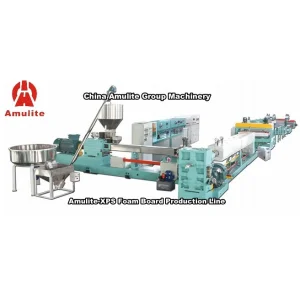
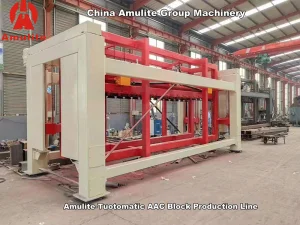
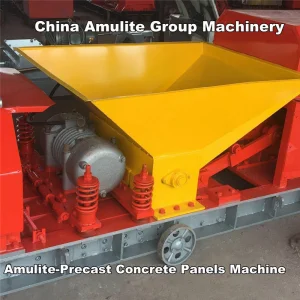
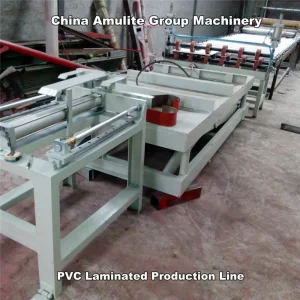
Discover specialized auxiliary lines, AAC block systems, foam board machinery, and precision cutting tools for modern material processing.
Contact our senior process directors today to receive a complete plant layout design, equipment sizing matrix, raw material formulation assessment, and turn-key cost evaluation.
Connect With Senior Engineers