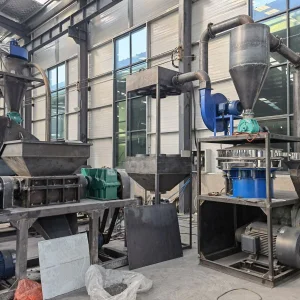
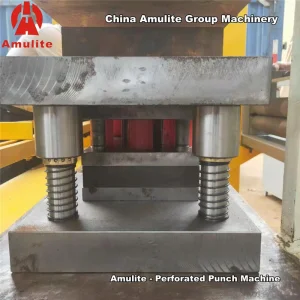
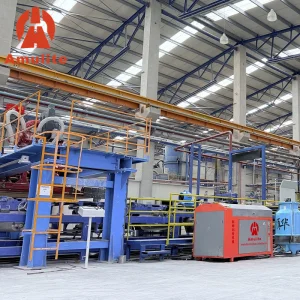
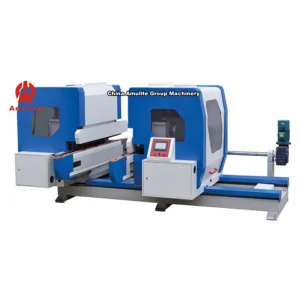
Explore our core engineering equipment powering global non-metallic mineral and structural board manufacturing plants.
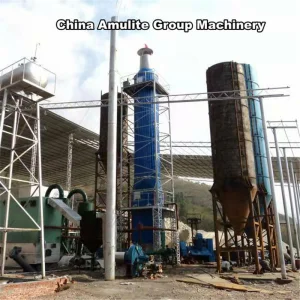
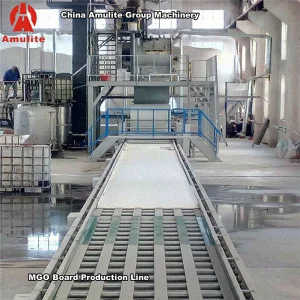
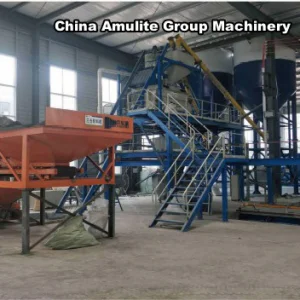
The international construction and industrial insulation sectors are experiencing a structural pivot toward Class A1 non-combustible, moisture-resistant, and high-tensile wall cladding solutions. As stringent building safety codes like ASTM C1186, EN 12467, and ISO 834 take center stage across Europe, the Middle East, Southeast Asia, and the Americas, structural engineers and EPC contractors are phased-out of traditional gypsum and plywood substrates in favor of autoclaved calcium silicate boards (CSB) and fiber cement panels.
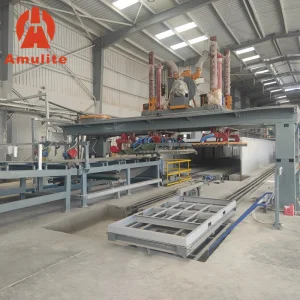
To capture this skyrocketing global demand, modern manufacturing facilities require high-efficiency, automated calcium silicate line machinery capable of operating continuous wet-forming cycles with minimum downtime. As a premier original equipment manufacturer (OEM) and turnkey plant engineering authority, China Amulite Group designs and constructs complete calcium silicate production lines ranging in capacity from 2 million to over 20 million square meters annually.
Demands high-density (1.4–1.7 g/cm³), weather-resistant exterior cladding boards capable of taking fluorocarbon coating, stone-grain finishes, or direct architectural rendering.
Low-density to medium-density boards (0.8–1.2 g/cm³) optimized for thermal insulation up to 1000°C, structural steel encasement, fireproof ceiling systems, and marine bulkhead linings.
Medium-density boards providing zero organic swelling, mold defense, and superior mechanical fastener retention in high-humidity zones like cleanrooms, hospitals, and subways.
The superiority of autoclaved calcium silicate boards over non-autoclaved cement panels lies in the chemical conversion of raw materials into a highly stable crystalline structure known as Tobermorite 5Å ($\text{C}_5\text{S}_6\text{H}_5$). The production process combines siliceous materials (finely ground quartz sand, silica fume, or fly ash) and calcareous materials (slaked lime $\text{Ca(OH)}_2$, Portland cement) with cellulose pulp fibers for structural reinforcement.
5Ca(OH)₂ + 6SiO₂ + 0.5H₂O → C₅S₆H₅.₅ (Tobermorite Crystal Phase at 180°C–190°C)
Under high pressure (1.0 to 1.3 MPa) and saturated steam conditions inside the autoclave for 10–12 hours, the calcium-silicate-hydrate gel matrix cures into locked crystalline needle structures. This eliminates free calcium oxide ($\text{CaO}$), ensuring the finished board exhibits zero hydric expansion, high flexural strength (E-modulus), and extreme dimensional stability.
| Performance Parameter | Hatschek Wet-Forming Process | Flow-on (Slurry Flow) Process | Industrial Value / Impact |
|---|---|---|---|
| Raw Slurry Solids Concentration | 8% – 12% Low Concentration | 20% – 30% High Concentration | Hatschek provides finer layer lamination and higher tensile bonding. |
| Sheet Lamination Structure | Multi-layer film wrapping (0.2–0.3mm per cylinder) | Single-layer extrusion or slurry pouring | Hatschek yields superior flexural strength in both longitudinal and transverse axes. |
| Board Density Range | 0.95 to 1.70 g/cm³ | 1.00 to 1.45 g/cm³ | Enables broad product diversity from lightweight ceilings to heavy facade panels. |
| Max Line Speed | Up to 80 meters / minute | Up to 45 meters / minute | Hatschek lines deliver higher annual ROI and maximum production capacity. |
| Cellulose Fiber Utilization | Optimized 6% – 10% Kraft Pulp | Requires 8% – 12% Pulp + Synthetic Additives | Hatschek lowers recurring raw material expenditures significantly. |
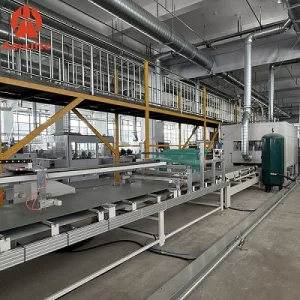
An end-to-end automated calcium silicate production line integrates six core technological subsystems working in perfect synchronization under SCADA and Siemens PLC master control.
Includes high-consistency hydro-pulpers to process unbleached kraft wood pulp, wet ball mills for quartz silica grinding, electronic gravimetric loss-in-weight feeders, and slurry homogenizing storage tanks equipped with continuous agitators.
Features 3 to 5 stainless steel mesh forming vats with adjustable slurry agitation, automatic felt washing/conditioning vacuum boxes, high-vacuum dewatering press rolls, and a precision steel making-drum with auto-wire cutting knives.
Includes continuous vacuum stackers that interleave stainless steel template plates between green sheets, a hydraulic press (up to 4000–7000 Tons) for high-density panel production, and insulated pre-curing tunnels maintaining 50°C–60°C.
Industrial ASME / CE certified pressure vessels (typically 2.0m to 2.5m internal diameter by 30m–45m length) engineered for quick door-opening mechanisms, automated steam distribution manifolds, and condensate heat recovery loops.
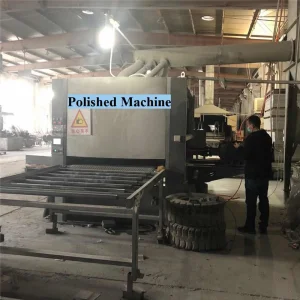
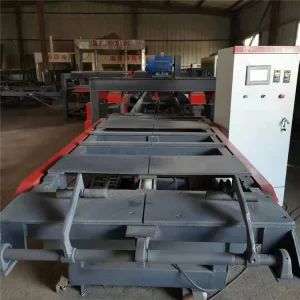
Automatic destacking units, high-speed 4-side edge trimming saws with diamond-tipped saw blades, surface calibrating heavy-duty sanding machines (6-head or 8-head), and thickness measurement lasers.
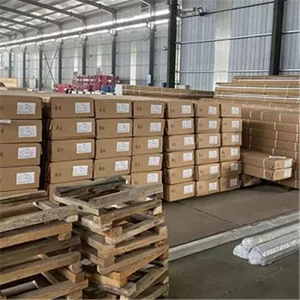
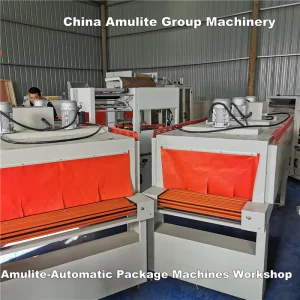
Automatic board inspection stations, robotic arm palletizers, auto strapping machines, stretch wrapping stations, and real-time ERP inventory tracking integration.
Investing in a commercial calcium silicate line requires more than buying industrial machinery; it demands an engineering partner capable of delivering total operational reliability, raw material formulation tuning, and international regulatory compliance. China Amulite Group enforces a strict quality control matrix compliant with CE electrical safety directives, ISO 9001 quality management, and ISO 14001 environmental protocols.
Water recycled from the Hatschek forming vacuum boxes and cylinder washings undergoes multi-stage continuous clarification through high-efficiency cone settlers. Process water is 100% recirculated into slurry mixing, ensuring zero industrial wastewater effluent discharged into local ecosystems.
Our Senior Chemical Engineers conduct comprehensive raw material laboratory tests on your local silica sand, quicklime, and cement sources. We custom-tune the hydro-slurry slurry viscosity, autoclave temperature curves, and fiber binder percentages to achieve target physical strength at minimal production costs.
In-depth technical answers addressing critical procurement and operational queries from global plant engineers and investors.
Integrate specialized auxiliary machines, profiling equipment, and panel manufacturing plants into your industrial portfolio.