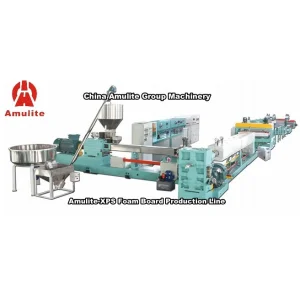
Explore our flagship automated manufacturing systems engineered for high durability, precision, and global regulatory compliance.
As modern building codes mandate stringent structural fire resistance and ultra-low carbon footprints, Magnesium Oxide (MgO) board machinery has advanced into a cornerstone of industrial board manufacturing.
Modern MgO board manufacturing lines utilize advanced chemical slurry dosing to achieve zero flame spread, zero smoke production, and Class A1 non-combustible ratings required by international fire safety codes.
Leading factories transition from traditional oxychloride formulas to pure Magnesium Oxysulfate ($MgSO_4$) tech. This prevents "crying boards," corrosion of metal fasteners, and moisture absorption in high-humidity zones.
Automated thickness tracking, real-time density adjustments, and SCADA-driven continuous curing ensure tight manufacturing tolerances within $\pm 0.2\text{mm}$ across high-volume production cycles.
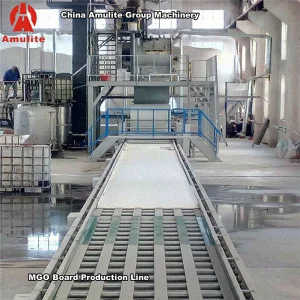
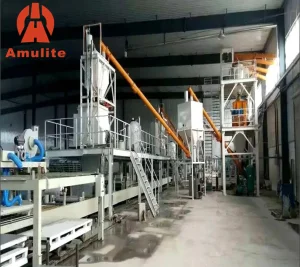
A comprehensive breakdown of engineering modules within an automated fireproof board plant, from raw material handling to continuous curing and stacking.
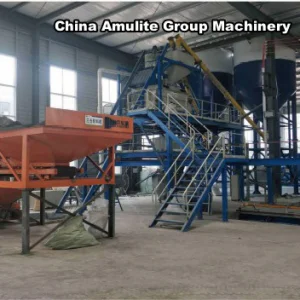
The manufacturing process begins with micro-processor controlled gravimetric feeders. Active caustic calcined magnesia ($MgO$), high-purity magnesium sulfate ($MgSO_4$), expanded perlite, wood flour, and specialized modifiers are automatically proportioned into high-shear planetary mixers. This guarantees chemical equilibrium and prevents unreacted free magnesia, eliminating expansion cracks.
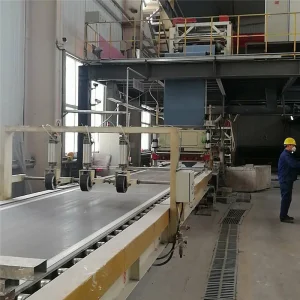
Superior flexural strength (tensile module) relies on tension-controlled fiberglass mesh feed units. The continuous board forming machine lays automated bottom and top layers of alkali-resistant (AR) fiberglass mesh, sandwiching the homogenous inorganic slurry. Pneumatic rollers remove entrapped air pockets, achieving dense compaction.
Hydration of magnesium oxysulfate cement is an exothermic reaction requiring precise micro-climate management. Our curing tunnels control initial setting temperatures ($35^\circ\text{C} - 55^\circ\text{C}$) and relative humidity above 80%. This accelerates crystal growth ($5\cdot Mg(OH)_2 \cdot MgSO_4 \cdot 7H_2O$), ensuring high structural density within 8 to 12 hours.
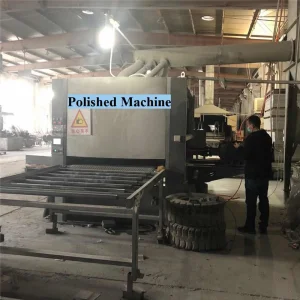
Once demolded, boards enter automated processing stages. High-speed diamond saws cut sheets to exact dimensions ($1220 \times 2440\text{mm}$ standard), while double-sided calibration sanding machines smooth surface roughness to tolerance levels required for direct laminating, painting, or exterior cladding applications.
Legacy MgO production lines using magnesium chloride ($MgCl_2$) often result in board delamination, corrosion of embedded metallic frames, and surface moisture weeping under humid environments. Modern factory configurations supplied by industry leaders integrate pure Sulfate ($MgSO_4$) crystal engineering. By installing non-corrosive stainless steel contact zones, continuous temperature control, and multi-mesh feeding mechanisms, modern plants yield boards suitable for marine, sub-floor, and exterior curtain wall applications without structural degradation.
Compare baseline technical capabilities across our scalable fire-resistant board machine configurations.
| Plant Parameter | Standard Line (MGO-1000) | High-Output Line (MGO-3000) | Ultra-Automated Line (MGO-5000) |
|---|---|---|---|
| Annual Capacity | 1,000,000 $m^2$ / Year | 3,000,000 $m^2$ / Year | 5,000,000+ $m^2$ / Year |
| Board Thickness Range | 3mm – 20mm | 3mm – 25mm | 3mm – 30mm |
| Forming Speed | 8 – 12 m/min | 15 – 22 m/min | 25 – 35 m/min |
| Installed Power | 110 kW | 240 kW | 380 kW |
| Dosing Accuracy | $\pm 0.5\%$ | $\pm 0.2\%$ | $\pm 0.1\%$ (Fully Automated) |
| Flexural Strength (Average) | $\ge 15 \text{ MPa}$ | $\ge 18 \text{ MPa}$ | $\ge 22 \text{ MPa}$ |
| Required Factory Footprint | $2,500 \text{ m}^2$ | $4,500 \text{ m}^2$ | $7,500 \text{ m}^2$ |
Evaluating capital expenditure (CapEx) against long-term operational efficiency (OpEx) when sourcing MGO board machinery from leading manufacturers.
International procurement teams require machinery capable of processing regional raw material variations. High-performance mixing and batching systems can calibrate water-to-cement ratios automatically, taking local $MgO$ purity ($75\%-85\%$) into account without causing unreacted phase shifts.
Top-tier factories incorporate automated edge trimming recirculation. Wet trim waste is immediately reclaimed and reintroduced into the primary mixing cycle, reducing raw material waste to under 1.5% while minimizing plant clean-up downtime.
Beyond initial purchase cost, buyers evaluate component longevity. Demanding applications require hardened alloy steel rollers, chrome-plated calibration heads, and IP65-rated control cabinets to resist alkaline dust and ambient humid curing environments.
Ensuring compliance with global building codes and providing end-to-end engineering support from blueprint design to commissioning.
Fireproof boards produced on our machinery meet strict international benchmarks:
We provide full technical support throughout every phase of plant development:
Anticipating industry trends: How artificial intelligence, green chemistry, and robotic automation will shape the next decade of board manufacturing.
Integrating non-contact ultrasonic sensor arrays to inspect board density and inner delamination in real time. Continuous feedback loops allow the machine to dynamically auto-adjust roller pressure and slurry pump speeds without stopping the production line.
Next-generation MgO matrices actively absorb atmospheric $CO_2$ during the curing phase, converting magnesium hydroxide into stable magnesium carbonate minerals. Future machinery lines feature pressurized $CO_2$ curing channels to create net-zero carbon boards.
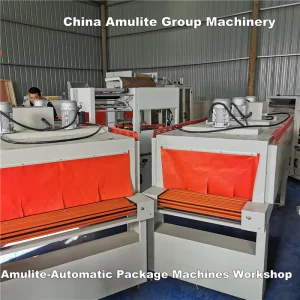
Fully autonomous end-of-line robotics inspect surface defects, apply protective corner guards, strap bundles, and stretch-wrap pallets without human intervention, maximizing throughput and operational safety.
Comprehensive answers to technical, operational, and commercial questions regarding MGO board machine procurement and installation.
Explore our complete ecosystem of stone crushers, board profilers, recycling equipment, and customized panel machinery.