Explore heavy-duty, industrial-grade production units designed for fireproof calcium silicate panels, insulating backers, and structural building elements.
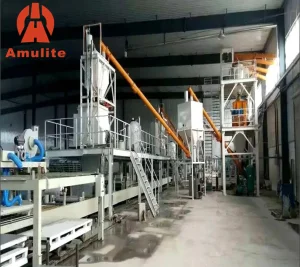
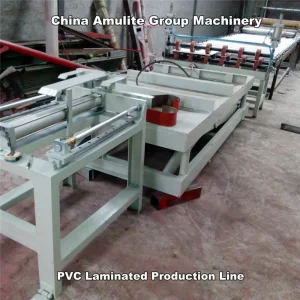
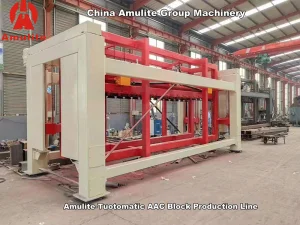
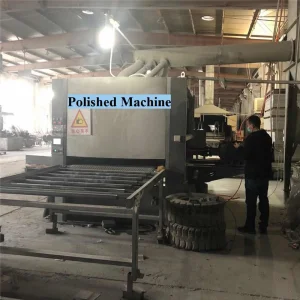
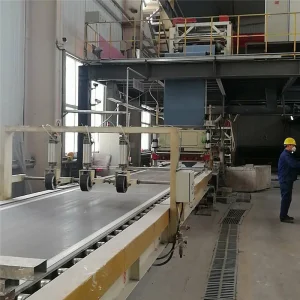
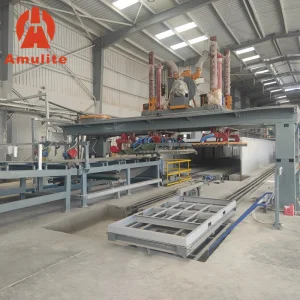
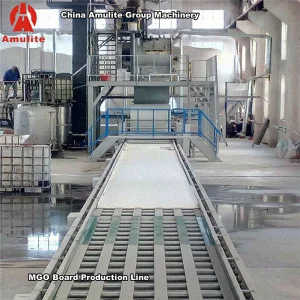
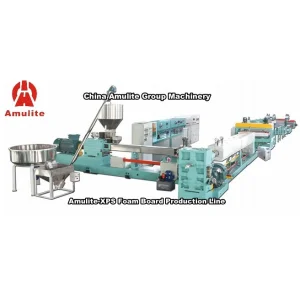
Analyzing the macro-economic drivers, technological evolutions, and regional demand dynamics shaping the high-performance building material machinery sector.
The acceleration of global urbanization, coupled with stringent international building codes (such as EN 13501-1 Class A1 non-combustibility standards and ASTM C1186 specifications), has triggered a monumental shift toward advanced non-metallic building materials. Calcium silicate boards have emerged as the premier material for internal partitioning, exterior facade cladding, cleanroom paneling, and passive fire protection systems.
Procurement behaviors vary significantly across key geographical zones, driving manufacturers to design modular, highly customizable machinery architectures:
| Substrate Type | Raw Material Base | Primary Curing Phase | Density (g/cm³) | Key Industrial Application |
|---|---|---|---|---|
| Calcium Silicate Board | Lime + Quartz Sand + Cellulosic Fiber | Autoclaved (Tobermorite Crystalline Phase) | 0.8 – 1.3 (Low/Medium) | Passive Fireproofing, Ceiling Panels, Wet Area Partitions |
| Fiber Cement Board | Portland Cement + Silica + Pulp Fibers | Air-cured / Steam-cured (C-S-H Gel) | 1.2 – 1.7 (High Density) | Exterior Architectural Cladding, Siding, Floor Substrates |
| Magnesium Oxide (MGO) Board | Magnesite + MgCl₂/MgSO₄ + Glass Mesh | Exothermic Hydration (Room Temp) | 0.9 – 1.1 (Medium) | Fire-rated Sub-flooring, Structural Insulated Panels (SIPs) |
| Gypsum Plasterboard | Stucco (Calcined Gypsum) + Paper Facers | Continuous Drying Kiln | 0.6 – 0.85 (Lightweight) | Standard Drywall Interior Residential Framing |
A deep-dive technical breakdown of core equipment components, chemical reaction parameters, and line integration requirements for high-yield industrial plants.
Engineering Core Principle: Calcium silicate board manufacturing relies on the hydrothermal reaction between siliceous ($SiO_2$) and calcareous ($CaO$) materials under saturated steam pressure ($1.0 - 1.4\text{ MPa}$ at $180^\circ\text{C} - 200^\circ\text{C}$). This reaction synthesizes **Tobermorite crystals ($5CaO \cdot 6SiO_2 \cdot 5H_2O$)**, imparting exceptional dimensional stability, zero moisture expansion, and A1-class fireproofing to the final board.
Precise continuous gravimetric batching system for raw material synthesis.
The mechanical heart of board green-body formation.
Crystalline phase evolution and post-production processing.
Next-generation advancements in calcium silicate board plant automation, energy recovery, and sustainable manufacturing technology.
Modern lines feature industrial IoT sensors and mass flow meters that continuously measure slurry viscosity, solids ratio, and vat levels. Real-time feedback loops automatically adjust raw material feed rates and flocculant dosages, maintaining green sheet density tolerances within $\pm 0.02\text{ g/cm}^3$ and virtually eliminating delamination risks.
Advanced water management modules capture, clarify, and recirculate 100% of process water from vacuum pumps, felt washing, and sheet trimming. Solid residues from sedimentation tanks are automatically returned to the raw slurry preparation tanks, eliminating chemical run-off and meeting strict environmental compliance mandates globally.
By implementing multi-stage flash evaporators and steam heat exchangers, exhaust steam from autoclaves is captured to pre-heat boiler feed water and pre-curing tunnels. This thermodynamic loop reduces total plant natural gas/coal consumption by up to 22% per cubic meter of finished board.
Integration of multi-axis industrial robots equipped with laser visual sensors allows high-precision automated trimming, defect detection, template separator positioning, and pallet packing at linear line speeds exceeding $120\text{ meters/minute}$.
Ensuring compliance with international pressure vessel, electrical, and environmental standards across all overseas installations.
Autoclaves represent the largest capital asset and highest pressure exposure in a plant. Machinery manufacturers must supply vessel designs compliant with ASME Section VIII Div 1 (Americas), PED 2014/68/EU (Europe), or DOSH (Malaysia) standards, backed by third-party non-destructive testing (NDT) reports and hydrostatic test certifications.
Calcium silicate machinery must be engineered to handle diverse local mineral compositions. Experienced manufacturers analyze regional silica sand purity, quicklime activity ($t_{60}$ slaking time values), and local fly ash chemical composition ($SiO_2 + Al_2O_3 + Fe_2O_3 > 70\%$), adjusting slurry formulas to optimize chemical reaction stoichiometry without compromising flexural strength.
Leading manufacturers maintain dedicated technical teams for civil foundation engineering design, electrical integration (Siemens/Schneider PLC architectures), mechanical erection supervision, operator training, and lifetime spare-parts supply chains to guarantee plant Operational Equipment Effectiveness (OEE) above 90%.
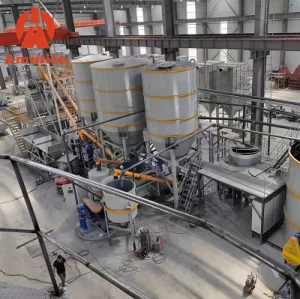
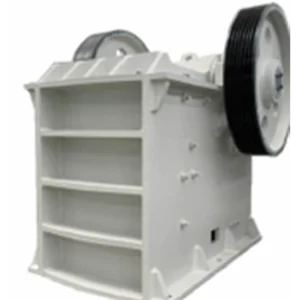
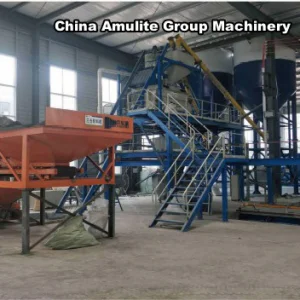
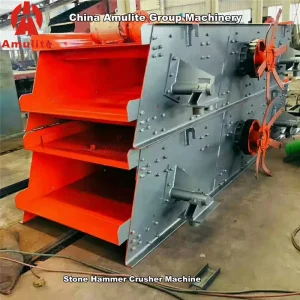
Explore complete equipment setups for lightweight wall panels, stone jaw crushers, recycling systems, and high-precision edge-cutting systems.
Direct engineering answers regarding CAPEX, technical parameters, capacity scaling, and operational considerations.