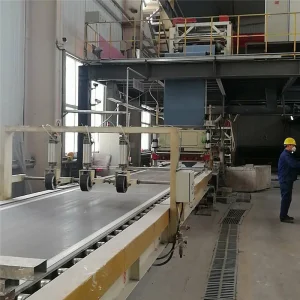
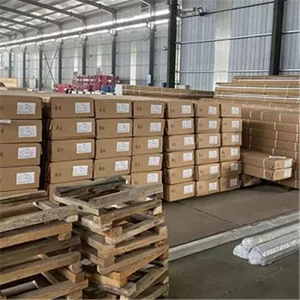
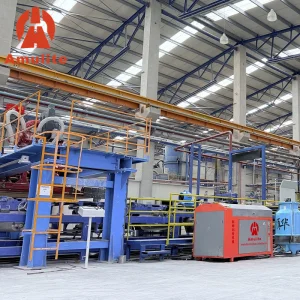
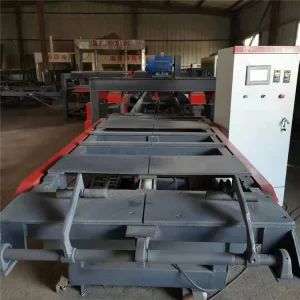
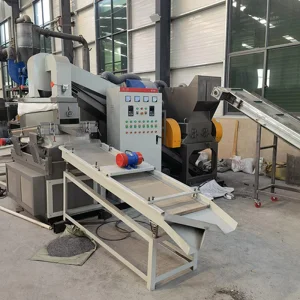
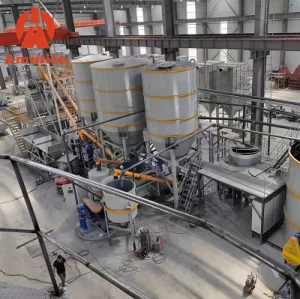
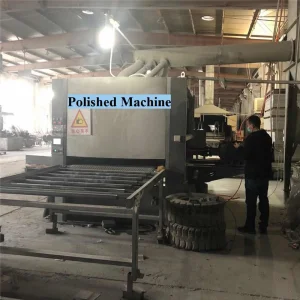
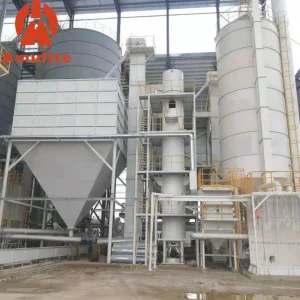
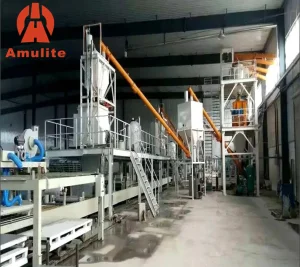
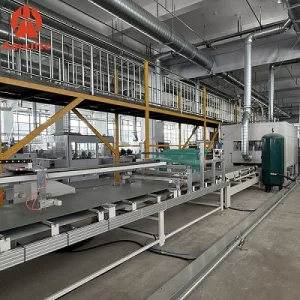
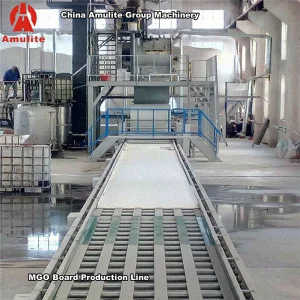
Explore our core machinery offerings engineered for cement wall panel production, fiber cement boards, and building material manufacturing.
Key operational statistics achieved by China EPS Sandwich Panel Machine factories through automated processing, precision batching, and advanced heat curing.
The global construction sector is undergoing a rapid paradigm shift toward prefabrication, modular assembly, and high-performance building envelopes. Within this context, Expanded Polystyrene (EPS) Sandwich Cement Wall Panels have emerged as a premier material for internal partitions, external cladding, and structural floor slabs. Engineered by combining calcium silicate or fiber cement face boards with a lightweight core matrix of expanded polystyrene beads, Portland cement, fly ash, and specialized chemical admixtures, these panels deliver exceptional strength-to-weight ratios, rapid installation velocity, superior thermal resistance ($\lambda \le 0.045 \text{ W/m}\cdot\text{K}$), and high acoustic dampening (up to 48 dB Sound Transmission Class).
As leading China EPS Sandwich Panel Machine suppliers and direct factory OEMs, modern machinery manufacturers have transitioned from manual, localized mold casting to fully automated, SCADA-controlled, continuous production ecosystems. Modern production lines optimize raw material dosing, automated EPS pre-expansion, micro-foaming slurry stabilization, automated vertical mold car circulation, pressure curing, and high-speed automatic demolding. This white paper serves as an authoritative guide for industrial plant owners, engineering procurement contractors (EPCs), project directors, and building material manufacturers seeking to evaluate technology pathways, equipment engineering specifications, localized compliance frameworks, and long-term return on investment (ROI).
Strategic economic factors driving global adoption of EPS lightweight cement panel manufacturing equipment.
Traditional masonry, burnt clay bricks, and thick concrete blocks carry significant embodied carbon penalties. EPS cement sandwich panels consume up to 40% less cement per cubic meter by utilizing industrial by-products (fly ash, blast-furnace slag, and quartz tailings) combined with expanded polystyrene core fillers. Plant operators achieve substantial carbon credit offsets while helping developers meet LEED, BREEAM, and EDGE green building certifications.
Rapid urban growth across Southeast Asia, the Middle East, Latin America, and Africa demands accelerated construction methodologies. EPS lightweight wall panels install up to 7 times faster than traditional hollow block masonry. A typical 2-person installation crew can erect over 80 m² of wall panel surface per shift, reducing structural dead-loads by up to 60% and shrinking structural foundation costs for high-rise buildings.
Investing in high-automation Chinese EPS panel machines offers capital expenditure (CAPEX) advantages ranging from 40% to 60% compared to Western European alternatives, without sacrificing mechanical precision, PLC control systems, or component longevity. Plant investors realize payback periods within 14 to 24 months based on market local demand dynamics and raw material availability.
Key Market Takeaway: According to global construction technology indexes, lightweight partition wall panels are replacing traditional concrete masonry at a CAGR of 8.4% globally. Machinery customized for localized cement chemistries and regional aggregate densities offers the highest market defensibility for industrial investors.
An end-to-end breakdown of the mechanical modules, automation control units, and fluid dynamics systems forming the production ecosystem.
The core matrix quality depends heavily on slurry homogeneity. Industrial EPS panel production lines utilize computer-controlled loss-in-weight feeders and pneumatic powder transfer systems. Cement, sand powder, fly ash, and chemical additives (foaming agents, plasticizers, acceleration agents) are micro-metered with ±0.5% accuracy. The high-shear planetary mixer incorporates anti-wear alloy paddles, inducing vortex mixing that uniformly coats EPS beads with cementitious paste without collapsing their closed-cell structure.
Raw expandable polystyrene granules are treated in a continuous steam pre-expander equipped with precise fluid-bed drying and temperature control sensors. The expanded beads achieve a target bulk density of 8 to 15 kg/m³. Following expansion, beads are pneumatically conveyed into multi-compartment aging silos equipped with air drying and electrostatic discharge units to stabilize internal cell pressure prior to core slurry injection.
Modern plant architecture favors vertical multi-cavity mold cars over horizontal flat casting tables. Vertical systems minimize plant footprints by over 70% while yielding dual-side smooth panel finishes. Fully automated mechanical suction arms feed 4.5mm–6mm Calcium Silicate Boards or Fiber Cement Boards into the vertical mold tracks. Hydraulic lock systems compress the mold cars under 15–20 MPa of locking force to eliminate edge slurry leakage during high-pressure injection.
The homogenized EPS-cement slurry is pumped directly into the vertical mold cavities via positive-displacement progressive cavity pumps or pneumatic pressure vessels. Integrated high-frequency vibrators remove micro-air pockets without causing bead segregation. The filled mold cars undergo accelerated thermal curing inside insulated, steam-heated curing tunnels (typically maintained at 50°C–65°C for 3 to 4 hours), accelerating hydration kinetics to reach handling strength rapidly.
Upon exiting the curing tunnel, hydraulic demolding machines tilt the panel stack by 90 degrees. Vacuum gripper arms lift individual panels, transferring them to automated four-side trimming and edge profiling systems. Here, female-male (tongue-and-groove) interlocking profiles are milled into panel edges with sub-millimeter precision, enabling seamless tongue-and-groove interlocking during building installation. Automated stackers bundle finished panels onto transport pallets for final curing yard transfer.
Compare key physical properties, machinery configurations, and building code compliance specs across wall technologies.
| Performance Parameter | EPS Cement Sandwich Panel | Autoclaved Aerated Concrete (AAC) | Traditional Hollow Concrete Block | Drywall Gypsum System |
|---|---|---|---|---|
| Dry Density (kg/m³) | 550 – 700 kg/m³ | 500 – 650 kg/m³ | 1200 – 1600 kg/m³ | 800 – 950 kg/m³ |
| Compressive Strength | ≥ 3.5 – 5.0 MPa | ≥ 3.5 MPa | ≥ 5.0 – 7.5 MPa | N/A (Non-load bearing) |
| Fire Resistance Rating | Up to 4 Hours (100mm) | Up to 4 Hours | 2 – 4 Hours | 1 – 2 Hours |
| Thermal Conductivity (λ) | 0.038 – 0.045 W/m·K | 0.11 – 0.16 W/m·K | 0.55 – 0.81 W/m·K | 0.19 – 0.25 W/m·K |
| Sound Transmission Class (STC) | 42 – 48 dB | 38 – 44 dB | 40 – 45 dB | 35 – 42 dB |
| Hanging Strength (Single Point) | ≥ 1000 N (100 kg) | ≥ 500 N | ≥ 1000 N | ≥ 250 N |
| Installation Velocity | 35 – 45 m²/worker/day | 15 – 20 m²/worker/day | 8 – 12 m²/worker/day | 25 – 30 m²/worker/day |
Customizing machine engineering, raw material formulas, and panel designs for diverse global climatic conditions.
In high-ambient thermal environments such as Saudi Arabia, UAE, and Qatar, building insulation codes (e.g., Saudi Building Code SBC 601/602) require low thermal transmittances (U-values). EPS sandwich panels produced with 100mm to 150mm thick cores serve as optimal external envelope walls, eliminating thermal bridging and lowering indoor HVAC cooling power loads by over 30%.
Countries like Indonesia, the Philippines, Chile, and Japan prioritize lightweight, ductile wall elements to prevent structural collapse during seismic incidents. EPS panels connected via steel pin systems, mortar joints, and rebar anchors absorb lateral shear movements during earthquakes without catastrophic brittle failure, reducing overall building dead weights dramatically.
In humid tropical regions across Southeast Asia, West Africa, and Central America, traditional gypsum wallboards deteriorate quickly due to moisture absorption and mold growth. Cement-EPS panels faced with water-resistant calcium silicate boards exhibit near-zero water absorption (<6%), ensuring long-term structural integrity in wet-room areas, kitchens, and tropical external claddings.
Comprehensive engineering compliance, international quality assurance protocols, and global field engineering support.
Purchasing machinery from leading China EPS Sandwich Panel suppliers involves strict compliance verification to ensure equipment conforms to international electrical, mechanical, and safety standards. Professional OEM factories adhere to rigorous Quality Assurance (QA) and Quality Control (QC) frameworks during component sourcing, machining, frame fabrication, and final testing.
All structural frame fabrications undergo ultrasonic flaw testing and stress-relief heat treatment. Electrical cabinets, PLCs, touchscreens, and servo drives utilize world-standard brands (Siemens, Schneider, ABB, Mitsubishi) conforming to CE Directive 2006/42/EC and ISO 12100 safety parameters.
Prior to international container shipping, production lines undergo comprehensive dry-runs and wet-load trials inside the manufacturing plant. Hydraulic pressures, PLC cycle timings, slurry pump flow rates, and automatic cutter tolerances are measured and logged for buyer verification.
Senior field engineers, mechanical specialists, and automation software programmers are dispatched to the client site. Services include foundation layout verification, mechanical positioning, electrical wiring, slurry recipe adjustment using local raw materials, and hands-on staff training.
Emerging technology trends driving higher efficiency, reduced carbon emissions, and smart factory integration.
Modern production lines feature edge-computing IoT nodes installed on critical servo drives, hydraulic power packs, and slurry mixers. Operational metrics—including motor vibration spectra, oil temperatures, injection pressures, and raw material mass flow—are monitored in real time via SCADA interfaces. Machine learning models predict component wear before failures occur, minimizing unplanned downtime.
In response to global carbon neutrality goals, machinery OEMs are refining slurry injection systems to handle geopolymers, alkali-activated slag cements, and CO2-mineralized concrete formulations. Additionally, equipment is being adapted to process post-consumer recycled EPS (rEPS) beads and bio-based expandable polymers, achieving circular economy integration in building panel manufacturing.
Automated Guided Vehicles (AGVs) are replacing manual forklift operations for transferring heavy mold cars between pouring bays, curing tunnels, and demolding stations. Concurrently, machine vision systems equipped with multi-spectral camera arrays inspect finished panel faces for micro-cracks, edge chipping, or dimensional variance, guaranteeing 100% QA compliance prior to pallet wrapping.
Direct technical answers to common questions asked by project engineers, plant investors, and machinery importers.
Explore complementary machinery, processing equipment, and specialized recycling lines engineered by China Amulite Group.