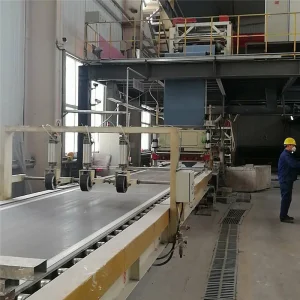
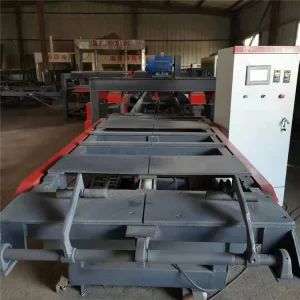
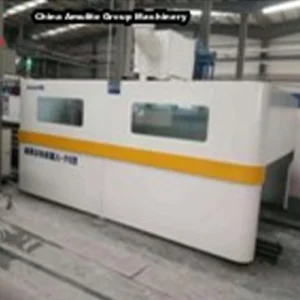
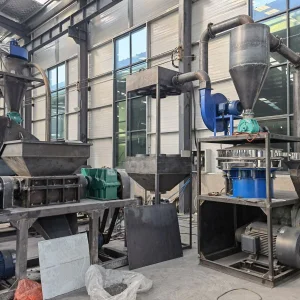
Explore high-tonnage sheet pressing equipment, continuous board formation systems, and automated line solutions engineered for global building material manufacturing.
Press cement sheet machinery forms the backbone of global non-asbestos fiber cement board (FCB) and calcium silicate board (CSB) manufacturing. This whitepaper analyzes critical selection criteria, technical specifications, and supply chain strategies for industrial buyers.
Information Gain Insight: Modern fiber cement pressing operations are pivoting from low-density air-cured boards to ultra-high-density autoclaved matrices. Hydraulic pressing under multi-thousand-ton loads eliminates internal voids, increases flexural strength (MOR > 16 MPa), and drastically reduces moisture absorption to below 10%.
A comprehensive analysis of hydraulic pressing mechanics, vacuum dewatering systems, and continuous multi-daylight press configurations.
The primary hydraulic unit utilizes heavy-duty forged steel columns and stress-relieved welded frames capable of withstanding continuous cyclic pressure up to 70-100 MPa.
During the pressing process, residual water trapped in the wet green sheet must be evacuated rapidly without destroying board structural integrity.
Siemens S7-1500 or Schneider Modicon PLC systems govern press gap control down to 0.05 mm precision, matching exact target thickness specifications.
| Machine Model Class | Nominal Tonnage | Max Board Dimensions | Thickness Range | Production Capacity (24h) |
|---|---|---|---|---|
| PCS-4000 Heavy Line | 4,000 Metric Tons | 1220 x 2440 mm / 1200 x 3000 mm | 4 mm – 20 mm | 12,000 - 15,000 Sheets |
| PCS-6000 Ultra Line | 6,000 Metric Tons | 1220 x 3050 mm / 1250 x 3660 mm | 6 mm – 30 mm | 18,000 - 22,000 Sheets |
| PCS-8000 Mega Line | 8,000 Metric Tons | 1500 x 3000 mm / Custom Jumbo | 8 mm – 50 mm | 25,000+ Sheets |
Why international EPC contractors and building material manufacturers source press cement sheet production machinery directly from Chinese industrial clusters.
Chinese OEM suppliers deliver turnkey press cement board lines at 40% to 60% lower CAPEX compared to European equivalents, without compromising structural steel thickness or hydraulic component reliability.
Concentrated equipment manufacturing zones in Hebei, Jiangsu, and Shandong enable rapid sourcing of raw castings, CNC machining, high-frequency quenching, and heavy hydraulic assembly.
Streamlined manufacturing cycles allow line production in 90-120 days, backed by mature international shipping routes, pre-assembled modular skid designs, and custom seaworthy export packaging.
Key technical parameters global engineering heads must evaluate prior to finalizing supplier purchase orders.
Verify whether the press design handles your local cement grade (OPC 42.5/52.5), quartz sand fineness (200-320 mesh), and cellulose pulp fiber types (kraft vs. recycled pulp). Formulations must balance hydration rates with dewatering speed under pressure.
Evaluate total kilowatt load. Modern hydraulic press units utilize dynamic servo drive motors, reducing standby power consumption by up to 35% during loading/unloading cycles.
Ensure quick-change die systems for textured cement siding (wood grain, stone texture, slate finish). Fast die changeouts reduce downtime to under 45 minutes per shift change.
High-density pressed cement boards deliver extreme impact resistance, weather durability, and fire prevention across diverse construction sectors.
Pressed fiber cement siding panels (density > 1.5 g/cm³) resist freeze-thaw cycles, UV degradation, and high wind-loads, meeting strict European EN 12467 Category A standards.
Autoclaved calcium silicate boards (A1 non-combustible) produced by high-tonnage presses serve as fire barriers in high-rise buildings, data centers, and industrial tunnels.
Water-impermeable pressed cement sheets prevent moisture creep in bathrooms, commercial kitchens, and swimming pool enclosures, offering ideal substrate adhesion for ceramic tiles.
Ensuring operational reliability through rigorous international certification and global engineer dispatch capabilities.
Our OEM manufacturing partners strictly comply with global industrial machinery mandates:
Global deployment teams provide end-to-end commissioning services to guarantee operational uptime:
Next-generation advancements reshaping the press cement sheet manufacturing ecosystem.
Integration of high-speed machine vision cameras post-press to detect micro-cracks, edge chipping, and thickness variations in real-time, automatically routing defective green sheets back to the slurry pulper.
Replacing up to 30% of Portland cement with calcined pozzolans and blast furnace slag to lower embodied carbon, supported by specialized press dosing algorithms that manage altered slurry rheology.
Capturing flash steam from thermal autoclaves and re-injecting thermal energy into pre-curing press tunnels, driving total plant thermal efficiency above 88%.
Expert engineering answers to critical purchasing, operational, and maintenance questions.
The Hatschek process builds up thin film layers (0.2-0.3 mm) onto a cylinder mold to reach desired thickness, while a press machine applies thousands of tons of hydraulic pressure to consolidate the dewatered sheet cake. Pressing increases density, eliminates delamination risk, reduces porosity, and significantly elevates flexural strength (MOR).
Factory manufacturing takes 90 to 120 days. On-site installation, hydraulic piping, electrical integration, and initial commissioning require approximately 45 to 60 days under the guidance of 3-5 resident Chinese field engineers.
Standard raw materials include Ordinary Portland Cement (35-45%), silica flour/quartz powder (35-45%), cellulose pulp fibers (8-11%), and functional additives such as wollastonite, mica, or aluminum hydroxide for enhanced fire suppression.
Yes. The automated PLC linear transducer system regulates hydraulic stroke depth, enabling rapid thickness adjustment from 4 mm up to 30 mm without changing mechanical hardware.
Routine maintenance involves hydraulic oil filtration and temperature monitoring, periodic filter cloth replacement, lubrication of column guide bushings, and inspection of seal rings every 3,000 operational hours.
Complete your turnkey manufacturing plant with high-performance downstream finishing, panel forming, and recycling systems.