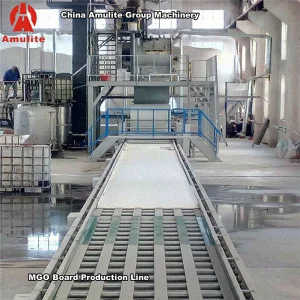
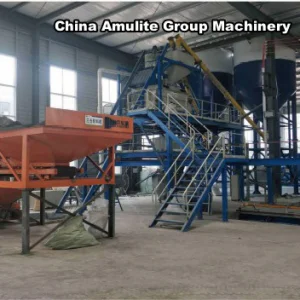
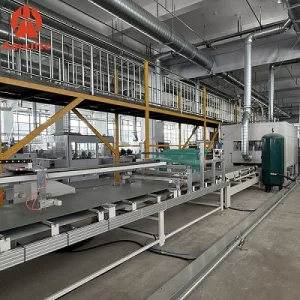
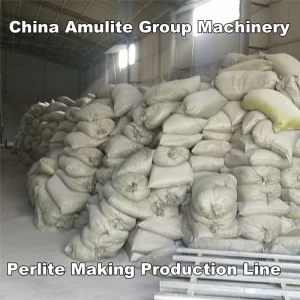
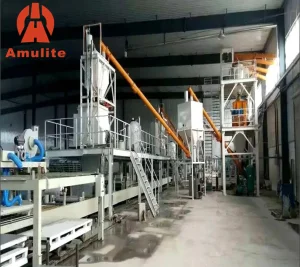
Explore high-capacity production line configurations customized for structural board, thermal insulation, and lightweight masonry manufacturing.
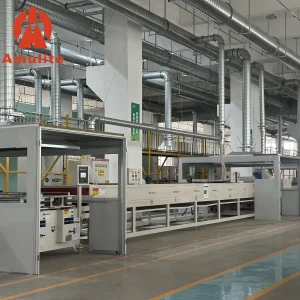
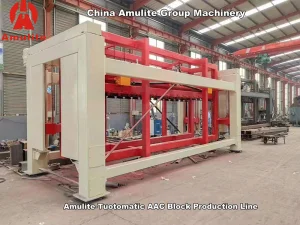
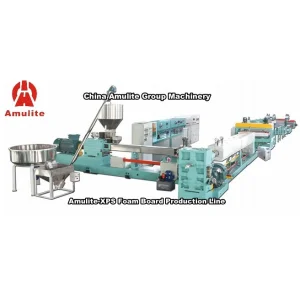
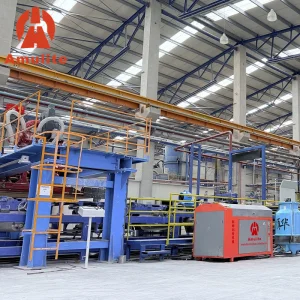
An in-depth analysis of Industrialized Building Systems (IBS), decarbonized panel chemistry, high-yield plant automation, and global supply chain dynamics.
The global construction sector is undergoing a structural transition driven by rising labor costs, strict carbon emissions targets, and the urgent imperative for rapid urban infrastructure expansion. Traditional wet-masonry techniques—characterized by heavy red-brick laying, extensive site plastering, and prolonged drying times—are rapidly being superseded by prefabricated lightweight wall panel systems. Decision-makers seeking to buy lightweight wall panel production lines from verified manufacturers and factories must navigate a sophisticated technical matrix involving binder chemistry, slurry rheology, hydraulic gang-mould design, and automated downstream processing.
Modern wall panel manufacturing encompasses several distinct material categories, each engineered for specific structural, acoustic, and thermal performance thresholds. Understanding these technological variants is fundamental to securing a high ROI on plant capital expenditure (CAPEX):
Engineered using Ordinary Portland Cement (OPC), expanded polystyrene (EPS) beads, fly ash, and specialized foaming surfactants, sandwiched between high-density fiber cement or calcium silicate skin boards. Offers high flexural strength, ultra-low dead load, and superior seismic energy absorption.
Utilizes fine silica sand/fly ash, lime, cement, gypsum, and aluminum powder expansion paste. Cured under high-pressure steam autoclaves (1.2 MPa, 190°C) to form tobermorite crystalline structures, achieving unmatched dimensional stability and thermal resistance.
Produced via continuous slipform extruders or battery mold cars. Internal longitudinal voids reduce self-weight by 35–45% while preserving vertical compression capacity and providing natural utility conduits for electrical and plumbing lines.
In high-capacity automated factories, maintaining a water-to-cement ratio (W/C) between 0.38 and 0.42 within the planetary intensive mixer is crucial. Precise dosing of polycarboxylate ether (PCE) superplasticizers prevents EPS bead flotation while securing early-stage green strength within 120 minutes of initial mold casting.
China's building material machinery ecosystem delivers an unmatched blend of technological maturity, scale economies, customization flexibility, and complete supply chain integration.
Procuring a complete lightweight wall panel factory from leading Chinese original equipment manufacturers (OEMs) yields a 40% to 60% reduction in initial capital outlay compared to European counterparts, without compromising core component quality. Plant owners benefit from top-tier global integrations, including Siemens PLC control architectures, Schneider electrics, SEW-Eurodrive gear motors, and Yuken hydraulic valves.
Chinese machinery plants do not supply rigid "one-size-fits-all" equipment. Process engineering teams conduct comprehensive chemical and sieve analysis of locally available raw materials (pozzolanic fly ash, blast furnace slag, silica sand, crushed marble dust, agricultural rice husk ash). Mix proportions are custom-formulated to maximize local binder usage and eliminate reliance on imported additives.
China's industrial machinery hubs host state-of-the-art CNC gantry machining centers, robotized longitudinal seam welding, and stress-relieving heat treatment furnaces. Mold cars and gang vertical battery machines undergo strict static load and dynamic vibration testing to guarantee structural deflection tolerances stay below 0.5 mm over a decade of continuous duty.
From civil engineering design approval to equipment fabrication, ocean freight shipment, on-site mechanical erection, PLC commissioning, and trial board output, Chinese factory teams complete projects within 90 to 120 days, ensuring rapid time-to-market for project developers.
Discover how IoT control, decarbonization imperatives, functional coating lines, and modular prefabrication are redefining panel plant engineering.
Modern panel lines are transitioning from isolated automation to fully integrated Cyber-Physical Systems (CPS). Internet of Things (IoT) sensor arrays deployed across batching silos, high-shear slurry mixers, hydraulic demolding cars, and curing tunnels transmit real-time telemetry to a central SCADA dashboard. Predictive algorithms dynamically adjust water addition based on aggregate moisture sensors, eliminating human error in slurry density control.
With stringent embodied carbon caps imposed globally, factory owners are incentivized to replace cementitious binders with industrial byproducts. High-performance lightweight panel production lines now accommodate up to 65% low-carbon mineral substitution, using ground granulated blast-furnace slag (GGBS), desulfurization gypsum (FGD), recycled glass micro-spheres, and expanded perlite. This reduces carbon intensity per square meter while maintaining core structural integrity.
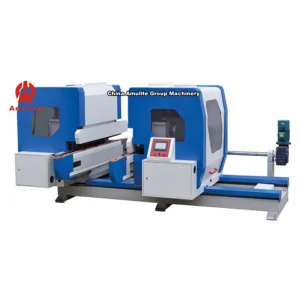
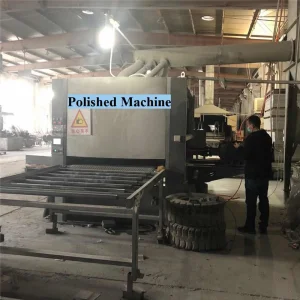
The boundary between raw structural panels and decorative architectural facades is vanishing. Factory automation now incorporates online UV-curing painting lines, automatic 4-edge tongue-and-groove profiling machines, and single/double-face calibration sanders directly downstream from curing tunnels. Panels leave the factory pre-sanded, edge-milled, and coated with hydrophobic or fire-retardant surface treatments ready for immediate jobsite assembly.
An end-to-end overview of the 5 core engineering modules in an automated lightweight wall panel factory.
| Production Phase | Core Equipment Array | Key Technical Parameters | Automation Level |
|---|---|---|---|
| 1. Raw Material Dosing | Loss-in-weight silos, screw conveyors, liquid additive meters, high-shear planetary mixer | Dosing accuracy ± 0.5%, mixer capacity 1.5–3.0 m³, mixing cycle time 3-5 mins | 100% Automated PLC Control |
| 2. Core Board & Panel Casting | Automatic gang vertical mold cars, hydraulic side-openers, EPS core insertion shuttle | Mold car capacity 20-40 panels/batch, hydraulic pressure 16-25 MPa, wall thickness 60-200mm | Semi-Automated / Robotic |
| 3. Curing & Pre-Handling | Thermally insulated curing chambers, automatic ferry transfer cars, steam heat exchangers | Curing ambient 55–70°C, relative humidity > 85%, preliminary strength achieved in 3-4 hours | Automated Conveyance |
| 4. Demolding & Stacking | 90-degree hydraulic mold turners, vacuum board lifters, automated robot arm stackers | Demolding cycle < 90 seconds per car, zero panel edge breakage, auto pallet feeding | Fully Robotic Control |
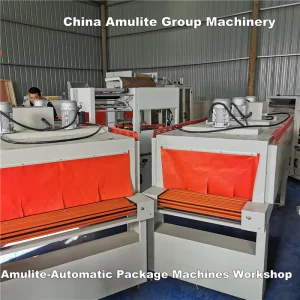
| 5. Finishing & Packaging | High-precision 4-side edge profiling machine, single-face sander, automatic shrink wrapper | Cutting precision ± 0.5mm, profiling speed 15-25 m/min, automatic strapping | 100% Automatic Inline |
Every complete plant configuration is tailored to the customer's intended annual output (typically scaled from 500,000 m² to 3,000,000 m² per annum). Auxiliary systems—including waste-slurry recycling clarifiers, compressed air stations, steam boilers, and dust extraction baghouses—are engineered for zero environmental discharge in full compliance with ISO 14001 environmental standards.
How wall panels manufactured on Chinese automated machinery perform across diverse architectural and climatic environments worldwide.
In dense urban centers like Dubai, Singapore, and Jakarta, non-loadbearing interior wall panels must deliver extreme fire ratings and acoustic privacy. EPS cement panels produced on our machinery achieve a 4-hour Class A1 fire rating (BS EN 1364-1) and an acoustic transmission loss of 52 dB, allowing property developers to optimize usable interior floor space by reducing wall thickness to just 90mm or 100mm.
In high-seismic activity zones across Chile, Peru, and the Philippines, heavyweight brick masonry poses severe structural collapse hazards. Lightweight interlocking tongue-and-groove panels installed with flexible steel clip anchors absorb lateral shear forces efficiently during seismic events, drastically mitigating structural risks in modern residential projects.
In sub-zero winter regions like Kazakhstan, Uzbekistan, and Northern Europe, composite panels featuring integrated XPS/EPS foam cores act as continuous thermal envelopes. With thermal conductivity as low as $\lambda = 0.045 \text{ W/m}\cdot\text{K}$, these panels cut building operational HVAC energy consumption by up to 40% compared to traditional hollow clay block walls.
Essential CAPEX vs. OPEX evaluations, Quality Control standards, and compliance checklist for building material factory investors.
When investing in an automatic lightweight wall panel production plant, financial returns are driven by raw material savings, labor reduction, and panel market premiums. A standard 1,000,000 m²/year capacity line operating at 85% utilization typically delivers complete payback within 14 to 22 months, based on the following average cost dynamics:
Cement, aggregate, fly ash, EPS beads, skin boards, and chemical additives account for approximately 68–74% of total per-panel direct manufacturing cost (COGS).
Automation reduces plant labor headcount from 45 workers on manual casting beds down to 8–12 technicians per shift. Power consumption averages 1.2–1.8 kWh per square meter of panel produced.
Prior to signing equipment procurement contracts, global engineering firms must demand the following verification protocols from the machinery supplier:
Clear, direct answers from our senior process engineers to assist in your plant evaluation and purchasing decision.
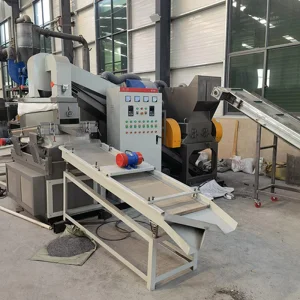
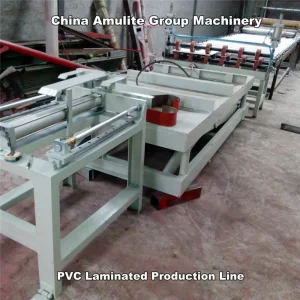
Complete your factory ecosystem with auxiliary crushing, trimming, laminating, and specialized material processing machinery.