The global construction sector accounts for nearly 39% of process-related carbon emissions. Modern commercial and residential developments are under stringent regulatory mandates (such as the EU Energy Performance of Buildings Directive and US LEED v4.1 standards) to phase out heavy, carbon-intensive clay bricks and uninsulated precast concrete blocks. Expanded Polystyrene (EPS) Concrete Sandwich Wall Panels deliver up to 40% reduction in embodied carbon per square meter while serving as a structural thermal barrier.
On-site labor shortages and escalating wage rates have elevated off-site prefabricated construction from an alternative methodology to an operational imperative. EPS sandwich cement wall panel machinery enables factory-controlled production of lightweight, tongue-and-groove interlocking panels. These prefabricated units allow structural installation up to 7 times faster than traditional bricklaying, drastically compressing structural build schedules and shortening real estate capital payback cycles.
With an average deadweight only 1/6th that of solid brickwork (60-90 kg/m² for a 90mm panel), buildings engineered with EPS cement sandwich wall panels experience significantly diminished structural shear loads during seismic events. Concurrently, the encapsulated EPS bead matrix exhibits low thermal conductivity (≤ 0.065 W/m·K), lowering HVAC energy consumption in high-heat and freezing climates alike.
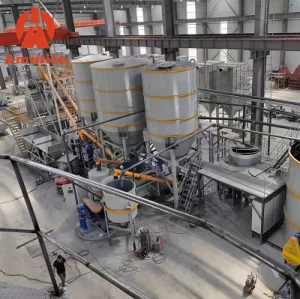
Precise gravimetric dosing of Ordinary Portland Cement (OPC), fly ash, silica sand, and chemical additives. High-shear multi-shaft slurry mixers ensure homogenous distribution before EPS bead injection, preventing bead floating or matrix segregation.
Fluidized bed steam pre-expanders expand raw expandable polystyrene beads to controlled bulk densities (12–25 kg/m³). Secondary aging silos stabilize internal pressure for uniform core formation.
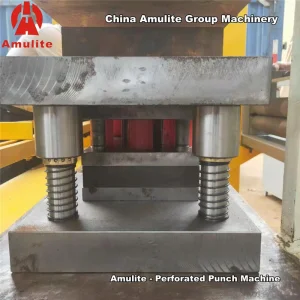
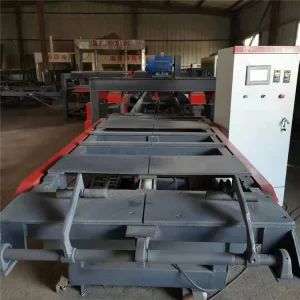
Heavy-duty, precision-engineered vertical mould cars equipped with automatic opening/closing, pneumatic core pulling, and vibratory compaction. Vertical casting guarantees dimensional tolerances within ±0.5mm.
Siemens S7-1500 PLC architecture with real-time SCADA tracking. Monitor slurry viscosity, mould pressure, curing chamber temperature, and cycle time metrics remotely with cloud ERP integration.
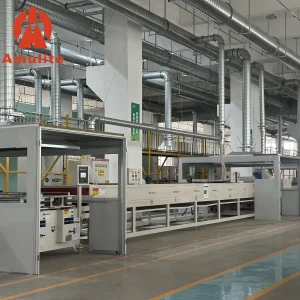
Automated weighing of cement, fly ash, additives & EPS bead pre-expansion.
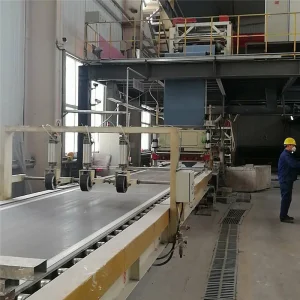
Robotic loading of Calcium Silicate or Fiber Cement Board skins into mould slots.
Slurry-EPS mix injected with high-frequency micro-vibration compaction.
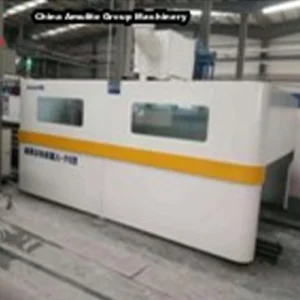
Accelerated thermal hydration in energy-efficient curing tunnels (45–60°C).
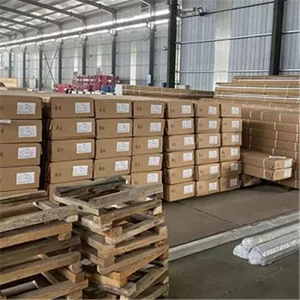
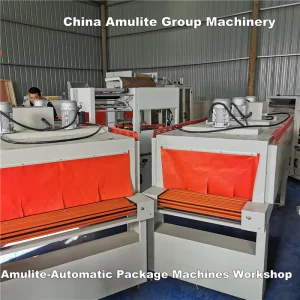
90° hydraulic tilting demoulder, automated edge trimming, and shrink wrapping.
The operational performance of an EPS concrete wall panel making plant relies not only on mechanical robustness but also on chemical formulation compliance. EPS core mix designs typically combine cementitious matrix binders with light cellular inclusions. Below is the technical property matrix achieved by top-tier automated EPS wall panel machinery systems:
| Performance Characteristic | Standard Concrete Wall | Standard AAC Block | Amulite High-Tech EPS Panel | Test Standard Method |
|---|---|---|---|---|
| Dry Density (kg/m³) | 2300 – 2500 | 500 – 700 | 450 – 650 | GB/T 30100-2013 / ASTM C138 |
| Compressive Strength (MPa) | 15.0 – 25.0 | 3.5 – 5.0 | ≥ 5.0 (Core & Board Bonded) | EN 12390-3 / GB 8624-2012 |
| Thermal Conductivity (W/m·K) | 1.30 – 1.50 | 0.13 – 0.16 | ≤ 0.058 – 0.065 | ASTM C518 / ISO 8301 |
| Sound Insulation (STC / dB) | 42 (120mm solid) | 38 (100mm) | 46 – 50 (90mm Panel) | ISO 140-3 / ASTM E90 |
| Fire Endurance Limit | 2 Hours | 3 Hours | ≥ 4 Hours (Non-combustible A1) | GB/T 9978 / BS 476 Part 22 |
| Moisture Absorption Rate (%) | 8.0 – 12.0 | 25.0 – 35.0 | ≤ 3.5 (Hydrophobic Matrix) | ASTM C1185 |
In mega-cities across Southeast Asia and the Middle East, structural engineers mandate lightweight internal non-load-bearing curtain walls. EPS wall panels allow structural engineers to reduce overall floor slab thickness and foundation piling requirements by up to 20%, generating major material savings in structural steel and rebar.
Regions prone to seismic activity (such as South America, Turkey, and the Pacific Rim) require structural building systems that withstand high shear forces without total collapse. Tongue-and-groove interlocking EPS panels anchored with flexural steel dowels offer elastomeric flexural response, mitigating collapse risk in social housing developments.
Industrial warehousing, food-processing hubs, and agricultural cold stores demand rigid thermal boundary layers. EPS sandwich cement panels manufactured with double-sided 5mm calcium silicate board skins function as moisture-impermeable, thermal-break perimeter walls that eliminate condensation bridge channels.
All structural frameworks, pressure vessels, steam piping networks, and electrical control cabinets strictly adhere to EU CE Directive 2006/42/EC and ISO 9001 quality management protocols.
Deploy specialized master mechanics, PLC programmers, and mix-design chemical engineers directly to your plant site for civil foundation verification, equipment assembly, and trial production run-throughs.
Our in-house R&D laboratories conduct material analysis on your local pozzolanic materials (fly ash, bottom ash, volcanic slag, sand grades) to formulate localized cementitious core recipes without requiring expensive imported additives.
Maintain centralized spare-part depots stocking wear plates, pneumatic core valves, high-pressure mixing blades, and PLC modules with expedited 48-hour global air freight delivery.
Transitioning from 100% virgin EPS beads to up to 45% post-consumer recycled expanded polystyrene (rEPS) and bio-based expanding agents. Machinery mixing zones are engineered with specialized anti-static dispersion heads to prevent bead clumping and density variances.
Integrating high-resolution optical infrared camera arrays over post-demoulding conveyors. AI visual inspection algorithms automatically detect edge chips, surface delamination, micro-fissures, and board thickness deviations with sub-millimeter precision before packaging.
Integrating closed-loop thermal condensation recovery and solar thermal steam pre-heaters into the curing tunnel circuit. Reduces boiler gas consumption by up to 35%, assisting building material producers in meeting stringent Net-Zero factory targets.
Annual plant capacity ranges from 100,000 m² to over 2,000,000 m² per year. Capacity is determined by the number of vertical mould cars operating in rotation, the steam boiler output rating, and whether an automated continuous track system is selected versus a stationary batching system.
Our EPS panel machines are engineered to accept Fiber Cement Boards, Calcium Silicate Boards, Magnesium Oxide (MGO) Boards, or can produce solid core panels without facing sheets by applying automated release oil onto precision steel mould plates.
When properly encapsulated within an inorganic Portland cement and fly ash matrix (reinforced with fiber cement facing sheets), the EPS beads carbonize without supporting flame propagation. Panels pass 4-hour non-combustibility testing under GB/T 9978 and BS 476 standards.
A standard 500,000 m²/year facility requires approximately 3,500 m² to 5,000 m² of covered factory space (including raw material storage and cured product stacking). Electrical connected load is roughly 120 kW – 180 kW, plus a 2–3 ton/hour steam boiler.