Explore our foundational plant configurations engineered for extreme durability, precision thickness control, and continuous mass production.
Analyzing Qatar's structural transition toward sustainable, fire-rated, and energy-efficient building materials under Qatar National Vision 2030.
Doha's commercial and industrial landscape is undergoing unprecedented expansion driven by projects in Lusail City, the North Field Expansion, Msheireb Downtown, and the West Bay financial precinct. As Qatar accelerates its infrastructure build-out under Qatar National Vision 2030, demand for high-strength, non-combustible building materials has surged dramatically.
Traditional drywall and gypsum plasterboards frequently underperform in the Arabian Gulf’s hyper-humid coastal atmosphere. This structural limitation has turned fiber cement boards (FCB) and calcium silicate boards (CSB) into the indispensable gold standard for Qatari contractors, architects, and government developers.
Operating building material production lines designed for Doha requires deep technical customization. Summer temperatures routinely exceed 50°C, coupled with relative humidity spikes above 90% and elevated salinity levels along the coast.
Building boards deployed in Doha must achieve strict A1 Class fire ratings under Qatar Civil Defence (QCD) regulations while exhibiting near-zero linear moisture expansion (<0.12%). Turnkey production machinery must deliver autoclaved crystal structures capable of maintaining structural integrity under perpetual thermal cycling.
Technical benchmarks guaranteed across our turnkey Fiber Cement & Calcium Silicate Board manufacturing lines.
The science of non-asbestos fiber cement and high-density calcium silicate board manufacturing.
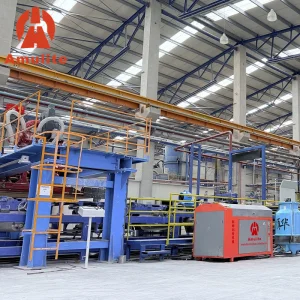
Our advanced plant machinery utilizes refined multi-vat Hatschek sheet-forming processes. Raw material slurries composed of Ordinary Portland Cement (OPC), ground quartz sand ($SiO_2 > 92\%$), selected cellulose fibers, and micro-fillers are continuously mixed to exact specific gravity targets.
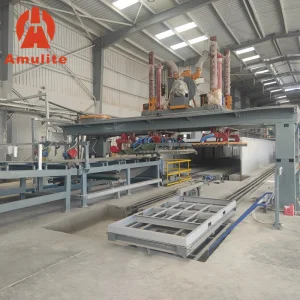
The slurry is picked up by rotating sieve cylinders, forming microscopic green films (0.2–0.3mm thick) transferred onto a continuous felt belt. Multi-stage high-vacuum dewatering boxes strip free moisture, densifying the film before continuous accumulation onto the main forming drum to reach exact targeted thickness (4mm to 30mm).
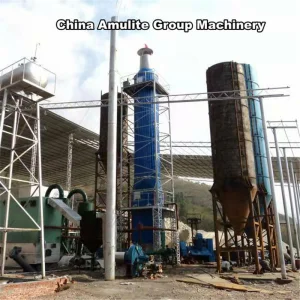
Unlike air-cured cement boards, premium calcium silicate boards undergo high-pressure hydrothermal reaction inside industrial steam autoclaves. Operating at saturated steam pressures between 1.2 and 1.4 MPa (190°C–200°C) for 10 to 14 hours, free silica reacts with calcium hydroxide ($Ca(OH)_2$):
5CaO + 6SiO₂ + 5H₂O → C₅S₆H₅ (Tobermorite Crystalline Matrix)
This hydrothermal synthesis converts soft hydrated lime into rigid Tobermorite crystals, imparting zero moisture movement, extreme dimensional stability, and unyielding flexural strength (bending strength $\ge 14\text{ MPa}$).
| Performance Parameter | Fiber Cement Board (Air-Cured) | Autoclaved Fiber Cement Board | Autoclaved Calcium Silicate Board |
|---|---|---|---|
| Primary Raw Ingredients | Cement, Kraft Pulp, Silica, Fly Ash | Cement, Quartz Sand, Kraft Pulp | Lime, Quartz Powder, Pulp/Glass Fiber |
| Bending Strength (Cross/Parallel) | 10 - 14 MPa | 14 - 18 MPa | 12 - 16 MPa |
| Density Range (g/cm³) | 1.10 - 1.30 | 1.25 - 1.50 | 0.95 - 1.25 |
| Thermal Conductivity (W/m·K) | 0.24 - 0.30 | 0.20 - 0.25 | 0.12 - 0.18 (High Insulation) |
| Fire Endurance Standard | BS 476 Part 6/7 Class 0 | EN 13501-1 Class A1 | EN 13501-1 Class A1 Non-combustible |
| Doha Project Suitability | Interior Partitions, Sub-floors | Exterior Cladding, Facades | Fire-rated Shaft Walls, Ceilings |
Combining heavy engineering capability, custom machine fabrication, and dedicated Middle East localization support.
Acquiring building material manufacturing lines from Western European OEMs often entails prohibitive initial capital expenditures and extended lead times. Leading Chinese manufacturers deliver comparable or superior operational precision—utilizing Siemens PLC controls, Schneider electrics, and Rexroth hydraulics—at a 35% to 50% CapEx reduction.
Every line is custom-designed with modular heavy structural frames, heavy-duty CNC-machined forming drums, and pressure vessel-certified autoclaves built to ISO 9001 and ASME standards, allowing cost-effective expansion in Doha’s industrial hubs.
Deployment success relies on seamless site integration. We provide comprehensive local services tailored to Qatar's operating environment:
Enabling Qatari developers to build faster, safer, and more resilient structures.
Doha's vertical skyline demands strict compartmentation to stop fire spread. Low-density calcium silicate boards (800–1000 kg/m³) produced on our machinery achieve up to 4-hour fire endurance ratings under standard ISO 834 fire curves, making them essential for elevator shafts, emergency stairwells, and service ducts in West Bay towers.
Severe UV radiation and salt-laden ambient vapor along Doha's Corniche cause paint flaking and corrosion in traditional cladding. Autoclaved high-density fiber cement boards (1.30–1.50 g/cm³) provide superior impact resistance, hydrophobic performance, and color retention when coated with fluorocarbon (PVDF) finishes.
Underground metro networks, utility tunnels, and subterranean parking structures in Lusail require moisture-impermeable, non-decaying ceiling and wall linings. Fiber cement boards manufactured via our double-pressing hydraulic systems remain structurally stable even under permanent groundwater contact.
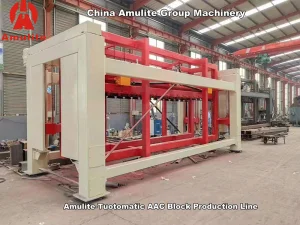
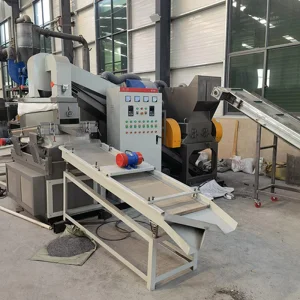
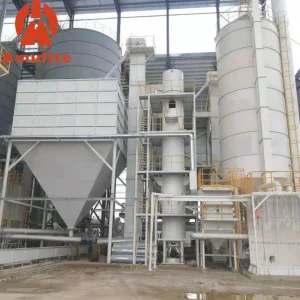
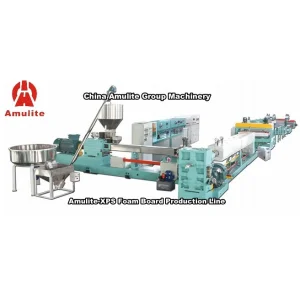
Explore our extended series of building material production lines, block plants, and material processing systems engineered for global deployment.
A proven engineering framework from site evaluation to commercial output.
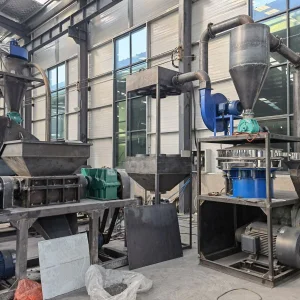
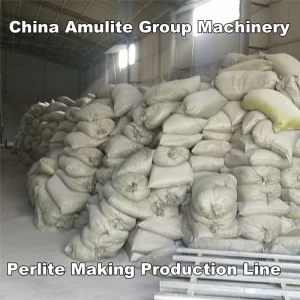
Every plant investment begins with rigorous lab analysis of local Qatari raw materials. Investors send samples of quartz sand, cement, lime, and fly ash to our central engineering laboratory. We determine optimal wet-grinding fineness ($>90\%$ passing 200 mesh) and establish precise hydrothermal curing curves before committing to machine sizing.
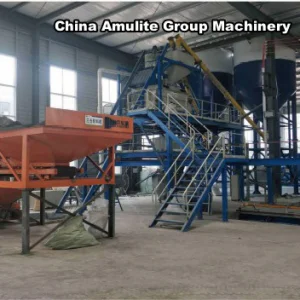
Machinery manufacturing is executed in our heavy machine shop. Forming vats, hydraulic stackers, pre-curing tunnels, cutting machines, and automated de-stackers undergo mechanical assembly and factory dry runs. Autoclaves are manufactured to ASME VIII standards and subjected to non-destructive ultrasonic and hydrostatic pressure testing prior to shipment to Hamad Port.
Upon arrival in Doha’s Industrial Area or Ras Laffan zone, our resident engineers oversee foundation bolt setting, pipework integration, electric cable wiring, and PLC network integration. We execute trial production runs, adjusting slurry viscosity and autoclave vacuum cycles until the line reaches stable rated output and compliant EN 12467 board quality.
Expert answers addressing operational, financial, and technical inquiries.
Contact our engineering specialists today to receive a complete turnkey proposal, including custom equipment layout, utility load consumption calculations, raw material formulation guidance, and CapEx investment analysis.
Send Inquiry Now