Direct OEM engineered machinery solutions for surface finishing, panel processing, and automated building product lines.
Quantitative benchmarks demonstrating the impact of high-efficiency OEM paint machinery in automated production ecosystems.
Analyzing the technological transition from manual spray booths to intelligent, closed-loop automated coating systems.
The global industrial manufacturing landscape is experiencing a structural shift in surface treatment and automated coating application. For tier-1 manufacturers, architectural substrate fabricators, automotive OEM suppliers, and heavy equipment producers, selecting top-tier OEM Paint Machine Suppliers & Companies is no longer merely an equipment procurement decision. It has become a strategic imperative linked directly to operational throughput, regulatory compliance, environmental sustainability metrics, and total cost of ownership (TCO).
Historically, industrial painting relied heavily on manual air-atomized spray booths or rudimentary mechanical curtain coaters. These legacy systems suffered from severe paint overspray, high Volatile Organic Compound (VOC) emissions, non-uniform film thickness, high labor dependencies, and substantial material waste. Modern industrial paint machines have evolved into highly integrated smart systems featuring multi-axis articulated robots, servo-driven reciprocating spray arms, precision roller coaters, vacuum coaters, and automated inline UV/IR curing tunnels.
Unlike standard generic spray booths, specialized OEM paint machines utilize laser profiling arrays prior to the spray zone. This continuous scanning maps the 3D surface topography of incoming panels or complex components, dynamically calculating atomizing pressure and gun distance to eliminate edge build-up and achieve micro-level coating uniformity across all board densities.
Evaluating enterprise-level buying criteria across major industrial sectors requiring high-capacity paint machinery.
Procurement teams and engineering directors at large-scale manufacturing facilities evaluate OEM paint machine suppliers against rigorous operational parameters. Depending on the end-use substrate—whether fiber cement boards, calcium silicate panels, metal composite siding, wood-plastic composites (WPC), or extruded plastic profiles—the functional configuration of the painting machinery changes significantly.
| Substrate Industry | Dominant Painting Technology | Key Buyer Metrics (KPIs) | Critical OEM Machinery Features |
|---|---|---|---|
| Architectural Fiber Cement & Cement Panels | Reciprocating Sprayers, Roller Coaters, UV Curing Lines | Weatherability, scratch resistance, high line speeds (30-60 m/min), low cost per m² | Heavy-duty dust removal blowers, pre-heating tunnels, multi-stage roller coaters, high-intensity UV curing |
| Embossed Metal Composite Exterior Panels | Multi-Color Roller Coaters, Continuous Spray Lines | Color consistency, deep groove penetration, anti-corrosion layer adhesion | Groove-following spray nozzles, high-precision reverse roller coaters, precise film thickness control (±1μm) |
| Automotive & Components Manufacturing | Robotic Spraying Arms, Electrostatic Rotary Bells | First-pass yield (>98%), flawless surface gloss, zero particle contamination | Class 100 cleanroom enclosure, electrostatic charging control, real-time viscosity regulation |
| Furniture, Doors & Engineered Wood | Curtain Coaters, Vacuum Edge Painting, Reciprocating Sprayers | Edge-wrapping coating quality, minimal overspray, rapid color changeover | Paint recovery conveyor belts with Teflon scrapers, vacuum edge-sealing modules, dust-proof drying beds |
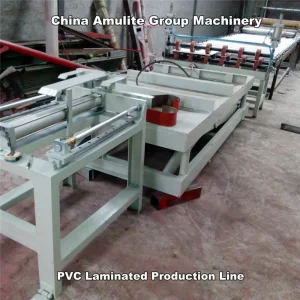
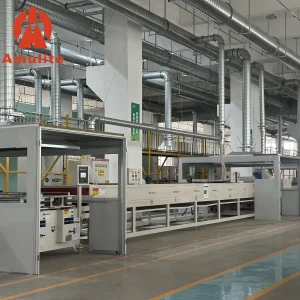
Modular line architectures engineered for continuous industrial coating, drying, and surface treatment application.
Equipped with dual or quad arm servo-driven reciprocators, operating at speeds up to 120 m/min. Features photoelectric barrier sensors that activate individual spray guns only when the substrate is present, eliminating spray waste between board gaps.
Includes single-roll, double-roll, and reverse roller coaters with laser-engraved chrome doctor rollers and durable rubber application rollers. Perfect for applying primers, basecoats, and clear topcoats with ultra-precise wet film thickness from 10 to 100 g/m².
Integrates electronic ballast UV lamp stations (Gallium and Mercury lamps) with stepless intensity adjustment (10%-100%). Coupled with jet-air convection drying and near-infrared (NIR) flash-off tunnels for instantaneous drying of water-based and solventless UV coatings.
Pioneering advancements in AI vision control, zero-emission coating technologies, and autonomous smart factory integration.
As smart manufacturing principles spread globally under Industry 4.0 guidelines, OEM paint machine builders are integrating advanced digital control layers into physical mechanical structures. The paint machine of the next decade is no longer an isolated mechanical device, but an intelligent node connected to cloud-based manufacturing execution systems (MES).
High-resolution line-scan cameras combined with AI visual recognition algorithms inspect 100% of coated board surfaces post-curing. The computer vision system immediately identifies micro-defects such as pinholes, orange peel, dust spots, edge sags, or color variations (ΔE > 0.5). If a defect pattern emerges, the AI controller automatically corrects gun air pressure, fluid flow rate, or conveyor speed without human intervention.
Incorporating vibration telemetry sensors on atomizing turbines, thermal sensors on UV transformer cores, and pressure transducers across fluid filters allows the machine PLC to build a live "Digital Twin." Potential pump failures, nozzle clogs, or lamp degradations are predicted days before an unplanned line stop occurs, maximizing total effective equipment performance (OEE).
Fluid delivery circuits are engineered with electro-polished 316L stainless steel pipes, non-shear diaphragm pumps, and temperature-controlled circulation loops. This ensures stable fluid viscosity when spraying sensitive water-borne acrylics or high-viscosity 100% UV-curable polyurethane dispersions without inducing fluid micro-foaming or shearing.
Ensuring compliance with international safety, environmental, and electrical engineering standards.
Industrial painting processes frequently involve volatile solvent vapors or combustible fine mists. Consequently, global compliance and safety engineering represent crucial benchmarks when choosing an OEM paint machine supplier.
Top OEM paint machine suppliers provide comprehensive lifecycle support: Factory Acceptance Testing (FAT) using customer-supplied liquid coatings and substrate samples prior to packing; followed by Site Acceptance Testing (SAT), mechanical leveling, electrical integration, chemical formulation tuning, and local workforce operator certification on-site.
Direct technical answers addressing the key queries of procurement engineers and plant directors.
Reciprocating sprayers use automated moving arms mounted with spray guns to atomize liquid paint onto flat or structured 3D workpieces (such as embossed wall panels or louvers). Roller coaters use precision chrome and rubber rollers to physically transfer a uniform film onto flat sheet substrates (such as flat fiber cement or wood panels). Roller coating achieves near 100% material utilization, whereas reciprocating sprayers offer superior coverage for textured or grooved surfaces.
Coating thickness control depends on the machine type. In roller coaters, thickness is adjusted to micro-millimeter tolerances by setting the gap between the doctor roller and application roller via digital handwheels or servo motors. In spray machines, thickness is controlled by regulating line conveyor speed, fluid pump delivery pressure, atomization air pressure, nozzle orifice size, and reciprocator stroke speed.
Yes, provided the machine is engineered with compatible fluid lines and safety systems. Water-based paints require stainless steel (SS316) fluid passages and corrosion-resistant pumps, along with specialized IR/hot-air drying tunnels. Solvent-based paints require explosion-proof (ATEX/Ex-certified) electrical components and effective VOC exhaust venting. Dual-circuit systems allow seamless switching between coating formulations.
Daily maintenance involves clearing spray nozzle tips, cleaning fluid recovery scrapers, checking dry-filter media or water-curtain sludge levels, and inspecting conveyor belt scrapers. Weekly maintenance includes flushing paint supply lines, checking drive belt tension, lubricating reciprocator guide rails, and inspecting UV lamp reflector cleanliness to ensure consistent radiation intensity.
Automated lines minimize waste through several methods: 1) Optical shape-recognition sensors that stop spraying in empty gaps between boards; 2) Continuous Teflon conveyor belts equipped with motorized doctor blades that scrape oversprayed liquid paint into recovery tanks; 3) Electrostatic spray technology that charges paint particles to attract them directly to grounded workpieces.
Standard industrial UV coating lines for flat panel substrates operate at linear speeds ranging from 15 m/min up to 60 m/min, depending on substrate density, coating weight, and UV curing lamp wattage. High-speed continuous lines incorporate multi-station UV lamps to ensure complete photopolymerization at maximum conveyor velocity.
Explore our full range of turnkey manufacturing, panel pressing, recycling, and high-capacity processing equipment.