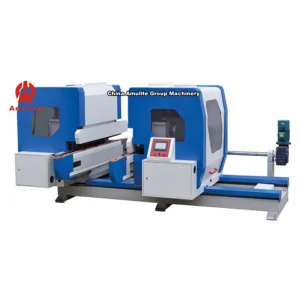
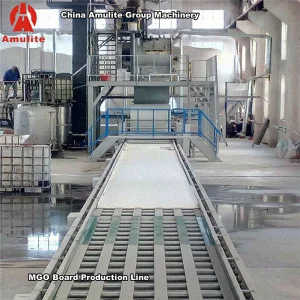
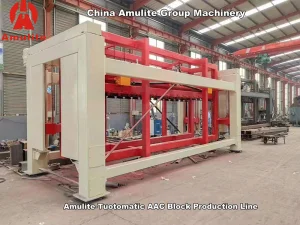
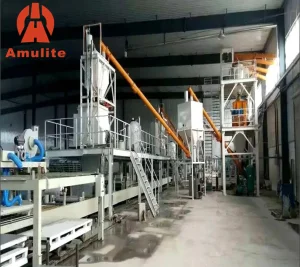
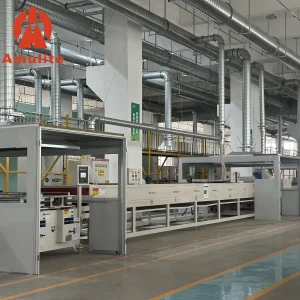
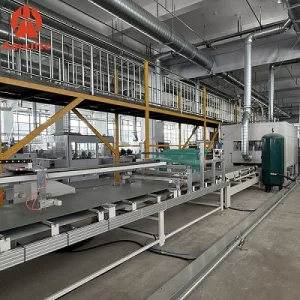
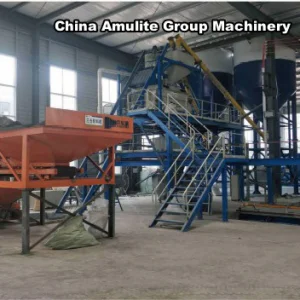
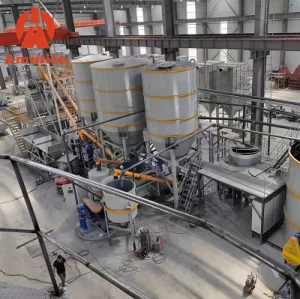
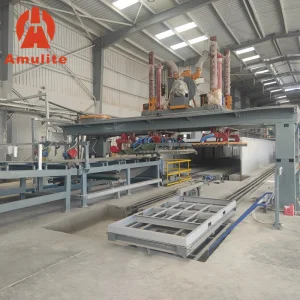
Explore our primary machinery systems, engineered for maximum operational uptime, exact dimensional control, and low thermal energy consumption.
Calcium silicate boards represent a cornerstone of modern fireproof, moisture-resistant, and high-strength architectural construction. As global building codes tighten around fire safety (ASTM E119, BS 476, EN 13501-1 Class A1) and structural durability, the demand for high-precision, OEM-engineered calcium silicate board production lines has reached unprecedented levels.
Engineered for standard high-density architectural boards (1.2–1.5 g/cm³). Operating under 1.0–1.2 MPa autoclave pressures at 180°C–190°C, creating interlocking blade-like crystals that deliver superior flexural strength (>16 MPa) and dimensional stability.
Designed for ultra-lightweight industrial thermal insulation boards (0.2–0.4 g/cm³). Cured under elevated autoclave parameters (1.4–1.6 MPa, 200°C), yielding extreme thermal resistance up to 1000°C for metallurgical and petrochemical applications.
Our advanced Hatschek forming machines utilize unbleached kraft wood pulp, synthetic PP/PVA fibers, and wollastonite reinforcement. Fully compliant with strict European REACH and North American health regulations.
Navigating the global capital expenditure landscape for non-metallic building material plants requires an understanding of localized compliance standards, raw material availability, and total cost of ownership (TCO).
| Target Region | Primary Board Application | Key Technical Procurement Criteria | Recommended Line Configuration |
|---|---|---|---|
| Middle East & GCC | High-rise core walls, exterior soffits, passive fire protection | Extreme heat resilience, low moisture absorption (<10%), fire resistance (240 min) | High-Capacity Hatschek Line with 1.2 MPa Autoclave & UV Surface Coating System |
| Southeast Asia | Interior ceiling tiles, lightweight partition walls, wet-area backer boards | High humidity stability, zero swelling, anti-fungal properties, termite resistance | Standard Hatschek Line with Automatic Punching & Edge Profiling Integration |
| Europe & North America | Prefabricated modular housing, ventilated facades, industrial insulation | LEED v4.1 compliance, EPD certification, low embodied carbon, 100% Non-Asbestos guarantee | Industry 4.0 Energy-Recycling Line with Fly-Ash Slurry Utilization Module |
| Latin America & Africa | Low-cost housing partitions, acoustic ceilings, commercial cladding | Low CapEx per m², ability to utilize low-grade silica sand, ease of manual operator control | Modular Flow-On or Compact Hatschek Line with Semi-Automated Stacking |
The shift from traditional semi-manual board manufacturing to fully integrated digital factories has redefined production economics. Chinese original equipment manufacturers (OEMs) have pioneered the integration of AI-driven slurry monitoring, automated robotic transfer, and closed-loop thermal management.
Legacy sheet-forming machines suffer from board-to-board thickness variances caused by fluctuating slurry viscosity. Our Industry 4.0 lines incorporate real-time ultrasonic density sensors and automated micro-adjusting press rollers. This system continuously monitors slurry concentration in the vat, adjusting cylinder rotation speeds and vacuum pressure dynamically to maintain a tight ±0.1mm thickness tolerance across a 1.22m x 2.44m board width.
Energy cost accounts for up to 35% of total operational expenditure in autoclaved board plants. Our proprietary flash-steam heat recovery system captures high-pressure exhaust steam during autoclave depressurization. This thermal energy is redirected to preheat boiler feed water and power the pre-curing tunnel radiators, reducing overall plant natural gas or coal consumption by up to 28% per thousand square meters of board produced.
All heavy machinery frames, forming vats, and press rollers undergo stress-relieving heat treatment and precision CNC gantry milling in our Hebei manufacturing facility to ensure zero frame distortion under continuous 24/7 load.
Full integration with Siemens S7-1500 PLCs and WinCC SCADA interfaces. Operators can monitor raw material dosing, vacuum levels, autoclave pressure curves, and error diagnostics from a central control hub or mobile telemetry.
From raw steel procurement to electrical cabinet assembly and pressure vessel certification, 100% of core components are engineered and assembled under one roof, guaranteeing rapid spare-part availability and global dispatch.
A turn-key calcium silicate board factory consists of five interconnected engineering zones. Each stage is designed for maximum material recovery, minimal dust emissions, and zero un-recycled water discharge.
Automated weighing of silica sand flour (325 mesh), quicklime (CaO >85%), Portland cement, pulp fibers, and additives. Wet ball-milling ensures optimum quartz particle size for reactivity.
Dilute slurry (5-8% solids) is fed into 3 to 5 agitation vats. Rotating mesh cylinders deposit paper-thin film layers onto a felt belt, wrapped onto a accumulator roll until desired thickness is reached.
High-pressure hydraulic press (up to 7,000 tonnes) dewaters and compacts green boards. Sheets enter a 50°C–60°C humidity-controlled tunnel for 4–6 hours to gain green handling strength.
Palletized green boards are moved into saturated steam pressure vessels at 1.0–1.2 MPa for 10–12 hours. This step locks in the chemical crystalline structure, eliminating post-installation shrinking.
Calcium silicate boards manufactured on our machinery lines serve diverse, high-specification sectors across global markets.
High-density boards (1.3–1.5 g/cm³) engineered for rear-ventilated facades. Exceptional wind-load resistance, freeze-thaw durability, and dimensional stability make them an optimal backing substrate for fluorocarbon or UV-cured coatings.
Medium-density smooth boards utilized in pharmaceutical plants and surgical suites. Features zero volatile organic compound (VOC) emissions, high impact strength, and resistance to aggressive chemical disinfectants and chlorine wipes.
Low-density Xonotlite boards installed as backup insulation in steel ladles, cement kilns, and glass furnaces. Operates continuously at 1000°C with thermal conductivity as low as 0.055 W/(m•K).
Direct technical answers from our engineering directorate to assist buyers, project engineers, and factory investors during initial feasibility studies.
Complete your building material manufacturing ecosystem with our specialized processing, recycling, and finishing production lines.