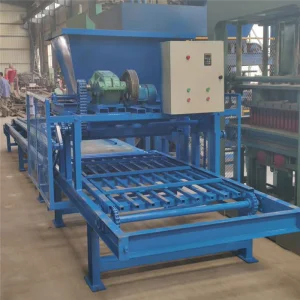
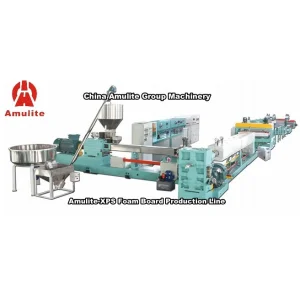
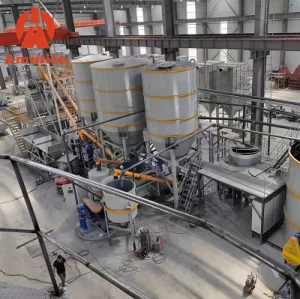
Explore our core engineering hardware and turnkey production lines designed for high-capacity, low-energy building material manufacturing.
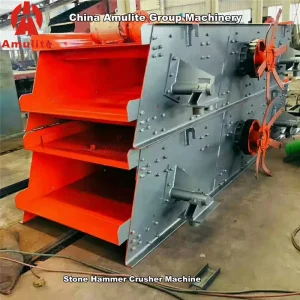
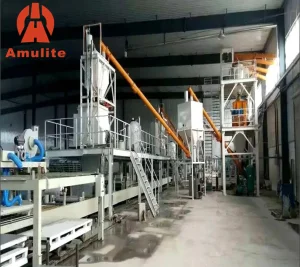
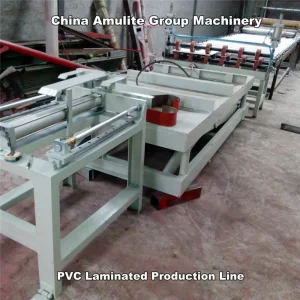
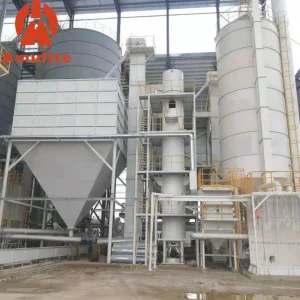
The global construction sector is undergoing a paradigm shift toward off-site industrial prefabrication, driven by strict green building mandates, labor shortages, and demanding thermal efficiency regulations. Within lightweight wall partition technologies, Expanded Polystyrene (EPS) Sandwich Cement Wall Panels have established themselves as the premier modern building material for commercial, residential, and industrial applications.
An advanced EPS sandwich wall panel machine enables manufacturing plants to produce composite lightweight wall elements consisting of fiber-cement or calcium-silicate outer facings and a core matrix of expandable polystyrene beads, Portland cement, fly ash, and proprietary chemical admixtures. The resulting structural elements provide superior strength-to-weight ratios, exceptional acoustic damping, low thermal conductivity, and high fire resistance.
Information Gain Metric: Traditional masonry walls (red clay brick or heavy concrete block) impose dead loads of 240–360 kg/m² and require labor-intensive wet plastering. Modern high-density EPS sandwich wall panels produced on automated battery mold lines weigh only 55–85 kg/m² while cutting installation speed by over 400%.
As governments worldwide accelerate net-zero carbon building standards, investment in modern EPS wall panel machinery represents a capital-efficient pathway for construction material suppliers, real estate developers, and infrastructure conglomerates to capture growing market share in prefab building components.
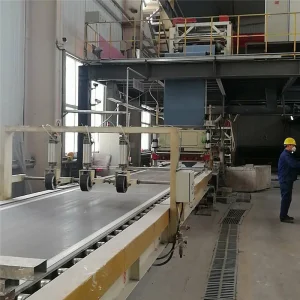
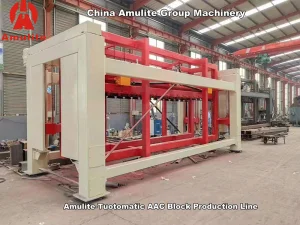
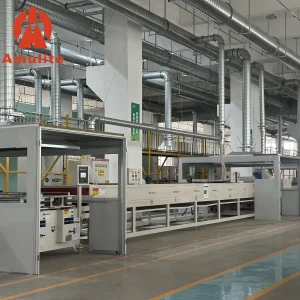
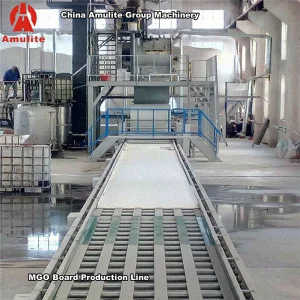
A high-efficiency EPS sandwich cement panel manufacturing plant integrates mechanical, hydraulic, pneumatic, and automated PLC control subsystems. China Amulite Group’s engineering framework divides the production process into six fully integrated process modules:
Controlled batching of raw expandable polystyrene resin beads. Our closed-loop primary and secondary steam pre-expanders achieve precise bulk density control ($\pm 0.5 \text{ kg/m}^3$), essential for consistent structural core performance and thermal isolation ratings.
Dual-shaft planetary slurry mixers ensure homogenous blending of cementitious binders, fly ash micro-spheres, specialized foaming agents, water-reducing agents, and recycled EPS beads without causing physical damage to cell walls.
Automated vertical mold cars feature high-grade CNC-machined steel side plates with hydraulic clamping mechanisms. Fiber cement or calcium silicate surface boards are inserted via mechanical suction arms prior to pressurized slurry injection.
Accelerated chemical hydration occurs within temperature and humidity-monitored curing tunnels. Precise hydraulic demolding systems eliminate surface micro-cracking and panel corner chipping during mechanical extraction.
High-precision multi-blade four-edge trimming and profiling units machine male-female tongue and groove joint profiles into panel borders, guaranteeing seamless interlocking during field installation.
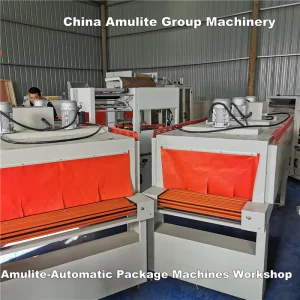
Industrial robotic gantries palletize finished EPS cement panels, which are then passed through automated stretch-hood shrink wrapping machinery for weather-proof export shipping and jobsite storage.
| Performance Parameter | Standard EPS Wall Panel (Amulite High-Spec) | Autoclaved Aerated Concrete (AAC) | Hollow Core Concrete Slab |
|---|---|---|---|
| Dry Bulk Density (kg/m³) | 550 – 680 kg/m³ | 525 – 700 kg/m³ | 1100 – 1400 kg/m³ |
| Compressive Strength (MPa) | ≥ 5.0 MPa | 3.5 – 5.0 MPa | ≥ 7.5 MPa |
| Thermal Conductivity (W/m·K) | 0.058 – 0.075 W/m·K | 0.13 – 0.16 W/m·K | 0.45 – 0.60 W/m·K |
| Acoustic Isolation (90mm panel) | 42 – 48 dB | 38 – 41 dB | 36 – 39 dB |
| Installation Output (m²/man-day) | 35 – 50 m² | 15 – 20 m² | 8 – 12 m² |
Because climate conditions, building codes, and labor availability vary around the world, EPS sandwich panel production systems must be engineered with flexibility in mind. Below are the primary deployment scenarios observed across global markets:
Primary Markets: Middle East (UAE, KSA), Southeast Asia (Vietnam, Indonesia), Latin America.
In high-rise residential towers and commercial office complexes, reducing structural weight directly scales down total foundation steel and concrete requirements. EPS sandwich panels serve as non-load-bearing internal division walls. Their smooth fiber cement surface allows immediate painting or tile adhesion without plastering, saving up to 30 days of internal finishing per project.
Primary Markets: Africa (Nigeria, Kenya), South Asia, Island Nations.
For government housing programs and emergency relief projects, rapid assembly speed is paramount. Interlocking tongue-and-groove EPS panels can be erected with lightweight steel framing without requiring heavy crane infrastructure. The high thermal resistance ($\lambda = 0.058 \text{ W/m}\cdot\text{K}$) significantly reduces air conditioning load in tropical climates.
Primary Markets: Eastern Europe, Central Asia (Uzbekistan, Kazakhstan).
With specialized water-repellent mortar formulas and high-density EPS core configurations, panels act as insulated thermal envelopes for cold storage warehouses, agricultural processing centers, and cleanrooms, providing continuous vapor barriers and moisture resistance.
Investing in building material machinery requires evaluating the supplier’s long-term manufacturing capacity, spare parts ecosystem, and quality assurance system. China Amulite Group leverages Hebei’s world-class industrial machinery cluster to deliver unmatched engineering quality and cost-efficiency.
Unlike assembly shops that outsource structural fabrication, Amulite executes laser cutting, heavy plate bending, robotic welding, stress-relief heat treatment, and precision boring within our 100,000 m² manufacturing plant. This guarantees exact geometric tolerances on all vertical mold battery cars.
Critical automation and hydraulic systems incorporate world-class suppliers: Siemens S7-1500 PLCs, Schneider Electric power controls, AIRTAC pneumatic components, and Yuken hydraulic valve blocks. Overseas operators can source replacement electronic components locally without downtime.
Every complete line undergoes mechanical dry-run testing, hydraulic pressure endurance checks, and PLC signal mapping prior to factory release. Third-party inspection teams (SGS, TÜV, BV) are routinely welcomed on-site to verify quality before container loading.
Acquiring an EPS sandwich wall panel line extends far beyond receiving machinery hardware—it requires complete process transfer, local raw material calibration, and compliance with local building standards.
Amulite machinery and final panel product lines comply with international safety and performance specifications:
Technical and commercial answers addressing common engineering inquiries from project investors, plant managers, and procurement leads.
A standard high-performance formula consists of 35–45% Ordinary Portland Cement (OPC 42.5N/R), 30–40% Fly Ash or Fine Quartz Sand powder, 8–12% expanded EPS beads (density 12–15 kg/m³), 8–10% water, and 1.5–2.5% chemical additives (accelerators, water reducers, and air-entraining agents). Facing boards are typically 4.5mm or 5mm fiber cement or calcium silicate sheets. Our chemical engineers customize formulas on-site based on locally available raw materials to optimize cost while exceeding target strength requirements.
Vertical battery mold lines offer significant operational advantages over horizontal systems: they consume 70% less floor space, yield two smooth flat surfaces simultaneously using pre-loaded face sheets, allow double-sided filling per mold slot, and minimize air void entrapment. Horizontal lines require larger factory footprints, higher mold carrier investments, and extensive surface smoothing labor.
Panels produced with calcium-silicate or fiber-cement skins and a cement-EPS core reach Class A1 non-combustible ratings under international building standards. A standard 100mm thick panel achieves over 4 hours of structural integrity and thermal insulation fire endurance under testing conditions compliant with BS EN 1363-1 and ASTM E119.
Cement hydration is temperature-sensitive. In cold climates (below 15°C), we integrate closed steam heating pipes into the vertical battery mold cars and curing rooms to maintain demolding cycles within 3 to 4 hours. In warm climates (above 30°C), hydration accelerators are adjusted to prevent premature slump loss during slurry pumping. This allows a 24-hour multi-shift output regardless of ambient weather.
Based on typical global raw material prices and market selling rates of $14 to $22 per square meter, a well-managed 500,000 m²/year plant generally achieves full payback on capital equipment investment within 12 to 18 months of operating at 70%+ capacity, thanks to low labor requirements (only 8-12 operators per shift) and minimal waste recycling.
In addition to deploying our global field engineering staff directly to your site, all Amulite lines come equipped with remote IoT diagnostic modules connected directly to the Siemens PLC. This allows our control team in China to conduct live software updates, troubleshoot sensor inputs, and guide your local maintenance crew via AR video support in real-time.
Explore our extended catalog of specialty panel lines, block machines, and processing equipment.