Explore high-capacity automated production machinery engineered for global building envelope systems.
The structural shift toward sustainable, rapid-assembly, and energy-efficient building envelopes.
The global construction equipment sector is undergoing a paradigm shift driven by stringent thermal conservation mandates, net-zero carbon goals, and the accelerated adoption of off-site prefabricated construction. At the focal point of this transformation are modern Sandwich Panel Production Line Factories. Industrial insulated panels—comprising structural metal or cementitious facings combined with advanced core insulating materials such as Polyisocyanurate (PIR), Polyurethane (PU), Expanded Polystyrene (EPS), and Mineral/Rock Wool—have evolved from simple cladding components into highly engineered structural building envelopes.
According to recent industrial procurement analytics, the global market demand for continuous sandwich panel machinery is projected to expand at a CAGR of 6.8% through 2030. This growth is heavily anchored in commercial cold-chain logistics, microelectronic cleanroom facilities, modular data centers, and heavy industrial warehousing. EPC contractors and plant investors no longer look merely for machinery vendors; they seek integrated process engineering partners capable of delivering continuous lamination stability, minimal material loss, and high thermal efficiency ($\lambda$-values as low as $0.018\text{ W/m}\cdot\text{K}$).
Analyzing the mechanical engineering, chemical foaming, and double-belt precision required for high-yield operations.
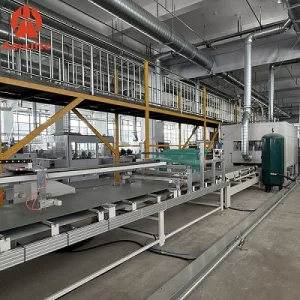
Modern production lines utilize dual hydraulic expansion decoilers paired with automatic strip splicers to enable uninterrupted roll forming. Precision cassette-type roll-forming stands allow fast profile changing between wall, roof, and concealed-fastener geometries with sub-millimeter sheet alignment tolerances.
Using 4-component high-pressure axial metering pumps and oscillating multi-component mixing heads, polyurethane and PIR formulations are applied with micro-gram accuracy. Pentane-blowing systems are integrated with sophisticated gas detection and explosion-proof ventilation protocols.
The core structural integrity depends on the length and precision of the double-belt conveyor (ranging from 24m to 42m). Precision-ground steel slat plates heated via hot-air circulation maintain uniform cross-sectional polymerization pressure, preventing panel delamination and surface blistering.
Selecting the optimal equipment configuration requires balancing capital investment (CAPEX) with target production volume and core material versatility. Below is a comparative breakdown established by leading process engineers:
| Engineering Metric | Fully Continuous PIR/PU Line | Mineral/Rock Wool Hybrid Line | Semi-Automatic Moulding Line |
|---|---|---|---|
| Annual Capacity Output | 1,500,000 to 3,500,000 m² | 800,000 to 2,000,000 m² | 150,000 to 400,000 m² |
| Line Speed Range | 6.0 – 35.0 m/min | 3.0 – 15.0 m/min | Batch operation cycles |
| Core Density Uniformity | ± 1.5 kg/m³ (Ultra-High) | ± 2.5 kg/m³ (Automated Slicing) | ± 4.0 kg/m³ (Manual Insertion) |
| Fire Resistance Class | B1 / B2 / PIR Non-combustible | Class A1 Non-combustible | B2 / B3 Dependent on core |
| PLC Automation Level | Siemens S7-1500 + SCADA IoT | Integrated Servo Synchronous | Basic HMI Push-Button Control |
How Chinese machinery manufacturers deliver world-class structural integrity, reduced lead times, and economic ROI.
In the global market for heavy industrial machinery, China’s manufacturing ecosystem has transitioned from low-cost assembly to high-precision engineering leadership under Industry 4.0 initiatives. Leading Chinese Sandwich Panel Production Line Factories utilize advanced CNC gantry machining centers, robotic laser welding cells, and automated ultrasonic non-destructive testing (NDT) to fabricate double-belt slats and roll-forming dies.
The primary competitive edge of Chinese equipment lies in supply chain consolidation and localized component integration. By leveraging deep regional ecosystems in steel fabrication, hydraulic valve manifolds, and industrial electronics, Chinese equipment manufacturers shorten delivery lead times from the Western industry standard of 12–14 months down to just 90–120 days—without compromising on component quality. Standard integration of global brands such as Siemens PLC systems, Schneider electrics, Rexroth hydraulics, and SEW-Eurodrive gearboxes ensures turnkey compatibility across European, American, and Middle Eastern electrical grids.
Machinery engineered in compliance with EU CE directives, ISO 9001 quality systems, and FM Global building panel safety protocols, facilitating smooth customs clearance and local operational licensing.
Factory 4.0 controllers incorporate secure VPN edge gateways allowing remote diagnostic troubleshooting, predictive motor vibration analytics, and real-time raw material consumption logging.
By optimizing drive motor power, incorporating thermal energy recovery from foaming tunnels, and minimizing adhesive overspray, Chinese lines lower per-square-meter operational costs by up to 25%.
Tailoring machine specifications to meet diverse geographical climate zones and functional requirements.
The versatility of a continuous Sandwich Panel Production Line is reflected in the diverse structural applications of the finished panels. Depending on regional climate conditions and architectural standards, plant operators adjust panel configurations:
Requires thick PIR/PU cores (150mm to 220mm) featuring double-tongue-and-groove joint profiles with integrated labyrinth vapor seals to prevent thermal bridging in -35°C deep-freeze environments.
Demands ultra-flat metal skins with anti-static, chemical-resistant PVC laminations or architectural coatings. Joint designs require flush non-dust-collecting interlocking profiles.
Utilizes corrugated trapezoidal outer metal skins combined with high-density mineral wool cores to provide structural roof loading strength alongside 2-hour Class A fire resistance.
Employs micro-ribbed or smooth architectural panels with concealed fixing fasteners (secret fix joints), allowing seamless exterior wall integration for modern commercial headquarters.
Authoritative technical answers to common procurement, operational, and commissioning queries.
For a continuous line operating at a baseline capacity of 1.5 million square meters annually in a two-shift model, full capital payback (CAPEX recovery) is typically achieved within 18 to 28 months, contingent on regional steel coil costs, raw chemical polymer prices, and prevailing market sales margins per square meter.
Pentane is an environmentally safe, zero-ODP blowing agent, but it is flammable. Operating a pentane-based foaming line requires installing an isolated chemical storage room, gas detection sensors connected to emergency N2 purge systems, explosion-proof (EX-certified) electrical motors, and specialized grounding to eliminate static discharge risks.
Yes. 2-in-1 or 3-in-1 Combination Lines are available. These lines incorporate automated rock wool slab feeding, grooving, turn-over, and mineral wool ribbon positioning systems directly upstream of the polyurethane metering injection head. This allows polyurethane side-sealing along mineral wool cores for enhanced moisture protection.
A standard continuous 30-meter caterpillar line requires a clear factory bay length of at least 120 to 160 meters to accommodate decoilers, roll formers, lamination tunnel, flying band saw, cooling stacker, and automated bundling machines. Minimum ceiling hook clearance for overhead cranes should be 6.5 to 8.0 meters.
Complete your industrial manufacturing eco-system with specialized recycling, tile, and crushing systems.