Explore engineered production lines manufactured to international technical standards for non-metallic building boards and composite sandwich panels.
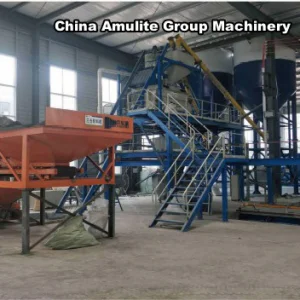
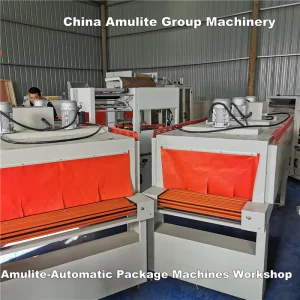
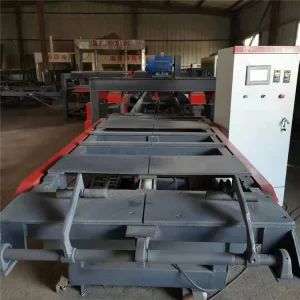
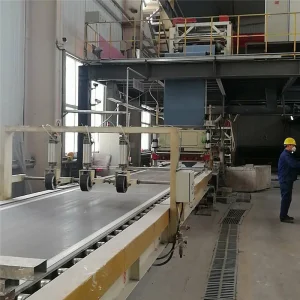
The global modern off-site construction industry is experiencing a structural revolution driven by stringent energy-efficiency directives, decarbonization policies, and acute labor shortages. At the focal point of this transformation is precast EPS (Expanded Polystyrene) cement sandwich panel technology. Engineered by combining high-density calcium silicate board or fiber cement board facings with a lightweight aggregate core of cellular cement, EPS beads, fly ash, and specialized admixtures, these composite elements represent the gold standard for high-performance non-load-bearing structural walls.
As a premiere famous precast EPS cement panel machine supplier, China Amulite Group has engineered turnkey manufacturing plants that bridges the gap between material science and high-speed mechanical automation. Modern construction developers no longer evaluate precast machinery strictly on mechanical throughput; instead, plant profitability relies on multi-variate metrics including thermal mass coefficient optimizations (R-value performance), structural load-to-weight ratios, operational safety compliance, and zero-discharge slurry recirculation loops.
Traditional precast EPS wall panel machinery frequently suffers from bead flotation and segregation during core slurry casting, resulting in non-uniform density distributions and structural micro-cracks. Amulite’s proprietary Dynamic High-Shear Slurry Homogenization Technology solves segregation by controlling viscosity through real-time Rheological PLC monitoring, ensuring precise physical properties across 100% of manufactured panels.
How tier-1 precast panel producers are staying competitive through Industry 4.0 automation, raw material flexibility, and modular plant layouts.
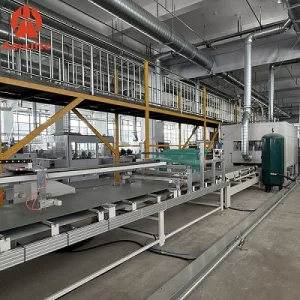
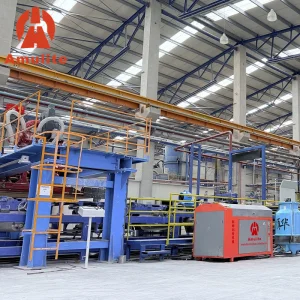
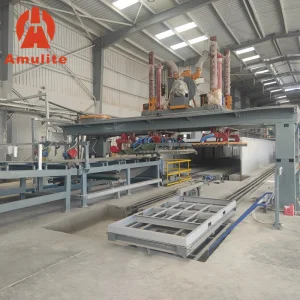
Shift from horizontal manual casting beds to multi-opening vertical battery mold cars equipped with hydraulic opening/closing mechanisms, internal thermal curing circuits, and automatic demolding systems that optimize factory floor footprint by 300%.
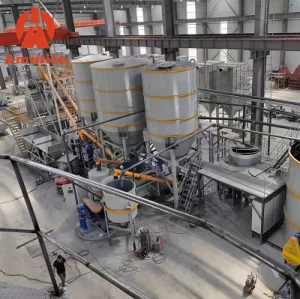
Integration of computerized weight-batching scales, fluidizing silos, and steam-controlled EPS pre-expanders. Precise particle density sizing (12–25 kg/m³) directly translates to controlled cement slurry consumption and reduced thermal conductivity.
Modern sustainability requirements demand complete elimination of process washouts. Amulite’s closed-loop filtration sediment systems recover residual cementitious slurry and return it to primary mixing tanks without compromising setting times or compressive strength.
Comprehensive mechanical parameter matrix comparing standard configurations engineered for varying annual output targets.
| Plant Configuration | Annual Capacity (m²) | Mold Car Quantity | Installed Power (kW) | Labor Requirement | Factory Area Needed |
|---|---|---|---|---|---|
| Amulite EPS-LITE 300 | 300,000 – 500,000 | 10 – 16 Units | 85 kW | 6 – 8 Operators | 1,500 – 2,500 m² |
| Amulite EPS-PRO 1000 | 1,000,000 – 1,500,000 | 24 – 36 Units | 160 kW | 8 – 12 Operators | 3,500 – 5,000 m² |
| Amulite EPS-MAX 3000 (Fully Auto) | 2,500,000 – 3,500,000 | 60+ Dynamic Units | 320 kW | 4 – 6 Operators (Robotic) | 8,000 – 12,000 m² |
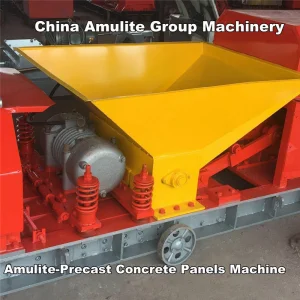
Features automated multi-component pneumatic powder scales (Cement, Fly Ash, Additives), liquid admixture metering pumps, and dual-shaft forced planetary mixers. Designed with wear-resistant high-chromium alloy liners ensuring continuous homogeneous mixing without damaging EPS beads.
Constructed with heavy structural steel frames, precision side-baffle plates, and hydraulic locking cylinders capable of withstanding intense hydrostatic pumping pressure. Equipped with top-sealing vibrator bars to eliminate internal air pockets during casting.
Utilizes vacuum suction arm manipulators to place facing boards (Fiber Cement or Calcium Silicate) seamlessly onto both sides of the mold cavity prior to slurry injection. Guarantees tight edge alignment and zero cement slurry leakage.
Once initial hydraulic curing achieves green-strength targets (2.5 – 3.5 MPa), the automated tilting system rotates the mold car 90 degrees vertically, demolding the finished panels onto transport carts without edge chipping or surface delamination.
A rigorous analysis for procurement officers, EPC contractors, and building material manufacturers evaluating capital investments.
When selecting a famous precast EPS cement panel machine supplier, evaluating total cost of ownership (TCO) extends far beyond initial equipment quotations. China Amulite Group integrates energy-saving components and low-wear materials to maximize profitability:
Foundation engineering drawings, power grid load mapping, steam pipeline planning.
Heavy structural welding, CNC machining, PLC cabinet wiring, pre-shipment dry runs.
On-site mechanical installation guided by senior Amulite field commission engineers.
Trial casting using local OPC cement, local sand, fly ash, and EPS bead density tuning.
How Amulite engineers adapt chemical and physical formulations to suit regional raw materials across over 60 export destinations.
Our in-house material testing lab analyzes local cement hydration curves, silica sand grain distributions, and fly ash pozzolanic activity. We supply fully customized mix proportions tailored to your local raw material supply chain.
Amulite machinery and precast EPS panels meet standard building requirements worldwide, including ASTM C90, EN 12467, and ISO 9001:2015 quality manufacturing certifications for structural integrity and environmental safety.
Equipped with Siemens S7-1500 PLC control architectures and secure VPN gateways, our technical support division delivers remote real-time troubleshooting, software optimization, and AR-guided maintenance assistance globally.
Pioneering advancements engineered by China Amulite Group to redefine precast manufacturing efficiency.
Integrating online moisture sensors and neural-network mix calculators that adjust water-to-cement ratios automatically in real-time as ambient temperature and sand moisture fluctuate, ensuring constant panel density.
Adapting high-shear slurry mixers to process 100% alkali-activated slag and pozzolanic geopolymers, eliminating Portland cement requirements and reducing carbon emissions per m² of panel produced by up to 70%.
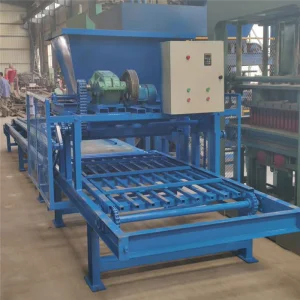
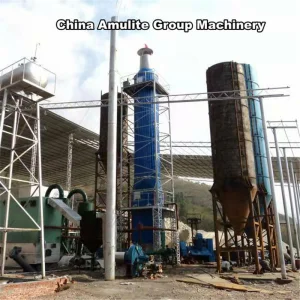
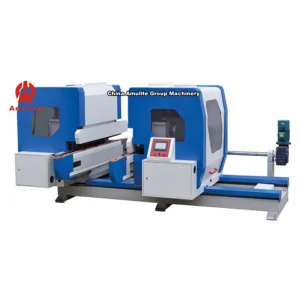
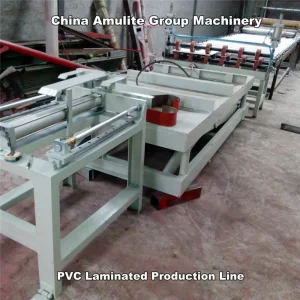
Complementary production equipment for modern building material manufacturing hubs.
Expert responses from China Amulite Group’s senior plant engineering division.