Explore our world-class, automated production lines engineered for industrial board fabrication.
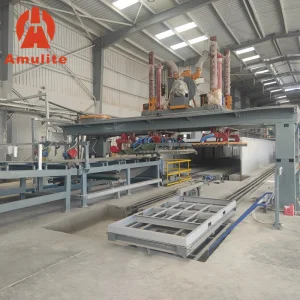
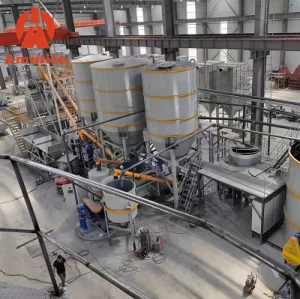
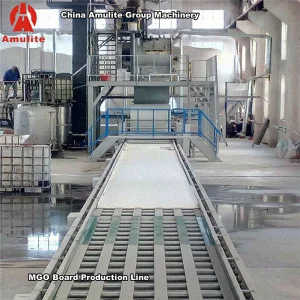
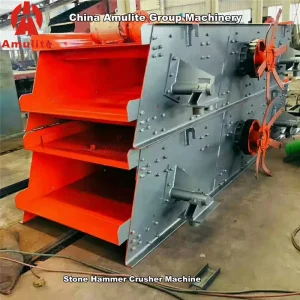
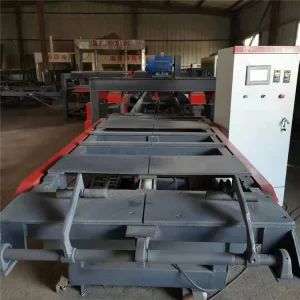
The global construction ecosystem is undergoing a fundamental structural transition. Driven by stringent decarbonization mandates, evolving fire-safety codes (such as EN 13501-1 Class A1 non-combustibility), and the rapid expansion of Modular/Prefabricated Construction, architectural engineers and project developers are systematically replacing traditional timber, gypsum, and asbestos-laden panels with autoclaved plant fiber cement boards (PFCB) and calcium silicate boards.
At the center of this industrial transformation are leading plant fiber cement board machine factories and engineering companies. Modern fiber cement board machinery must deliver high-speed production capability while maintaining micro-structural matrix integrity. By leveraging eco-friendly bio-based fibers—such as bleached kraft wood pulp, bamboo pulp, and unbleached botanical fibers—as primary structural reinforcement alongside Portland cement, crystalline silica sand, and reactive pozzolans, modern lines manufacture boards engineered for extreme durability, fire resistance, and moisture insensitivity.
Information Gain Insight: The integration of hydro-thermal autoclaving (170°C to 190°C saturated steam curing) transforms raw silica and calcium hydroxide into Tobermorite C-S-H crystalline matrix ($C_5S_6H_5$). This chemical synthesis reduces moisture movement to less than 0.12%, eliminating board warping in extreme tropical and maritime environments.
Automated fiber cement board plants engineer customizable boards tailored to precise mechanical and thermal parameters across diverse macro sectors:
High-density boards ($\ge 1.4\text{ g/cm}^3$) featuring exceptional flexural strength ($\ge 18\text{ MPa}$) designed to withstand high wind loads, freeze-thaw cycles, and intense UV exposure with hydrophobic surface coatings.
Medium-density boards optimized for 1-to-4-hour fire-rated wall assemblies. Superior acoustic isolation ($STC \ge 45\text{ dB}$) and impact resistance for commercial spaces, hospitals, and transit hubs.
Calibrated, high-impact fiber cement substrates engineered for zero mold growth, high compressive strength, and ideal adhesion under ceramic tile installations in wet environments.
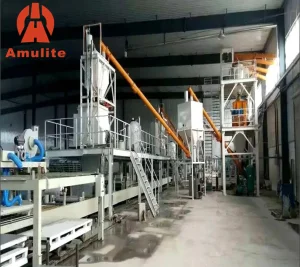
Industrial performance metrics achieved by China Amulite Group's flagship automated Hatschek fiber cement production lines.
The manufacturing process engineered by top plant fiber cement board machine factories revolves around two core forming methodologies: the Hatschek Process (ideal for thin, multi-layered high-density sheets) and the Flow-on Process (optimized for high-volume medium-density production).
| Process Stage | Technical Sub-System | Operational Parameters & Key Specifications | Quality Impact |
|---|---|---|---|
| 1. Fiber Refining & Raw Batching | Hydrapulper, Disc Refiners & Automated Dosing PLC | Cellulose pulp refined to 22°–30° SR (Schopper-Riegler); Automated micro-weighing of silica sand ($SiO_2 > 92\%$), OPC cement, and additives. | Ensures uniform matrix dispersion and prevents fiber clumping. |
| 2. Sheet Forming & Dewatering | Multi-Vat Hatschek Machine & High-Vacuum Suction Boxes | 3 to 5 rotating cylinder vats; Continuous felt carrying film layers ($0.2–0.3\text{ mm}$ thick per revolution); Vacuum dewatering at -0.06 to -0.08 MPa. | Defines board laminar structural strength and initial green density. |
| 3. Accumulation & Cutting | Making Roll & High-Precision Rotary Cutter | Automatic layer wrapping on making roll until target thickness ($4–30\text{ mm}$) is reached; Pneumatic/Servo synchronized cutting. | Guarantees exact dimension control and eliminates thickness tolerance variance. |
| 4. Pressing (Optional) | Multi-Daylight Hydraulic Pressing Unit | High pressure up to 10,000–12,000 Tons; Specific pressing force up to 250–300 kg/cm². | Increases density up to 1.7 g/cm³, reduces water absorption, boosts frost resistance. |
| 5. Hydro-thermal Autoclaving | High-Pressure Autoclave Vessels & Steam Generators | Saturated steam curing at 170°C–190°C under 1.0–1.2 MPa steam pressure for 10–12 hours. | Synthesizes Tobermorite phase; delivers permanent dimensional stability. |
As global enterprise buyers evaluate machinery suppliers, China's advanced machinery hubs—led by pioneers such as China Amulite Group—offer unmatched competitive advantages over traditional European equipment manufacturers. By integrating Industry 4.0 smart manufacturing technologies with complete vertical supply chains, Chinese factories deliver superior price-to-performance ratios without compromising engineering precision.
Spanning over 100,000 m² of specialized heavy industrial workshops, every core machine component—from CNC-machined forming cylinders and heavy hydraulic presses to autoclave vessels—is manufactured in-house under strict ISO 9001 quality audits.
Equipped with Siemens S7-1500 controllers and industrial IoT sensors, our lines monitor real-time slurry viscosity, vacuum pressures, thermal consumption, and board thickness, minimizing human error and batch variations.
Leveraging China's dense industrial supply chain ecosystem, baseline turnkey line delivery times are condensed to 90–120 days, featuring pre-assembled wiring and modular mechanical frames for fast site commissioning.
A structured engineering framework for procurement teams, plant directors, and project investors.
Acquiring a fiber cement board plant represents a significant capital expenditure (CAPEX). Enterprise buyers must conduct rigorous technical audits evaluating supplier capabilities across four crucial vectors: Total Cost of Ownership (TCO), material adaptability, mechanical reliability, and safety compliance.
Can the machinery accommodate local raw materials? A top-tier manufacturer must supply lab testing to optimize batch formulas utilizing regionally available quartz sand, local OPC cement grades, and low-cost local cellulose or waste paper pulp substitutes without sacrificing product MOR (Modulus of Rupture).
Autoclaving and drying account for up to 40% of operational costs (OPEX). Modern lines incorporate multi-stage flash steam recovery systems, boiler economizers, and closed-loop process water filtration achieving zero industrial wastewater discharge.
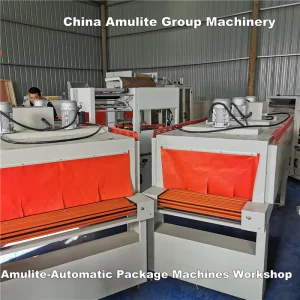
High-end lines integrate automated robotic green-sheet stackers, automatic pallet conveying, automated trimming lines, and auto-packaging units. This reduces factory labor from 40 workers per shift down to fewer than 8 operators.
Ensure autoclaves hold international pressure vessel certifications such as ASME Code Stamp, CE-PED (Pressure Equipment Directive), or Gost-R, alongside ISO 9001 and ISO 14001 plant accreditations.
The fiber cement machinery sector is rapidly advancing toward carbon neutrality, intelligent self-optimization, and ultra-lightweight high-strength board synthesis. Plant Fiber Cement Board Machine Factories are actively developing and commercializing next-generation modules:
To comply with global Net-Zero initiatives, equipment designs are moving away from coal/gas-fired steam generation. Hybrid steam plants powered by industrial solar-thermal concentration and green hydrogen boilers drastically cut the carbon footprint per square meter of board.
R&D efforts focus on partial replacement of imported wood pulp with micro-fibrillated cellulose (MFC) and treated agricultural fibers (rice straw, bagasse, oil palm empty fruit bunches). Machinery modification involves specialized pulping disc geometries and micro-dosing injectors to ensure uniform dispersion within the cement matrix.
Integrating high-speed laser scanners and ultrasonic defect detectors along the cutting line enables real-time identification of internal delamination, thickness variations, or micro-cracks. Automated feedback loops adjust vacuum suction and forming roll pressure dynamically.
Turnkey engineering services ensuring seamless deployment across North America, EU, Middle East, Southeast Asia, and Latin America.
Resident installation engineers oversee civil foundation validation, steel structure alignment, electrical wiring, mechanical assembly, and dry/wet trial commissioning on-site globally.
Factory testing guarantees manufactured boards comply with standard building codes including ASTM C1186 (Standard Specification for Flat Fiber-Cement Sheets), EN 12467, and ISO 8336 standards.
Encrypted cloud connection modules enable direct engineering diagnostic access from China Amulite headquarters to assist local plant operators with PLC troubleshooting and software upgrades.
Complementary machinery systems engineered for modern building panel factories.