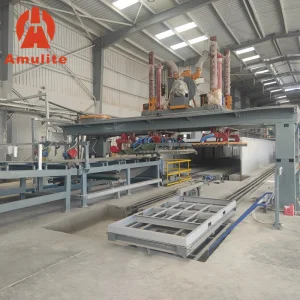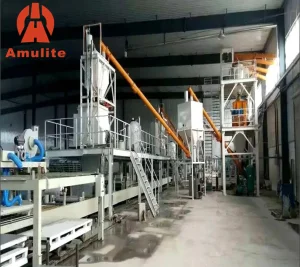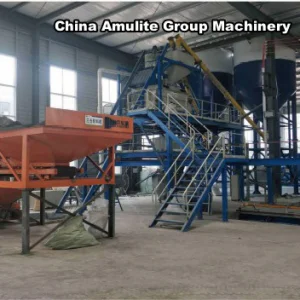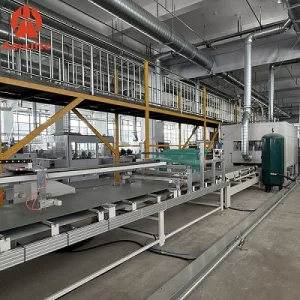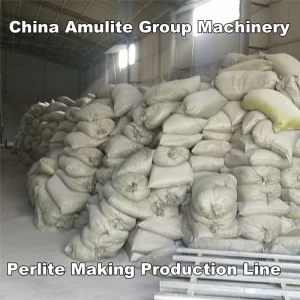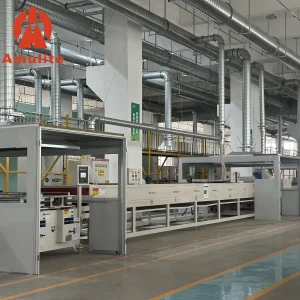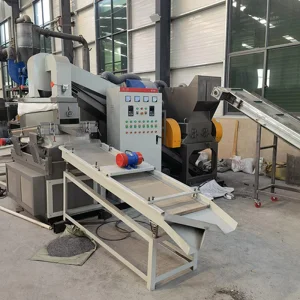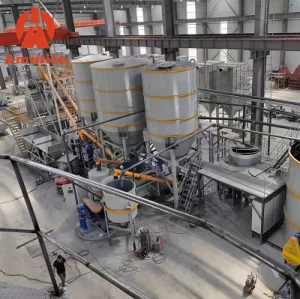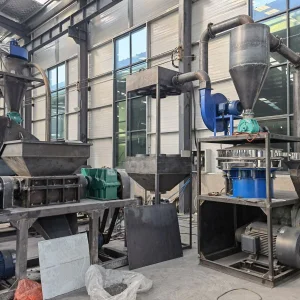
In global building material manufacturing, the standard for structural integrity, fire-resistance (Class A1), and weatherproofing is dictated by high-performance fiber cement boards and calcium silicate panels. At the foundation of this industry lies specialized equipment engineered by a premier Famous Flat Cement Sheet Machines Factory & Company. Modern flat cement sheet machines utilize advanced wet-process slurries consisting of Portland cement, micro-silica sand, cellulose pulp, and synthetic reinforcing fibers (such as PVA). These raw materials undergo hydro-thermal crystallization within high-pressure steam autoclaves to form a matrix known technically as Tobermorite ($C_5S_6H_5$).
The engineering challenge in manufacturing high-density flat cement sheets lies in maintaining ultra-precise thickness tolerances ($\pm0.2\text{ mm}$), uniform mass distribution, and optimum dewatering rates at high linear speeds (up to $80\text{ m/min}$). Leading machinery manufacturers have shifted from legacy batching techniques to fully automated, closed-loop continuous slurry control systems integrated with multi-vat Hatschek forming units.
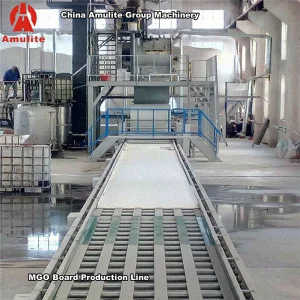
Engineered with high-vacuum multi-chamber suction boxes, pneumatic press rollers, and automated felt tracking systems that pull excess moisture out without disturbing fiber alignment.
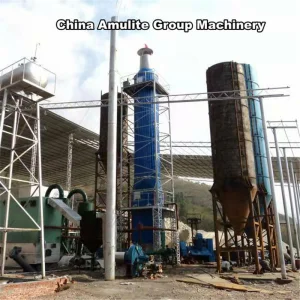
Equipped with 1.0–1.2 MPa pressure autoclaves capable of generating saturated steam curing at $185^\circ\text{C}$ to synthesize Tobermorite crystals for zero dimensional shrinkage.
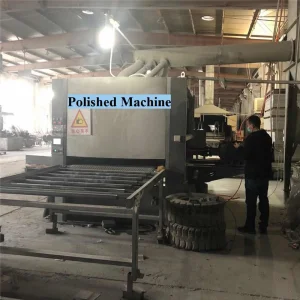
Integrated CNC waterjet and diamond-saw edge profiling stations capable of forming bevels, tongue-and-groove joints, and custom architectural cutouts in-line.
Flat cement sheets manufactured by modern plant equipment provide critical structural and environmental performance across diverse global civil engineering sectors. Below is a detailed breakdown of how various sheet specifications fulfill specific industrial demands:
| Application Sector | Target Board Thickness | Density Range ($g/cm^3$) | Key Mechanical Performance Requirements | Primary Production Line System |
|---|---|---|---|---|
| Exterior Ventilated Facades | 8mm - 16mm | 1.40 - 1.70 | High flexural strength (>28 MPa), freeze-thaw resistance (100 cycles), weather resistance. | Autoclaved Fiber Cement Board Line |
| Fireproof Interior Partitions | 6mm - 12mm | 1.20 - 1.45 | Class A1 fire rating (4-hour integrity under BS 476), sound attenuation (>45 dB). | Calcium Silicate / MGO Board Line |
| Heavy-Duty Flooring Underlayment | 15mm - 25mm | 1.50 - 1.75 | High impact resistance (>10 kJ/$m^2$), point-load bearing capacity, moisture resistance. | High-Density Compressed Cement Board Line |
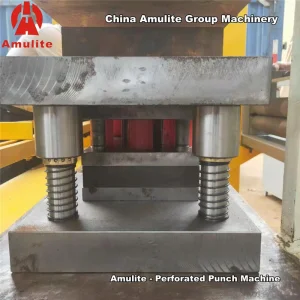
| Acoustic Ceiling Tiles | 4mm - 6mm | 0.95 - 1.15 | Ultra-lightweight, high sag resistance under 95% RH, precision perforation compatibility. | Perforated Punch Machine & Board Line |
| Wet Area Tile Backer Board | 6mm - 10mm | 1.25 - 1.40 | Zero water absorption degradation, strong adhesive bonding strength with C2-tile adhesives. | XPS/Fiber Cement Backer Line |
As the international building sector moves toward Net-Zero carbon emissions and Industry 4.0 automation standards, machinery manufacturers are upgrading core production line technologies. The following 5-stage technology roadmap outlines the evolution of flat cement sheet production over the coming decade:
Real-time ultrasonic measurement of slurry viscosity and density, allowing automatic slurry adjustment based on pulp quality and sand moisture fluctuations.
Multi-stage thermocompressor units capturing flash steam from curing chambers, reducing total plant boiler fuel usage by up to 32%.
Transitioning from standard OPC cement to alkali-activated blast furnace slag and calcined clay matrix systems, eliminating $CO_2$ process emissions.
Full-line vision-guided robotic arms replacing traditional mechanical vacuum lifters, boosting stacking speeds up to 120 green sheets per minute.
Vibration sensors installed on accumulator rolls and vacuum pumps feed real-time telemetry into cloud SCADA systems for predictive bearing diagnostics.
Establishing a modern high-capacity building material plant requires massive industrial infrastructure, reliable precision machining, and dependable long-term supply chain integration. Leading Chinese machinery conglomerates—such as China Amulite Group—possess distinct structural advantages over European and regional competitors:
From 100,000 $m^2$ machining facilities to heavy vertical boring mills, core assemblies such as forming drums, hydraulic presses, and 60-meter autoclaves are manufactured completely in-house under strict ISO9001 supervision.
Direct integration with premier electrical and pneumatic component suppliers (Siemens PLC, Schneider controls, NSK bearings, Festo pneumatics) guarantees immediate replacement part availability worldwide.
Delivering plant machinery with equivalent technical output and tolerances to European manufacturers at 40-50% lower capital expenditure (CAPEX), dramatically shortening overall payback periods for investors.
When issuing an RFP or evaluating proposals from a Famous Flat Cement Sheet Machines Factory & Company, global procurement teams must audit crucial machine engineering parameters to ensure operational success and long-term mechanical reliability:
Exporting machinery to international markets requires more than shipping hardware. China Amulite Group provides end-to-end technical stewardship to eliminate commissioning risks for overseas buyers:
Our in-house R&D analytical laboratory tests regional sand silicates, local cement hydrates, and regional cellulose options to create optimized, low-cost raw material formulations before factory dispatch.
Senior mechanical, electrical, and process engineering teams are deployed on-site to oversee civil foundation works, equipment assembly, wiring, line dry-runs, and full-capacity commissioning.
All machines are built in strict compliance with EU CE electrical standards, OSHA mechanical safety guarding, emergency stop networks, and low-noise operational acoustic enclosures.
Detailed technical insights provided by China Amulite Group’s Chief Engineer and Project Director Office: