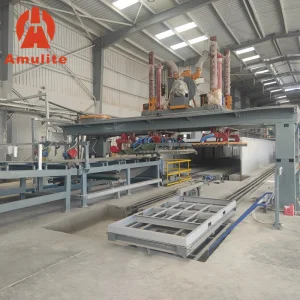
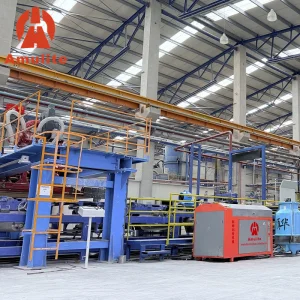
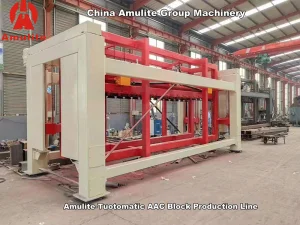
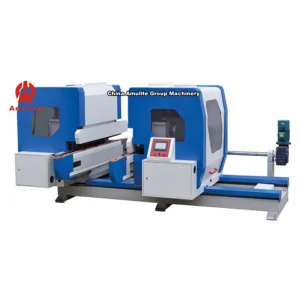
In the contemporary landscape of global structural engineering, the shift toward lightweight, thermally efficient, and prefabricated building materials has transitioned from an environmental preference to a structural imperative. At the epicentre of this transformation is the Expanded Polystyrene (EPS) Concrete Sandwich Wall Panel Production Line. As leading China EPS concrete sandwich wall panel line manufacturers, China Amulite Group integrates mechanical precision, automated chemical batching, and digital quality control to deliver high-capacity industrial systems capable of producing premier lightweight composite wall panels for global deployment.
EPS cement sandwich panels—comprising fiber cement or calcium silicate surface boards sandwiching a core of modified expanded polystyrene beads, ordinary Portland cement (OPC), fly ash, and specialized chemical foaming agents—represent a vital innovation in Modern Methods of Construction (MMC). The production architecture required to manufacture these panels demands extreme slurry homogeneity, zero-defect core-to-skin adhesion, and rapid cycle demolding without structural micro-cracking.
Integration of fiber-reinforced silicate boards ensures high flexural strength (up to 12.5 MPa), enabling seismic movement tolerance and superior impact resistance in load-bearing partition assemblies.
Uniformly distributed micro-expanded EPS beads lower thermal conductivity to as low as 0.045 W/(m·K), drastically cutting building HVAC energy demands across tropical and sub-zero zones.
Engineered core slurry formulations ensure up to 4 hours of fire endurance at 1000°C without generating toxic combustion gasses, complying fully with international fire barrier safety standards.
Selecting the optimal manufacturing methodology directly impacts plant CAPEX, operational throughput, and product dimensional tolerance. Modern China EPS wall panel equipment manufacturers generally employ two main structural engineering designs: Vertical Battery Mold Systems and Continuous Horizontal Extrusion Lines.
| Engineering Vector | Vertical Hydraulic Battery Mold System | Continuous Horizontal Extrusion Line |
|---|---|---|
| Target Application | High-density wall panels with tongue & groove interlocks, dual facings. | Single-layer homogeneous lightweight slabs without surface boards. |
| Dimensional Tolerance | Ultra-precise (±0.5mm thickness variation via fixed vertical steel plates). | Moderate (±1.5mm requiring downstream calibrating sanding). |
| Daily Output per Module | 400 m² – 1,200 m² per shift per battery bank cluster. | Up to 3,000 m² continuous run per line. |
| Core Slurry Density Range | 350 kg/m³ – 800 kg/m³ (fully customizable via EPS pre-expander ratio). | 450 kg/m³ – 950 kg/m³. |
| Core-to-Board Adhesion | Hydrostatic pressure during vertical curing yields bond strength > 0.5 MPa. | Requires synthetic polymer chemical binder sprays prior to continuous pressing. |
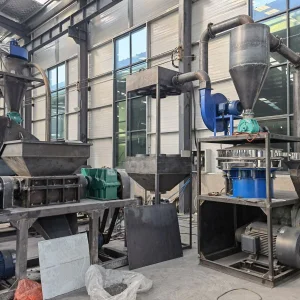
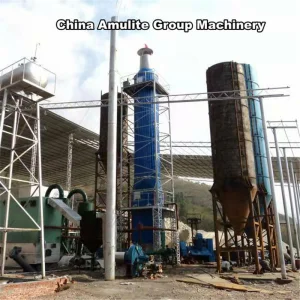
The structural consistency of the panel core depends fundamentally on the volumetric stability of the EPS expandable polystyrene beads. Amulite’s closed-loop continuous steam pre-expander utilizes proportional valves and digital pressure transducers to maintain bead density variation within ±1.5%. Following expansion, fluidized bed drying and automated pneumatic conveying age the expanded beads for 4 to 8 hours in silo batteries to achieve internal pressure equilibrium, preventing post-casting volumetric shrinkage inside the cured panels.
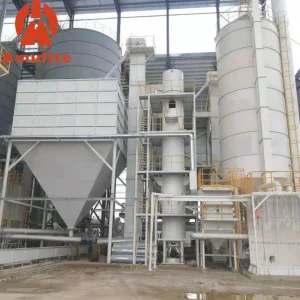
The slurry mixing station is controlled via a centralized Siemens S7-1500 PLC operating on a Profinet fieldbus network. Dry raw materials (OPC 42.5 grade cement, class F fly ash, sand powder) are batched via gravimetric loss-in-weight feeders. Liquid additives (superplasticizers, air-entraining agents, hydrophobic silicones) are dosed with peristaltic pumps. The high-shear planetary mixer ensures complete dispersion of EPS beads within the cementitious matrix without crushing the cellular structure of the beads.
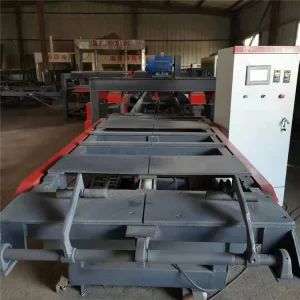
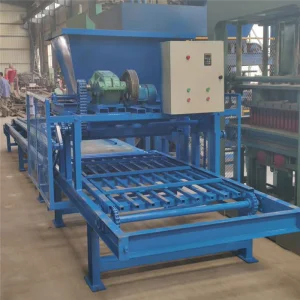
The mobile vertical battery mold cars feature CNC-machined steel side plates lined with Teflon anti-stick coatings. Hydraulic clamping cylinders exert up to 30 MPa of closing force to prevent joint leakage during high-pressure grouting. Integrated high-frequency vibratory shafts purge entrained air bubbles, ensuring dense compaction around perimeter tongue-and-groove profiles while preserving uniform core cell distribution.
Interlocking male-female joint designs coupled with flexible polyurethane joint sealant matrices allow EPS panels to absorb shear stresses up to Magnitude 8.0 earthquakes without catastrophic wall collapse.
Utilizing calcium silicate facings with water absorption rates below 10% prevents mold growth and efflorescence in humid coastal regions (Middle East, Southeast Asia, Latin America).
Core formulations utilizing low-density EPS bead concentration yield wall insulation properties replacing 300mm brick masonry with a thin 100mm sandwich panel, expanding usable interior floor area by 8%.
The manufacturing efficiency of China Amulite Group stems from a integrated heavy-engineering cluster located in Hebei Province. Unlike equipment aggregators who outsource frame welding and machining to third-party workshops, Amulite performs 100% of critical component manufacturing in-house across our 100,000 m² facility.
Our structural steel frames undergo stress-relief heat treatment to eliminate internal welding stress, guaranteeing structural alignment of mold tracks across decades of continuous operation. Key automation hardware is standardized using tier-one global brands (Siemens PLC, Schneider Electric power distribution, Festo pneumatics, Yuken hydraulics) combined with domestically sourced high-yield steel and precision-machined heavy rollers.
All load-bearing gantry structures and pressure vessel tanks undergo 100% ultrasonic weld defect testing to ensure zero structural fatigue failure under 24/7 industrial stress.
Integrated vibration and temperature sensors on main gearboxes feed telemetry back to the PLC, predicting bearing wear and scheduling maintenance before catastrophic downtime occurs.
Equipment modules are skid-mounted and dimensionalized to fit standard 40ft High Cube containers, minimizing international freight overhead and simplifying port customs handling.
Investing in a turnkey EPS sandwich wall panel line involves analyzing capital expenditure (CAPEX) alongside operational expenditure (OPEX). Below is an empirical cost breakdown structure for a standard 500,000 m²/year automated production line operationalized in an emerging industrial market:
| Cost Element | Percentage of Total Annual OPEX | Optimization & Efficiency Strategy |
|---|---|---|
| Raw Materials (Cement, Fly Ash, EPS, Sand) | 62% – 68% | Local sourcing of Industrial Fly Ash (powerplant waste) to reduce cement binder cost by up to 35%. |
| Surface Board Procurement (Calcium Silicate / Fiber Cement) | 18% – 22% | Pairing the wall panel line with an in-house Amulite Fiber Cement Board Line for vertical raw material margin capture. |
| Energy Consumption (Electricity & Thermal Steam) | 6% – 9% | Implementing heat-recovery condensate systems on steam curing lines reduces boiler gas consumption by 22%. |
| Direct Operations & Plant Labor | 4% – 7% | Full automated demolding, stacker robotics, and auto-clamping reduce manual floor crew to only 6-8 operators per shift. |
| Preventative Maintenance & Spare Parts | 2% – 3% | Standardized spare parts inventory kit delivered with initial machine shipment prevents unbudgeted emergency freight costs. |
All electrical enclosures, emergency stop loops, and safety light curtains are fully compliant with European Union Machinery Directive 2006/42/EC and Low Voltage Directive 2014/35/EU.
Custom-wound transformers and VFDs accommodate multi-regional power standards (380V 50Hz, 415V 50Hz, 460V 60Hz, or 220V 60Hz 3-Phase) without operational efficiency loss.
Amulite dispatches senior mechanical and software field engineers to supervise civil foundation work, direct assembly, execute trial mix designs, and train local staff until full plant hand-over.