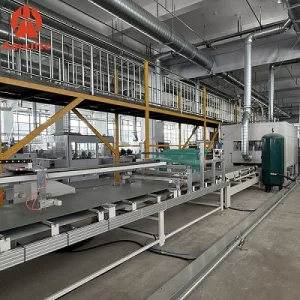
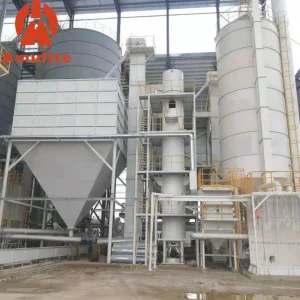
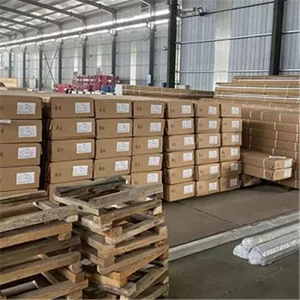
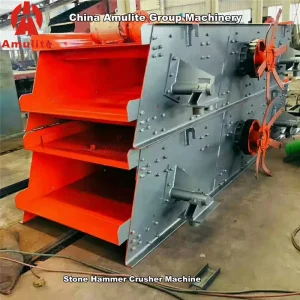
High-performance manufacturing equipment and custom plant machinery engineered by China Amulite Group.
Quantifiable performance indicators defining China's leading EPS cement sandwich panel mould engineering leadership.
An authoritative analysis of the structural shift toward prefabricated wall panel manufacturing and high-precision mould car engineering.
The global construction ecosystem is undergoing a dramatic paradigm shift toward modular prefabrication, rapid structural assembly, and decarbonized building envelopes. Central to this evolution is the Expanded Polystyrene (EPS) cement sandwich panel—a composite structural component composed of fiber cement or calcium silicate face boards encapsulating a lightweight core matrix of cement, EPS beads, fly ash, and specialized chemical admixtures. As global demand for high-performance thermal insulation, acoustic attenuation, and seismic resilience escalates, the role of a top-tier China EPS cement sandwich panel mould manufacturer has transitioned from simple mechanical supplier to essential industrial process partner.
Historically, precast concrete and lightweight partition wall manufacturing suffered from dimensional variance, surface warping, and labor-intensive manual demoulding. Modern industrial construction projects across Europe, the Middle East, Southeast Asia, and Latin America demand sub-millimeter dimensional tolerances. Consequently, leading machinery OEMs in China have revolutionized EPS wall panel mould technology through the development of automated vertical mould cars, hydraulic opening/closing mechanisms, and precision tongue-and-groove side sealing systems.
The global market for EPS cement sandwich panels is projected to grow at a Compound Annual Growth Rate (CAGR) exceeding 8.5% over the next decade. Key macro-environmental drivers include:
Core technological features engineered by leading China EPS cement sandwich panel mould manufacturers.
Mould cars built from stress-relieved Q355B heavy structural steel undergo thermal annealing to eliminate welding stress, ensuring zero frame deflection even after 10,000+ high-pressure slurry casting cycles.
Fully integrated hydraulic power units automate side-plate opening and panel ejection. Integrated proportional valves ensure smooth movement without thermal cracking or edge damage to fresh panels.
Patented EPDM dual-lip rubber seals combined with precision machined aluminum tongue-and-groove side profiles guarantee zero cement slurry leakage, eliminating post-casting flash trimming.
The technological trajectory of automated moulding plants, AI slurry monitoring, and low-carbon cement chemistry.
As smart manufacturing standardizes across the building material sector, EPS sandwich panel production is evolving from semi-automated batch casting to fully integrated Industry 4.0 automated vertical mould car circuits. Next-generation manufacturers in China are spearheading breakthroughs across four core technology vectors:
Traditional curing relies on fixed steam timing, leading to energy waste or incomplete hydration. Next-generation mould cars feature wireless thermocouple sensors embedded within individual mould cavities. Connected to edge-computing PLC systems, these sensors monitor real-time exotherm curves of cement hydration, automatically adjusting steam injection rates and demoulding triggers. This reduces batch cycle time from 8 hours down to 4.5 hours while cutting thermal energy consumption by up to 30%.
Mould cavities are being re-engineered with specialized anti-stick polymer coatings and high-frequency internal vibrators capable of compacting highly viscous, ultra-lightweight slurry mixes. Modern plants are shifting from pure Ordinary Portland Cement (OPC) to geopolymers, alkali-activated slag, and high-volume fly ash matrices. Mould surfaces must withstand chemical attack from alternative binders while facilitating effortless panel release without oil-based release agents.
How customized panel mould dimensions address regional structural & climate requirements worldwide.
Building specifications vary widely across climate zones and regulatory regimes. Customized EPS panel moulds allow manufacturers to meet exact regional standards:
From raw material batching to automated packaging: total equipment optimization for plant operators.
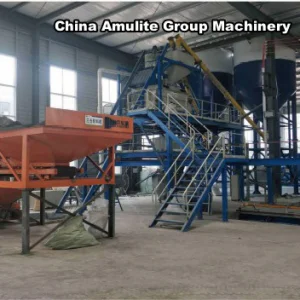
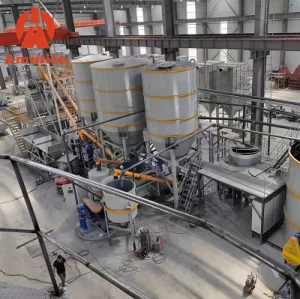
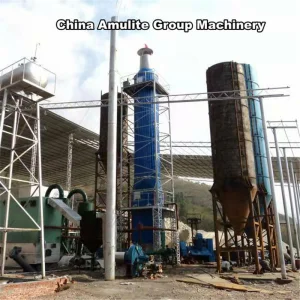
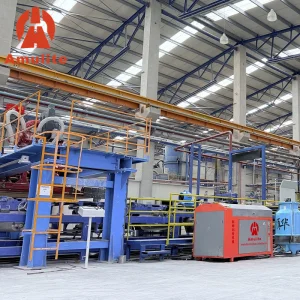
Investing in EPS cement sandwich panel machinery requires an integrated systems-engineering approach. A standalone mould car cannot reach peak efficiency without synchronized mixing, pumping, curing, and handling subsystems. Leading Chinese suppliers provide complete turnkey industrial solutions incorporating:
PLC-controlled weighing hoppers for cement, fly ash, sand, and EPS foam beads. High-shear planetary mixers ensure uniform bead dispersion without crushing fragile EPS structures.
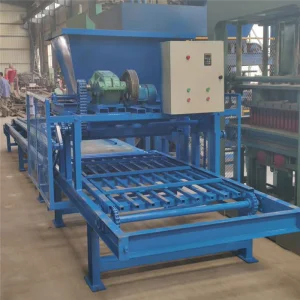
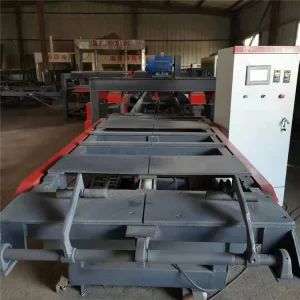
Rail-mounted battery mould cars featuring automated hydraulic locking, core pulling, and pneumatic slurry injection manifolds for simultaneous multi-cavity filling.
90-degree hydraulic tilting tables turn vertical panel cars into horizontal discharge positions, allowing vacuum suction grippers to stack finished panels on transport pallets.
Expert technical answers addressing core engineering, maintenance, and process optimization challenges.
Explore our full line of precast equipment, block machines, and recycling industrial production plants.