



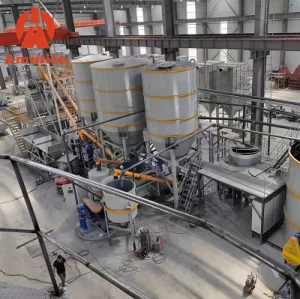
High-precision engineering solutions manufactured by China Amulite Group, serving over 60 countries with complete turnkey plant capabilities.
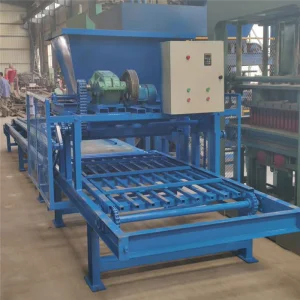
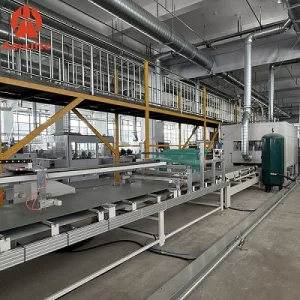
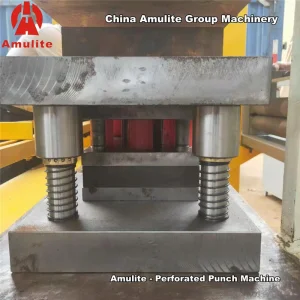
Decoding the Global Transition Toward Lightweight Composite EPS Cement Sandwich Panels in Modern Off-Site Construction.
The global market for prefabricated wall elements is expanding at a projected CAGR of 7.4% through 2030. Driven by strict net-zero carbon targets, rapid urban modular construction, and rising labor costs, commercial and residential developers are pivoting from traditional wet-masonry (AAC blocks, red brick) toward Composite EPS Cement Sandwich Panels.
China has emerged as the global epicenter for EPS sandwich panel manufacturing and machinery engineering. Through decade-long supply chain integration, Chinese manufacturers offer unparalleled economies of scale, combining high-grade silicate facing board manufacturing with precision automated core injection systems.
Composite EPS panels integrate outer calcium silicate or fiber cement skins with an engineered core of Expanded Polystyrene (EPS) beads, Portland cement, fly ash, and specialized foaming additives. This matrix yields ultra-lightweight structural walls offering superior flexural strength and thermal performance.
Deep Dive into Physical Properties, Thermal Dynamics, Acoustic Insulation, and Fire Resistance Ratings.
| Performance Parameter | Technical Standard / Specification | Composite EPS Sandwich Panel | Traditional Autoclaved Aerated Concrete (AAC) |
|---|---|---|---|
| Volumetric Weight / Density | GB/T 23451-2009 / ISO 9001 | 550 - 650 kg/m³ | 650 - 800 kg/m³ |
| Bending / Flexural Load Strength | EN 12467 / ASTM C1185 | 1.5x - 2.0x Panel Dead Weight | 0.8x - 1.2x Panel Dead Weight |
| Fire Resistance Rating | GB 8624-2012 Class A1 / EN 13501-1 | ≥ 4 Hours (at 1000°C) | 2 - 3 Hours |
| Thermal Conductivity (λ) | ASTM C518 / ISO 8301 | 0.038 - 0.058 W/(m·K) | 0.16 - 0.22 W/(m·K) |
| Acoustic Sound Insulation (STC) | ISO 140-3 / ASTM E90 | 38 dB (90mm) to 48 dB (150mm) | 32 dB - 38 dB |
| Moisture Absorption & Shrinkage | GB 23451 / ASTM C1186 | < 0.5 mm/m (Ultra-stable) | 0.8 - 1.2 mm/m (Prone to cracking) |
The exterior facing consists of high-density, non-asbestos Calcium Silicate Boards or Fiber Cement Boards (4mm–6mm thickness). These skins act as tensile structural membranes, conferring superior impact resistance (up to 1000 N) and smooth paintable finishes directly out of the factory.
Using expanding EPS foam beads intermixed with hydraulic cement slurry and micro-air-entraining agents, the core achieves an optimized strength-to-weight ratio. The engineered male-female tongue and groove side profile eliminates thermal bridging and prevents joint cracking during seismic events.
The closed-cell micro-structure of EPS beads coupled with dense cement hydrates creates an acoustic barrier that attenuates airborne noise significantly, making it ideal for hotel partitions, luxury apartments, multi-family housing, and hospital interior walls.
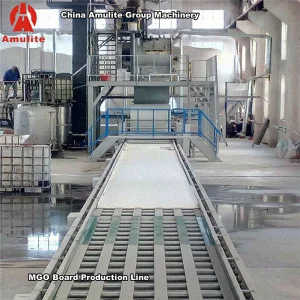
From Raw Material Dosing to Automated Demoulding: How China Amulite Group Redefines Plant Efficiency.
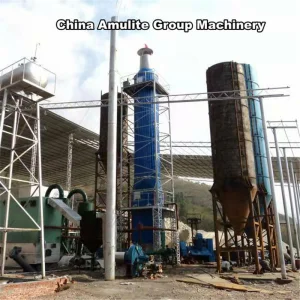
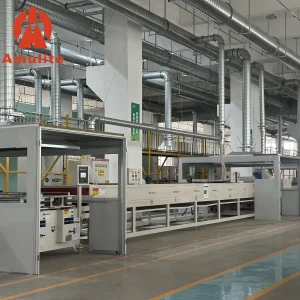
Integrated PLC control systems (Siemens/Schneider) precise-weigh cement, fly ash, sand, water, and specialized additives. High-shear multi-shaft mixers ensure uniform dispersion of EPS beads without damaging their cellular integrity.
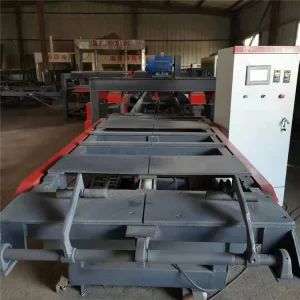
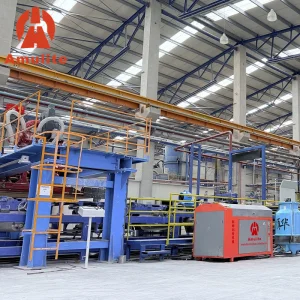
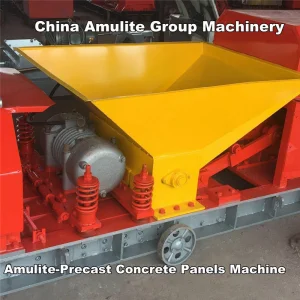
Amulite's proprietary vertical hydraulic mould cars accommodate up to 40 panels per cycle. Vertical casting guarantees perfectly uniform core density, exact thickness tolerances (±0.5mm), and dual-sided tongue-and-groove precision.
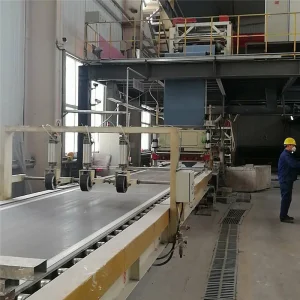
Equipped with robotic suction arms and automated turning machines, finished panels are extracted smoothly from mould cars, inspected by AI machine-vision sensors for surface flaws, and automatically stacked onto curing pallets.
Maximizing ROI for EPC Contractors, Real Estate Developers, and Building Material Distributors.
Investing in a China Amulite turnkey EPS sandwich panel production line reduces initial capital outlay by 45% to 65% compared to European equipment suppliers, while maintaining equivalent mechanical precision, Siemens PLC automation, and CE/ISO certified safety standards.
By substituting expensive lightweight aggregates with expanded polystyrene beads and locally sourced fly ash/pozzolanic waste, plant operators lower unit raw-material costs by up to 30%. High-efficiency steam curing loops cut boiler fuel consumption drastically.
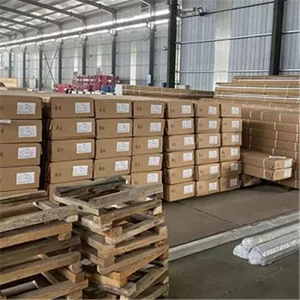
Standardized panel dimensions (e.g., 2440mm x 610mm, 60mm–200mm thickness) are engineered for optimal sea-container volumetric utilization. Customized edge-protectors, moisture-proof shrink packaging, and steel-strapped bundles ensure zero breakage during trans-oceanic shipping.
Delivering High-Performance Solutions Across Diverse Construction Sectors Worldwide.
Because EPS cement wall panels weigh only 1/3 of traditional brickwork, high-rise structural engineers can reduce foundation structural steel and concrete reinforcement requirements by 15-20%, offering substantial overall structural cost savings.
Ideal for rapid-assembly residential developments, disaster-relief housing, and remote mining camps. Interlocking male-female grooves allow dry-work installation speeds exceeding 40 m² per installer per day—over 10x faster than wet blockwork.
The closed-cell EPS core provides an exceptional thermal barrier (λ ≤ 0.042 W/m·K), reducing HVAC energy consumption in temperature-controlled warehouses, agricultural cold stores, and industrial cleanrooms.
With non-combustible calcium silicate skin boards and flame-retardant treated EPS beads, composite panels satisfy 4-hour fire barrier code demands, serving as dependable perimeter curtain walls and firewalls in industrial complexes.
Ensuring Seamless Regulatory Approval in North America, the European Union, the Middle East, and Asia-Pacific.
Amulite machinery and board production recipes comply strictly with European standards (EN 15283, EN 12467). All electrical hardware features CE marking with IP54/IP65 protective enclosures and emergency safety interlocking.
Composite panels engineered on Amulite lines pass ASTM C1185 (Flexural Strength), ASTM E84 (Surface Burning Characteristics), and ASTM E90 (Acoustic Performance), enabling smooth regulatory submittals across USA and Latin American markets.
Formulations adjusted for extreme desert climates feature high thermal resistance, low moisture absorption, and thermal-expansion stabilization to meet Saudi Arabian (SASO) and UAE (ESMA) civil defense regulations.
Pioneering Circular Economy Solutions, Recycled Aggregate Integration, and AI-Driven Smart Factories.
Amulite R&D is pioneering advanced slurry formulations capable of incorporating up to 40% post-consumer recycled EPS scrap and ocean-bound plastics without sacrificing tensile or compressive panel integrity.
By replacing traditional Ordinary Portland Cement (OPC) with alkali-activated blast furnace slag and fly ash geopolymers, next-generation EPS panel lines achieve up to a 60% reduction in embodied carbon footprint.
Industry 4.0 integration connects every plant sensor to cloud-based predictive maintenance systems. Amulite engineers provide 24/7 remote PLC diagnostics and automated real-time mix ratio calibration worldwide.
Detailed Technical Answers from China Amulite Group’s Chief Process Engineers.
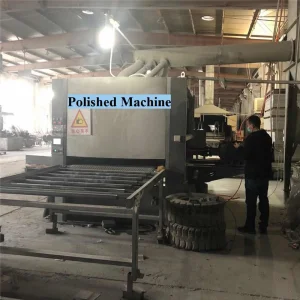
Explore our full engineering line-up for board finishing, recycling, perlite expansion, and block manufacturing.
Contact China Amulite Group today to receive a detailed engineering proposal, plant layout design, utility consumption analysis, and custom ROI calculation for your production line project.