Explore our top-tier engineering lines designed for high-capacity fireproof board, sandwich panel, and structural material fabrication.
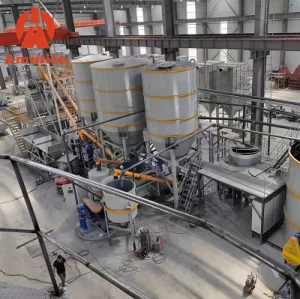
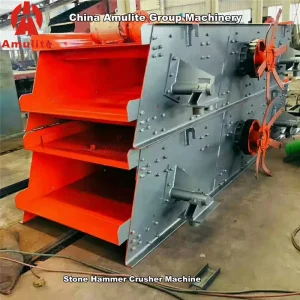
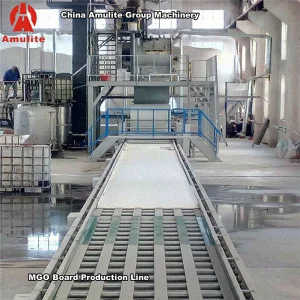
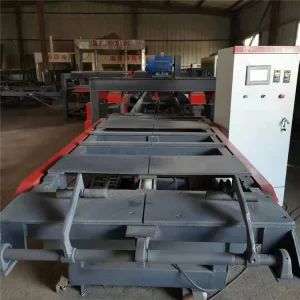
An architectural and engineering procurement breakdown for project developers, machinery buyers, and industrial factory investors.
In contemporary industrial, commercial, and high-density residential architecture, the global demand for advanced fireproof building panels has escalated to unprecedented levels. Driven by rigorous urban fire safety regulations such as EN 13501-1 (Classes A1 and A2-s1,d0), ASTM E119, UL 263, and BS 476, modern building codes mandate structural envelopes that prevent thermal propagation and maintain physical integrity under temperatures exceeding 1000°C. For industrial plant investors and construction conglomerates looking to buy a fireproof panel production line supplier ecosystem, selecting an equipment partner requires deep evaluation of material science, PLC automation integration, and operational efficiency.
The global fireproof panel manufacturing sector has transitioned from manual batch mixing and low-pressure pressing to fully continuous, high-shear slurrying, automated dewatering, multi-day hydrothermal autoclave curing, and robotic edge profiling. Today's commercial plants must deliver panels with high flexural strength (≥ 14 MPa), low moisture movement (≤ 0.15%), controlled dry density (800–1400 kg/m³), and absolute zero flame spread index. Achieving these metrics consistently across millions of square meters annually necessitates a turnkey production line engineered with precise tolerance control and robust industrial components.
SEO Information Gain Insight: Modern fireproof panel lines do not rely solely on traditional portland cement formulations. Advanced lines integrate recycled fly ash, silica flour, unrefined gypsum, and reactive magnesium compounds with micro-fiber matrices (cellulose, alkali-resistant glass fibers, and basalt filaments) to create high-density crystalline structures capable of withstanding 4-hour standard fire endurance tests.
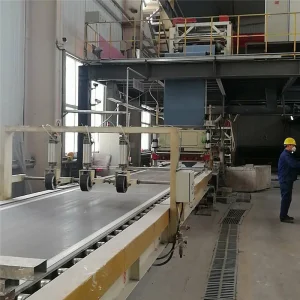
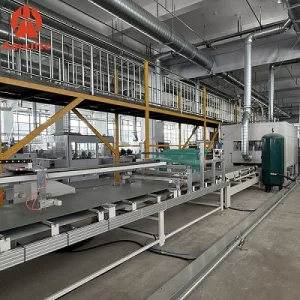
When procuring industrial machinery for fireproof boards (such as Fiber Cement Boards, Calcium Silicate Panels, MGO Boards, AAC Blocks, and EPS Cement Sandwich Panels), buyers must analyze five fundamental mechanical phases that define the production throughput and final board quality:
High-accuracy loss-in-weight gravimetric feeders, mass flowmeters, and high-shear turbo-mixers ensure homogeneous blending of binders, fillers, and fiber reinforcing agents with precise water-solid ratios.
Utilizing multi-vat Hatschek cylinder processes or advanced continuous extrusion methods. High-vacuum dewatering boxes strip free moisture, forming green sheets with exceptional green strength.
Multi-daylight hydraulic presses exert forces up to 10,000 tons. Pressing removes internal voids, increases board density, and raises ultimate flexural breaking load by over 30%.
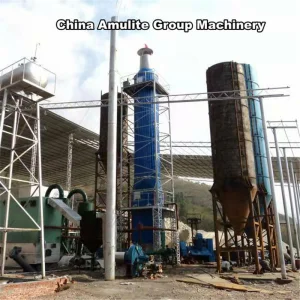
Saturated steam curing at 180°C–190°C and 1.0–1.2 MPa pressures accelerates the quartz-lime reaction, forming stable Tobermorite crystalline hydrates (C-S-H) that eliminate drying shrinkage.
Automated four-side saws with carbide/diamond tipping deliver precise sheet squareness (tolerance ±0.5mm), paired with heavy-duty calibrating wide-belt sanders for flawless surface smoothness.
Laser thickness measurement gauges, moisture sensors, and ultrasonic flaw detectors interface directly with SCADA systems, feeding automated robotic vacuum stackers.
Investors looking to buy fireproof panel production equipment must align machine capabilities with target product specifications. The technical matrix below outlines performance specs across major fireproof panel variants:
| Board Type | Primary Raw Materials | Fire Rating (Standard) | Density (g/cm³) | Flexural Strength (MPa) | Key Production Equipment |
|---|---|---|---|---|---|
| Fiber Cement Board | Portland Cement, Quartz Sand, Pulp, Synthetic Fibers | Class A1 (EN 13501-1 / ASTM E119) | 1.2 - 1.6 | 14 - 22 | Hatschek Machine, Autoclave, 7000T Press, Sanding Line |
| Calcium Silicate Board | Silica Powder, Lime, Cellulose Fiber, Water | Class A1 Non-Combustible | 0.8 - 1.1 | 9 - 14 | Dosing System, Cylinder Mold, High-Temp Autoclave |
| MGO Fireproof Board | Magnesium Oxide, MgCl₂/MgSO₄, Perlite, Mesh | Class A1 / UL 263 (3 to 4 Hours) | 0.9 - 1.2 | 12 - 18 | Automatic Slurry Spreader, Mesh Feeders, Curing Tunnel |
| EPS Sandwich Cement Panel | Cement Core, EPS Beads, Fly Ash, FC Board Skins | Class A1 (Core + Facing System) | 0.5 - 0.75 | 8 - 12 | Vertical/Horizontal Mould Cars, Foaming System, Mixers |
| Autoclaved Aerated Concrete (AAC) | Quartz Sand/Fly Ash, Cement, Lime, Aluminum Powder | Class A1 (Up to 4 Hours) | 0.4 - 0.7 | 3.5 - 7.5 | Tilting Cutting Machine, Demoulding Crane, Autoclave |
Deploying a fireproof panel production facility requires custom mechanical adaptation depending on local raw material availability, climate, and localized building regulations:
1. North America & Europe (ASTM E119, UL, EN Standards): Lines installed for these regions prioritize ultra-high automated precision, low volatile organic compound (VOC) emissions, and zero-asbestos formulations. Equipment design incorporates double-sided calibration sanders to meet strict sub-millimeter tolerances required for ventilated curtain wall facades and shaft-wall enclosures.
2. Middle East & GCC Region (Civil Defense Approval): Focus is directed toward high thermal insulation combined with A1 fire ratings for exterior wall cladding in extreme ambient heat. Lines often combine MGO or Calcium Silicate cores with decorative flexible clay or aluminum composite laminations.
3. Asia-Pacific & Latin America (Rapid Urbanization & Modular Housing): High demand for continuous EPS sandwich cement panel production lines. These plants allow rapid prefabrication of lightweight structural walls, significantly reducing crane loads and assembly cycles in high-seismic zones.
The next decade of fireproof board manufacturing will be defined by three critical engineering shifts:
• AI-Optimized Slurry Rheology: Real-time viscosity monitoring using acoustic sensors and machine-learning algorithms to dynamically adjust flocculant dosing, reducing water usage by up to 18%.
• Zero-Carbon Curing Integration: Direct injection of industrial flue-gas CO₂ into cementitious slurry, accelerating carbonation curing while permanently sequestering carbon within the mineral matrix.
• Fully Integrated Industry 4.0 SCADA Pipelines: End-to-end traceability where every single board is laser-etched with a QR code linking to its batch slurry chemistry, autoclave temperature curve, and flexural test verification.
Direct technical answers from process engineers regarding investment, sizing, and turnkey factory setup.
A standard 5 million square meter annual capacity line typically requires a plant footprint of approximately 180 meters in length by 24 meters in width, with a minimum hook height of 8 meters for overhead cranes. Electrical power transformer capacity should be sized at 800–1200 kVA, alongside a saturated steam boiler delivering 6 to 10 tons per hour at 1.3 MPa operating pressure.
MGO (Magnesium Oxide) board lines feature lower initial capital expenditure (CAPEX) because they do not strictly require high-pressure thermal autoclaves; curing occurs in energy-efficient low-temperature humidity chambers (40°C–60°C). However, OPEX depends on local access to reactive magnesia (MgO) and magnesium chloride/sulfate salts. Fiber cement lines have higher initial CAPEX due to autoclaves and presses, but lower raw material unit costs using local cement and silica sand.
Yes. Every project includes raw material laboratory analysis. Our process engineers adjust slurry formulations based on the particle size distribution (mesh size) and reactive silica content of your local river sand, crushed quartz, or power-plant fly ash, ensuring the final cured board meets international ASTM and EN standards without relying on imported raw materials.
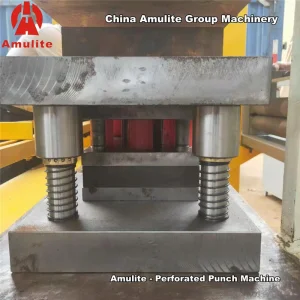
Our automatic 1300/1600 type edge-cutting machines feature twin-shaft high-speed carbide saws controlled via Siemens S7-1500 PLCs. Board indexing, squaring, chamfering, and dust extraction are fully integrated. Punching units utilize high-precision hydraulic matrix dies capable of per-minute stroke rates up to 40 cycles for acoustic acoustic-perforated fireproof ceiling panels.
All electrical cabinets and machinery components comply with European CE directives (Low Voltage Directive 2014/35/EU and Machinery Directive 2006/42/EC). All autoclaves and pressure vessels are fabricated under strict ASME Section VIII Div.1 or PED 2014/68/EU standards with third-party non-destructive testing (NDT) certification.
Discover auxiliary equipment, recycling machinery, and secondary finishing lines to complete your plant infrastructure.
Connect directly with our process engineering team for site layout drawings, raw material formula testing, and turnkey investment feasibility reports.