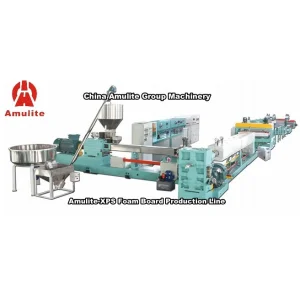
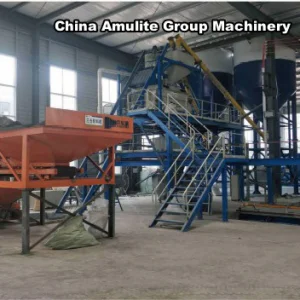
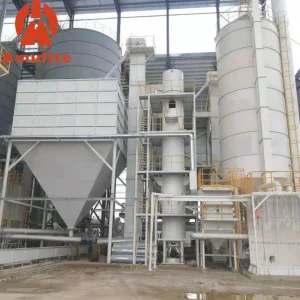
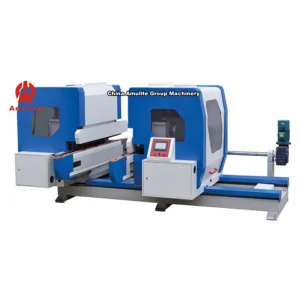
Explore our specialized production lines engineered for heavy-duty building material manufacturing, high output consistency, and automated plant operations.
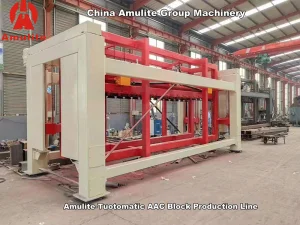
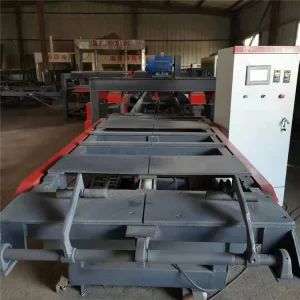
An in-depth analysis of global procurement shifting toward non-asbestos autoclaved fiber cement board production technologies to meet stringent modern structural and green building codes.
The modern architectural landscape demands structural materials exhibiting zero-flammability, exceptional dimensional stability, and long-term weathering resistance. Traditional air-cured cement boards lack the crystalline structural transformation required for extreme climate adaptability. By integrating High-Pressure Hydrothermal Autoclaving, raw silica ($\text{SiO}_2$) and lime/calcium ($\text{CaO}$) react chemically under saturated steam conditions ($170^\circ\text{C}-190^\circ\text{C}$ at $0.8-1.2\text{ MPa}$), forming Tobermorite ($\text{C}_5\text{S}_6\text{H}_5$) crystalline matrix structures. This transformation eliminates free lime efflorescence and shrinks moisture movement down to $<0.12\%$.
Advanced fiber cement board plants designed by China Amulite Group are engineered to utilize diverse local raw material streams without compromising mechanical flexural strength. The process utilizes Ordinary Portland Cement (OPC Grade 42.5/52.5), quartz sand (fineness $>325$ mesh), unbleached kraft cellulose pulp, and optional secondary cementitious materials such as fly ash, slag, or micro-silica. This flexible slurry rheology reduces primary material costs by up to $18\%$ while preserving Class 4 structural impact resistance under EN 12467 testing frameworks.
Our turnkey plant architectures align fully with European CE guidelines, ISO 9001:2015 quality management systems, and ISO 14001 environmental frameworks. Closed-loop water recycling eliminates process liquid effluent, achieving Zero Liquid Discharge (ZLD). Integrated dust collection scrubbers reduce airborne PM2.5 levels across raw material dosing and edge sanding stations to $<2.0\text{ mg/m}^3$, guaranteeing compliance with rigorous OSHA and EU occupational safety directives.
A granular breakdown of the continuous Hatschek wet-forming system, pre-curing dynamics, heavy-duty hydraulic pressing, and high-pressure steam autoclaving.
Cellulose pulp sheets are processed in high-consistency hydrapulpers to open up micro-fibers, reaching a Schopper-Riegler (SR) beating degree of $45^\circ-60^\circ\text{ SR}$. Automated weighing batchers feed OPC cement, finely ground quartz sand slurry (95% passing 45-micron mesh), calcium hydroxide, and recycled board scrap into high-shear slurry mixers. Computer-controlled density control sensors maintain solid-to-liquid concentrations within $18-22\%$, ensuring uniform film formation during cylinder rotation.
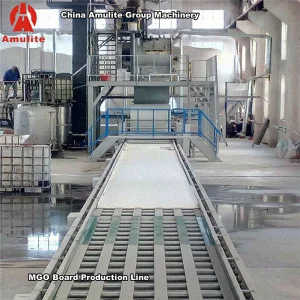
The homogeneous slurry flows into 3 to 5 continuous forming vats equipped with stainless steel wire mesh cylinders. Agitators prevent solids settling while rotation forms thin green films ($0.2-0.3\text{ mm}$ thickness per layer) onto a high-tension endless felt belt. High-vacuum dewatering boxes remove excess moisture under $-0.04\text{ to }-0.06\text{ MPa}$ pressure, building up green sheets layer-by-layer on the main accumulator roll until the target thickness ($4\text{ mm}$ to $30\text{ mm}$) is precisely reached.
Synchronized flying shears cut the endless green board into standardized dimensions (e.g., $1220 \times 2440\text{ mm}$ or $1220 \times 3050\text{ mm}$). Vacuum transfer handlers stack the green boards onto steel templates. For high-density board applications ($>1.4\text{ g/cm}^3$), an optional 7,000-to-10,000-ton hydraulic multi-opening press compresses the stack under $20-30\text{ MPa}$ surface pressure for 30 minutes, elevating mechanical density, removing micro-voids, and enhancing water imperviousness.
Stacked boards enter an energy-controlled pre-curing tunnel ($50^\circ\text{C}-60^\circ\text{C}$, $85-95\%$ RH) for 8 to 12 hours, achieving initial green handling strength. Next, automatic demolding robots separate steel templates from boards. The green boards are loaded into heavy-duty autoclave pressure vessels ($D3.2\text{m} \times L31\text{m}$). Over an 18-hour cycle (Heating, Hold at $185^\circ\text{C}$ / $1.0\text{ MPa}$, Cooling), amorphous C-S-H gel undergoes a phase transformation into crystalline Tobermorite ($\text{C}_5\text{S}_6\text{H}_5$), imparting permanent structural strength, zero moisture expansion, and fire resistance.
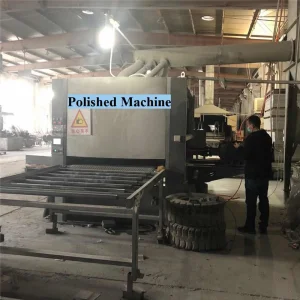
After autoclave cooling, boards pass through multi-head calibration thickness sanders to achieve strict dimensional tolerances within $\pm 0.2\text{ mm}$. Edge-trimming saws square all four sides automatically. For high-value decorative applications, boards are routed directly to fully automated UV coating lines, water-repellent silane impregnation systems, or wood-grain embossing stations to produce exterior architectural cladding panels, ceiling tiles, and soffit boards.
Every Amulite autoclave fiber cement line integrates a centralized Siemens S7-1500 PLC architecture paired with industrial SCADA visualization software. Real-time sensor telemetry monitors slurry flow rates, vat vacuum levels, press tonnage, autoclave steam enthalpy, and energy consumption metrics per square meter. Predictive AI diagnostics detect motor vibration anomalies and slurry viscosity shifts, reducing unplanned plant downtime by over $35\%$.
| Performance Parameter | Medium Density Board (Air-Cured Equivalent) | High Density Autoclaved Board (Amulite Standard) | Test Protocol / Standard |
|---|---|---|---|
| Dry Density ($\text{g/cm}^3$) | $1.00 - 1.25$ | $1.35 - 1.70$ | EN 12467 / ASTM C1185 |
| Flexural Strength (EMC, MPa) | $\ge 9.0\text{ MPa}$ (Category B) | $\ge 16.0 - 24.0\text{ MPa}$ (Category A Class 4/5) | EN 12467 / ISO 8336 |
| Moisture Movement (%) | $\le 0.25\%$ | $\le 0.08 - 0.12\%$ | ASTM C1186 |
| Water Absorption (%) | $\le 35\%$ | $\le 20 - 25\%$ | EN 12467 |
| Thermal Conductivity ($\text{W/m}\cdot\text{K}$) | $0.24 - 0.30$ | $0.15 - 0.21$ | ASTM C177 |
| Reaction to Fire | Class B-s1,d0 | Non-Combustible Class A1 / BS 476 Part 4 | EN 13501-1 |
| Freeze-Thaw Resistance (100 Cycles) | $R_L \ge 0.75$ | $R_L \ge 0.92$ (No Cracking/Delamination) | EN 12467 Clause 5.5.2 |
Strategic CAPEX/OPEX framework for building material manufacturers evaluating capital equipment investments in high-efficiency fiber cement board production infrastructure.
Selecting an optimal plant footprint requires balancing initial capital investment against scale economies. A standard Amulite 5-Million $\text{m}^2/\text{year}$ autoclaved line requires a total facility footprint of approximately $18,000\text{ m}^2$, including raw material siloing, wet-forming bays, pre-curing space, autoclave tracks, and finished goods storage. Equipment CAPEX encompasses slurry dosing, 4-vat Hatschek sheet machine, 8,000-ton hydraulic press, 4 set autoclaves, sanding/trimming lines, and boiler utilities.
Per square meter of $8\text{ mm}$ autoclaved fiber cement board (density $1.4\text{ g/cm}^3$, weight $\approx 11.2\text{ kg/m}^2$), operational material inputs average:
Autoclaved fiber cement boards command significant market price premiums ($+\%35\text{ to }+60\%$) over traditional plasterboards and non-autoclaved calcium silicate boards due to their structural durability and exterior cladding capability. Based on global average market selling prices ($USD\text{ }4.50 - 8.00/\text{m}^2$ depending on surface finishing) and total manufacturing cost ($USD\text{ }2.10 - 2.80/\text{m}^2$), investors typically reach complete CAPEX amortization within 22 to 30 months of reaching baseline $85\%$ capacity utilization.
How China Amulite Group manages overseas installation, commissioning, local raw material calibration, and compliance certification across 60+ countries.
Every production line project is overseen by dedicated senior mechanical, electrical, and process engineering leads. From foundation civil drawing delivery to final acceptance testing, Amulite dispatch teams manage on-site installation, pipework alignment, electrical PLC panel integration, and dry-run mechanical testing. Resident process engineers remain on site until local staff are trained and continuous production achieves target board density and strength metrics.
Raw materials vary drastically across geographical regions. Silicates in South America may exhibit higher alumina content, while Scandinavian pulp sources present different fiber lengths. Amulite operates a specialized central materials testing laboratory that analyzes client-submitted quartz sand, cement, fly ash, and pulp samples. We formulate tailored chemical recipes and slurry rheology protocols to guarantee that final product characteristics pass local building codes (e.g., ASTM, CE, AS/NZS standards).
To minimize supply chain interruption, all critical line components—including Siemens PLCs, Schneider contactors, SEW gear reducers, and heavy-duty vacuum pumps—are standardized globally. Amulite provides remote VPN gateway access on control cabinets, allowing our software engineers to diagnose PLC logic, adjust autoclave temperature/pressure control loops, and push SCADA software updates worldwide within hours.
Review our supplementary automated production lines, finishing machinery, and resource recycling units engineered for global building material enterprises.
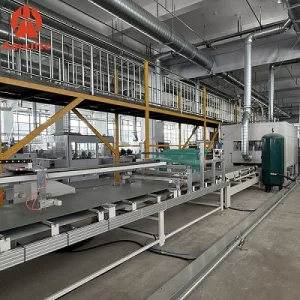
Authoritative technical guidance compiled by senior process engineers at China Amulite Group for procurement managers and factory investors.