High-capacity automated machinery designed for modern non-metallic wall panels, board manufacturing, and raw material processing.
Evaluating market growth, geographic expansion, and the rising demand for moisture-impermeable high-density wall board manufacturing machinery.
The global market for Waterproof Fiber Cement Board Wall Panel Making Machines is undergoing a structural surge, projected to expand at a compound annual growth rate (CAGR) of over 7.4% through 2032. This trajectory is driven by strict building fire-safety regulations (Class A1 non-combustibility), growing demand for prefabricated wall systems, and the shift from traditional wet plaster walls to fast-track dry construction. High-performance fiber cement panels with low water absorption (<10%) are rapidly replacing gypsum and plywood in humid commercial environments.
Asia-Pacific & Middle East: Rapid urbanization and megaprojects drive massive consumption of exterior rainscreen cladding and interior high-density wet-area backer boards.
North America & Europe: Severe weather resistance requirements, freeze-thaw durability, and timber-frame construction demand ultra-durable, waterproof fiber cement siding made with advanced autoclave technology.
From smart Industry 4.0 PLC automation to inline mass hydrophobization, equipment engineering is evolving to solve traditional board performance bottlenecks.
Modern production lines integrate liquid silane/siloxane emulsion dosing directly into the slurry batching phase. This coats cementitious pores at a molecular level, creating permanent water-repellent crystalline structures throughout the board matrix rather than relying solely on surface sealants.
Industry 4.0 integration connects raw material feeding, slurry consistency sensors, vacuum dewatering pressure pumps, and hydraulic press intensity into a single Siemens SCADA suite, minimizing thickness variance to within ±0.15mm.
Leading machine suppliers design autoclave curing systems equipped with dual steam re-compression heat exchangers. Uncured board trim waste is 100% recycled back into slurry pulping vats, eliminating raw material waste.
How a high-capacity Hatschek fiber cement board production line operates from raw material refinement to finished waterproof panel packaging.
High-shear wet pulping of unbleached cellulose fibers combined with Portland cement, silica sand fine powder, and hydrophobic dosing additives.
Slurry is transferred to multi-vat cylinder vats. Synthetic felt picks up micro-layers (0.2mm), winding them onto a solid steel accumulation roll under heavy pressure.
Green sheets pass through a 7,000 to 10,000-ton multi-daylight hydraulic press to eliminate micro-cavities, boosting board density up to 1.65 g/cm³.
High-pressure steam curing at 170°C–180°C (10 bar) for 12–14 hours synthesizes Tobermorite crystals ($C_{5}S_{6}H_{5}$), ensuring maximum flexural strength and low hydric movement.
Automated four-edge profiling saws cut sheets to exact dimensions, followed by online double-sided hydrophobic sealer coating and stack packaging.
| Machine Parameter | Standard Air-Cured Line | Advanced Autoclaved Line (Amulite High-Spec) |
|---|---|---|
| Target Board Density | 1.1 – 1.3 g/cm³ | 1.4 – 1.65 g/cm³ (High Density) |
| 24h Water Absorption | < 28% | < 8% to 12% (Waterproof Grade) |
| Flexural Strength (MOR) | 10 – 14 MPa | 18 – 28 MPa (Class 4/5 EN 12467) |
| Moisture Expansion (Hydric) | < 0.25% | < 0.10% (Zero Expansion Risk) |
| Forming Speed | 30 – 50 m/min | 60 – 90 m/min (Fully Automated) |
| Fire Rating Compliance | B1 / A2 | Non-Combustible Class A1 (BS 476 / EN 13501) |
Different climate zones and building architectures demand specific machinery parameters and chemical formulations.
Challenge: Continuous ambient humidity (>85% RH) and intense UV lead to mold decay, warping, and moisture swelling in low-tier boards.
Machinery Solution: Lines equipped with dual-stage hydrophobic dosing and post-curing UV sealer spray units ensure total moisture rejection, keeping panels stable in Southeast Asia, Africa, and South America.
Challenge: Absorbed water freezes and expands inside internal board capillaries, resulting in surface spalling and interior sheet delamination.
Machinery Solution: Autoclaved high-density press machinery refines micropore structures, reducing capillary suction so water cannot enter, passing >100 freeze-thaw cycles without strength degradation.
Challenge: Commercial kitchens, hospital operating rooms, and high-rise bathrooms require rigid substrate boards under heavy ceramic tiles.
Machinery Solution: Calibrated four-side sanding and edge-profiling equipment provides flat surfaces with precise tongue-and-groove or square edge cuts for immediate tile adhesion.
Why leading international building material investors choose China Amulite Group for full-scope plant design, equipment manufacturing, and commissioning.
Setting up a waterproof fiber cement board plant requires far more than ordering individual machines. It requires comprehensive process engineering, raw material slurry formulation testing, steam boiler thermal planning, and wastewater recycling integration.
Amulite Group engineers multi-purpose production lines capable of producing standard flat fiber cement board, textured wood-grain siding, pre-perforated acoustic ceiling panels, and high-density exterior sandwich panel facings.
Explore our complete range of autoclaved lightweight block lines, insulation board systems, and high-precision trimming machinery.
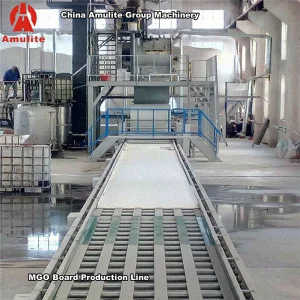
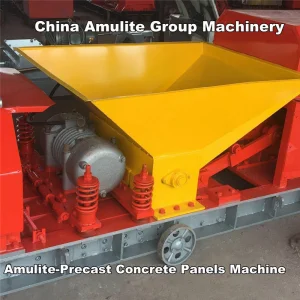
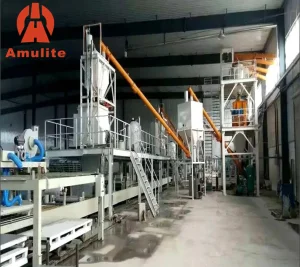
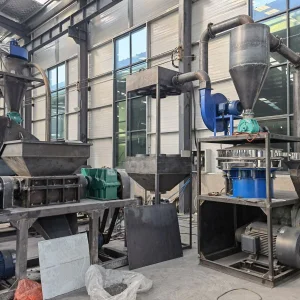
Engineering insights into machine capacity, waterproof formulations, return on investment, and plant setup.
True waterproofing requires dual-stage engineering: first, high-pressure hydraulic compaction (up to 10,000 tons) to eliminate macro-voids and reduce capillary suction; second, internal chemical mass hydrophobization via silane/siloxane emulsion added directly into the slurry batching system. This ensures that even if the board is cut, drilled, or chipped on site, the core remains 100% water-repellent with absorption below 8-10%.
Amulite configures customized lines ranging from 2 million m² per year (for regional market startup lines) up to 30 million m² per year for large-scale industrial plants. Output capacity is tailored by increasing sheet machine forming width (1,300mm to 1,600mm), adding cylinder vats (3 to 6 vats), and expanding autoclave chamber volumes.
Yes. Amulite operates an in-house process testing laboratory. Before machinery fabrication begins, we analyze your local Ordinary Portland Cement (OPC), silica sand flour, quartz tailings, fly ash, and pulp fiber samples to establish a custom formulation matrix that achieves target flexural strength and waterproof density without relying on expensive imported raw materials.
Typically, machinery manufacturing takes 90 to 120 days. Site civil foundation work occurs simultaneously under Amulite guidance. On-site mechanical and electrical erection takes 45 to 60 days, followed by 15 to 30 days of trial production, formulation fine-tuning, and operator safety/maintenance training conducted by our resident engineers.