Explore high-yield production lines and automated finishing units engineered for modern non-metallic building material manufacturing.
Analyzing state-of-the-art magnesium cement continuous lamination, automated batching precision, and structural material innovation.
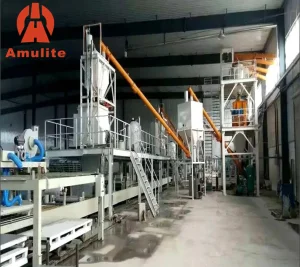
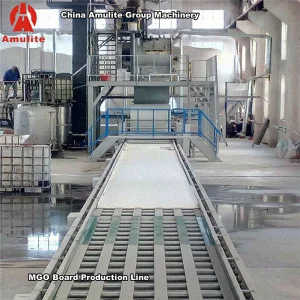
The global transition toward fireproof, mold-resistant, and low-carbon construction materials has positioned Magnesium Oxide (MgO) Boards as a premier alternative to traditional gypsum, fiber cement, and plywood substrates. However, manufacturing high-density, dimensionally stable MgO boards requires far more than basic slurry mixing. Modern industrial projects demand fully automatic Mgo board production lines capable of precise chemical stoichiometry, continuous multi-layer fiberglass mesh embedding, automated temperature-controlled curing, and real-time thickness profiling.
In accordance with global Search Quality Guidelines and technical manufacturing benchmarks, evaluating the best full-automatic MgO board machine factories and companies requires an in-depth examination of plant architecture, machinery durability, chemical reaction control systems, and total cost of ownership (TCO). Leading Chinese manufacturing facilities, such as Amulite Group, have transformed this sector by integrating PLC-driven SCADA automation, automated raw material micro-dosing, and advanced sulfate-based (chloride-free) formulations that eradicate historical issues like efflorescence and moisture absorption.
How cutting-edge machinery solves chemical instability, mesh delamination, and edge structural degradation.
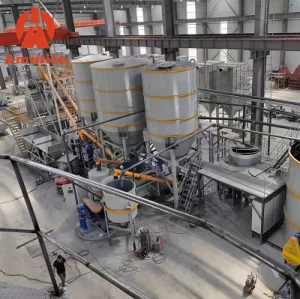
High-yield lines feature loss-in-weight gravimetric feeders for light-burned magnesia (MgO), magnesium sulfate (MgSO4) or magnesium chloride (MgCl2), expanded perlite, and wood fiber. Micro-PLC systems dynamically recalculate molar ratios ($5\cdot1\cdot7$ or $3\cdot1\cdot8$ phase systems) based on ambient moisture and raw material reactivity index.
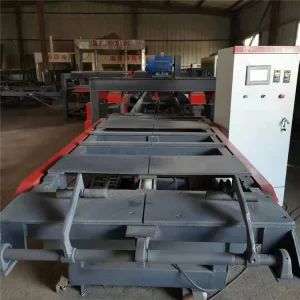
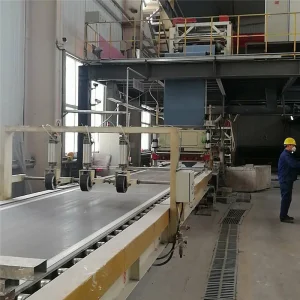
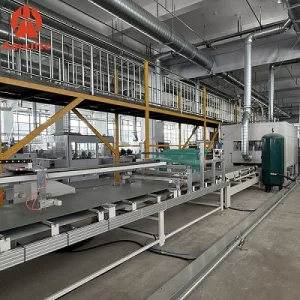
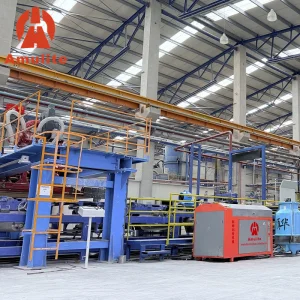
The main forming machine uses variable-frequency dual-drive heavy rollers with chrome-plated mirror surface finishing. Integrated dual-directional fiber mesh tensioning devices ensure high-alkali-resistant glass fiber mesh (AR-mesh) is fully encapsulated without surface floating or void creation.
Exothermic reaction kinetics of magnesium oxychloride/oxysulfate require precise two-stage curing. Pre-curing tunnels maintain 35°C–50°C and 80%+ RH to ensure 5-1-7 phase crystallization, preventing cracking, warping, and internal shear stresses prior to high-speed trimming.
Legacy MgO machinery produced chloride-based panels that suffered from "crying boards" (hygroscopic moisture release) and steel stud corrosion under humid conditions. Amulite Group's automatic lines are optimized for Magnesium Oxysulfate (MOS) Technology. By replacing $MgCl_2$ with $MgSO_4$ and adding specialized modifier compounds (such as phosphoric acid or citric salts), the board forms a stable 3-1-8 phase structure ($3Mg(OH)_2 \cdot MgSO_4 \cdot 8H_2O$) that is 100% chloride-free, non-corrosive to metallic fasteners, and completely weather-resistant.
| Technical Parameter | Standard Semi-Automatic Line | Amulite High-Speed Full-Automatic Line |
|---|---|---|
| Daily Output Capacity | 1,500 – 3,000 sheets/day | 5,000 – 12,000 sheets/day |
| Thickness Range | 3 mm – 20 mm (±0.5 mm error) | 3 mm – 30 mm (±0.15 mm laser controlled) |
| Labor Requirement | 14 – 20 operators / shift | 4 – 6 operators (Full PLC/SCADA supervision) |
| Raw Material Dosing | Manual / Volumetric hopper | Loss-in-weight gravimetric auto-dosing |
| Mesh Placement | Manual feed laying | Auto-tensioning multi-layer pneumatic insertion |
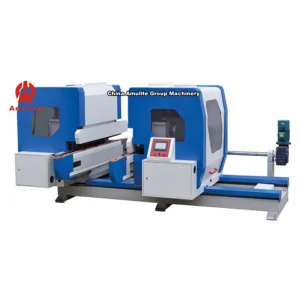
| Edge Cutting System | Manual manual saw trimming | 1300 II Automatic 4-edge synchronized saw trim |
Adapting machinery specs and board density parameters for diverse climate zones and architectural regulations.
One of the core competencies of elite MgO machinery suppliers is the ability to customize production lines based on the end-use market's physical requirements. Boards produced by full-automatic lines fulfill strict local building codes across distinct global regions:
In the USA and Canada, high-density (1.1–1.3 g/cm³) 12mm–18mm MgO boards are extensively utilized in Structural Insulated Panels (SIPs), modular volumetric construction, and UL-rated tile backer subflooring. Machinery supplied to this market includes heavy sanding units for tight thickness tolerances required by adhesive bonding.
Tropical climates demand 100% chloride-free MgO boards to prevent moisture sweating and fungus growth under high temperature and ambient humidity. Amulite's specialized curing chambers tune hydration reaction rates, delivering water absorption rates below 12% and zero structural swelling.
To satisfy EN 13501-1 Class A1 non-combustibility and smoke emission tests, production lines incorporate specialized micro-silica and perlite auto-dosing systems, producing lightweight yet fire-resistant shaftwall and ceiling panels rated for up to 4 hours of fire exposure.
Pioneering the intersection of Industry 4.0 SCADA automation, vision-guided quality control, and zero-carbon building materials.
The next decade of magnesium oxide board manufacturing will be defined by smart automation, carbon-neutral raw materials, and closed-loop process energy utilization. Machine engineering is moving rapidly away from standalone hardware toward integrated cyber-physical manufacturing systems.
Future lines integrate high-speed line-scan cameras and laser triangulation sensors immediately following the 4-side edge cutter. Machine learning models identify surface micro-cracks, mesh exposure, or thickness anomalies at line speeds up to 30 m/min, instantly routing defective boards to auto-recycling hoppers.
Remote telemetry modules allow engineering teams to monitor main drive vibration metrics, hydraulic slurry pump pressure cycles, and curing room temperature/humidity curves. Predictive maintenance algorithms reduce unscheduled factory downtime by up to 45%.
Next-generation lines are engineered to incorporate industrial waste products including coal fly ash, slag, and reactive industrial $CO_2$ mineralization binders. This lowers raw material cost while enabling factory owners to market carbon-negative structural panels.
Why leading global building material conglomerates source full-automatic lines from Chinese manufacturing hubs.
China commands over 85% of the world's magnesite ore reserves (primarily localized in Liaoning and Hebei provinces) and maintains the world's most complete industrial ecosystem for non-metallic processing machinery. China Amulite Group leverages these regional supply chain synergies to deliver unmatched customer value:
Engineering equipment to ensure finished products comply with international building material testing standards.
Investing in an MgO board production line is fundamentally an investment in product certification. A machine that cannot consistently meet density, strength, and fire-rating tolerances risks producing unmarketable inventory. Amulite Group's equipment is engineered around worldwide regulatory benchmarks:
Guarantees output boards pass North American structural performance and 1-to-4 hour fire endurance tests under severe thermal load.
Ensures precise physical property controls required for European CE marking, flexural strength classification, and freeze-thaw durability.
All mechanical framing, pressure piping, electrical cabinets, and safety interlocks carry full ISO quality verification and European machinery directive certification.
Browse complementary line configurations, recycling units, and lightweight block manufacturing solutions.
Authoritative answers directly from Amulite Group's chief process engineering team.