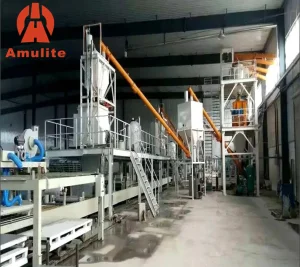
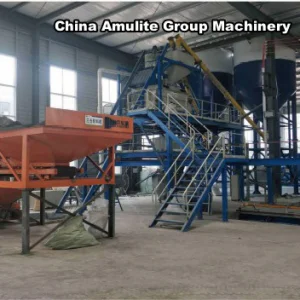
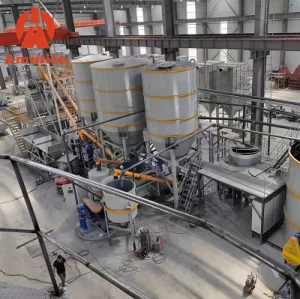
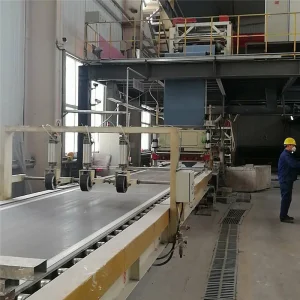
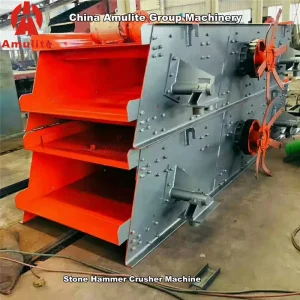
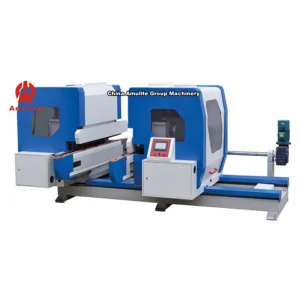
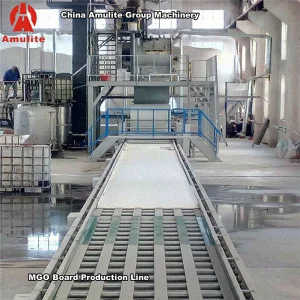
Explore our core product matrix engineered for high-performance thermal insulation, lightweight wall panels, and automated manufacturing systems.
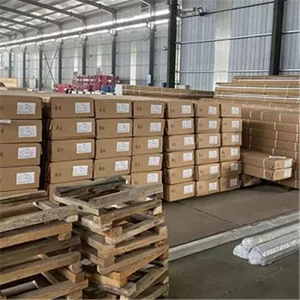
High-Quality Embossed Metal Composite Exterior Panels Production Line Manufacturers, Company
View Product DetailsAn in-depth analysis of Extruded Polystyrene (XPS) tile backer board production systems, structural sandwich lamination, and blowing agent dynamics.
In modern architectural engineering, standard gypsum and cement boards are rapidly being replaced by XPS Tile Backer Boards. Composed of a rigid extruded polystyrene core reinforced on both sides with alkali-resistant fiberglass mesh embedded in a polymer-modified cementitious mortar coating, these composite boards deliver absolute waterproofing, zero capillary action, superior thermal insulation, and exceptional shear bond strength for heavy ceramic and natural stone tiles.
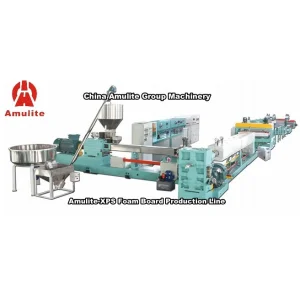
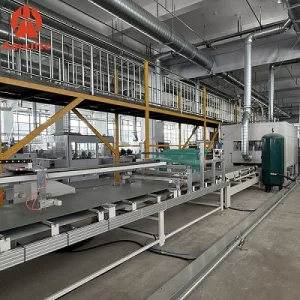
A complete, professional-grade XPS Insulation Tile Backer Production Line must integrate tandem extrusion technology, precise continuous double-sided fiberglass mesh coating, automatic multi-axis trimming, and dust-free stack packaging to ensure consistent industrial-scale production.
| Physical / Technical Property | XPS Core Layer Benchmark | Finished Backer Board Standard | Testing Standard Compliance |
|---|---|---|---|
| Density Control Precision | 32.0 – 45.0 kg/m³ (±1.5 kg/m³) | 160 – 220 kg/m³ (Incl. Cement Facings) | ISO 845 / ASTM D1622 |
| Compressive Strength (at 10% deflection) | 300 – 500 kPa | > 400 kPa | EN 826 / ASTM D1621 |
| Thermal Conductivity (λ) | 0.027 – 0.029 W/(m·K) | 0.030 – 0.033 W/(m·K) | EN 12667 / ASTM C518 |
| Water Absorption (28-day immersion) | < 0.7% by volume | 0.0% (Capillary Breaker) | EN 12087 / ASTM C272 |
| Tile Shear Bond Adhesion Strength | N/A (Uncoated) | > 0.35 MPa (C2 Tile Adhesive) | EN 12004 / ANSI A118.10 |
| Fire Reaction Class | Class B1 / Euroclass E or B-s2,d0 | Class B-s1, d0 (Flame Retardant) | EN 13501-1 / UL 94 |
Utilizes a primary twin-screw extruder for optimal polymer plasticization and flame-retardant mixing, paired with a high-displacement secondary single-screw extruder for controlled cooling and supercritical CO2 foaming agent injection.
Double-sided continuous polymer-modified cement slurry applicator with precision mesh tensioners, guaranteeing zero bubble formation, zero delamination, and precise depth control of the fiberglass reinforcer.
Full SCADA digital integration, continuous ultrasonic board thickness monitoring, real-time density feedback loops, and auto-tuning temperature zones across all die zones.
Why leading global building material conglomerates partner with China for turnkey XPS equipment sourcing.
Chinese machinery manufacturers leverage dedicated CNC machining centers for extruder screw barrel fabrication, coat-hanger die head shaping, and precision calendar roller manufacturing. In-house control over key mechanical components reduces machinery procurement costs by 35% to 50% compared to European counterparts, without sacrificing structural rigidity or operational life.
China accounts for a major share of global GPPS (General Purpose Polystyrene) resin production, eco-friendly flame retardants (such as organic phosphorus compounds), and high-tensile alkali-resistant fiberglass mesh. Sourcing equipment from an integrated hub allows factory owners to receive pre-tested raw material formulations tailored to local thermal and fire codes.
While Western suppliers often require 12 to 18 months for delivery of full extrusion-to-coating plants, Chinese suppliers operate streamlined production pipelines delivering complete customized manufacturing lines within 90 to 120 days. All lines undergo pre-shipment dry runs and electrical modular testing.
Targeted technical guidance for procurement officers, plant engineering directors, and industrial distributors.
Focus on equipment throughput speed (m/min), continuous edge grooving capability, and automated surface texturing (waffle grid, diamond emboss) to maximize mortar mechanical interlock strength for end-users.
Require modular plant designs capable of quick reconfiguration between varying board thicknesses (4mm to 100mm) for wall cladding, floor underlayment, and roof insulation projects.
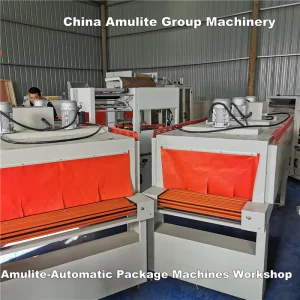
Demand integrated inline printing units, precision laser branding, micro-cut edge profiling, and shrink-wrap auto-palletizing systems for immediate direct-to-retail shipment.
Stay ahead of regulatory shifts and technical evolutions shaping the non-metallic insulation market.
Global environmental mandates (such as the EU F-Gas Regulation and Kigali Amendment) are phasing out Hydrofluorocarbons (HFCs). Advanced lines use Supercritical CO2 combined with Ethanol or DME, resulting in zero Ozone Depletion Potential (ODP) and negligible Global Warming Potential (GWP), while cutting gas costs significantly.
Innovations in multi-layer die design allow lines to extrude a dense skin on the XPS foam core before cement coating. This dual-density profile drastically increases point-load puncture resistance without increasing overall board weight.
Modern plant designs include inline edge trimming recovery systems. Edge waste and off-cut boards are routed directly to high-torque granulators, melt-filtered, re-pelletized, and fed back into the main feeder—achieving up to 98.5% material utilization.
Understanding where and how XPS tile backer boards perform in real-world construction installations.
In high-humidity environments, traditional moisture-resistant drywall eventually degrades due to vapor transmission. XPS tile backer boards act as an impenetrable vapor barrier and thermal break, preventing mold growth, structural framing rot, and tile pop-off.
Installed beneath heating wires or pipes, XPS tile backer boards reflect heat upward into the room rather than allowing it to bleed downward into the concrete subfloor. This reduces room warm-up times by up to 75% and slashes energy consumption.
Offsite modular construction requires lightweight, structurally rigid materials that withstand transport vibration. XPS backer boards provide the ideal substrate for pre-tiled pods, reducing pod weight by hundreds of kilograms per unit.
For external building envelopes, specialized coated XPS backer panels serve as a continuous insulation layer that accepts thin-brick, stone veneer, or synthetic stucco finishes, meeting modern energy code requirements.
Ensuring your manufacturing facility meets international engineering, electrical safety, and environmental standards.
All production line equipment can be engineered to comply with CE Directives (Machinery Directive 2006/42/EC, Low Voltage Directive 2014/35/EU), UL electrical standards, and CSA certification. Electrical control cabinets feature top-tier components from Siemens, Schneider Electric, or ABB.
Gas dosing units and primary extrusion gas barrels meet ASME Section VIII or EU PED (Pressure Equipment Directive 2014/68/EU) certifications, ensuring safe operation under high pressure CO2 dosing regimes.
Engineers are dispatched for factory layout civil guidance, line mechanical assembly, electrical commissioning, raw material formulation tuning, and comprehensive staff training in English, Spanish, Russian, or Arabic.
Browse our extended catalog of specialized board machines, recycling lines, and automation units.
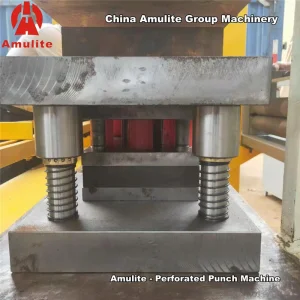
High-Quality Amulite Perforated Punch Machine System Technical Data Manufacturer, Suppliers
View Product DetailsEssential technical and financial information for prospective equipment buyers and plant operators.