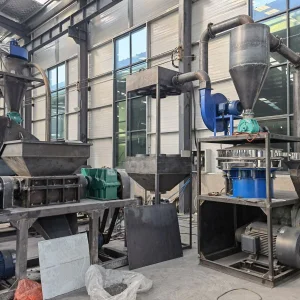
Engineered for high-volume automated processing, maximum throughput, and structural durability.
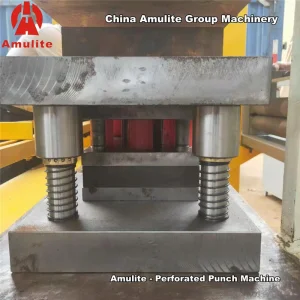
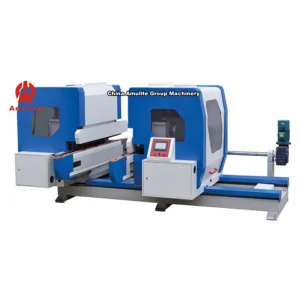
High-Quality Amulite Perforated Punch Machine System Technical Data Manufacturer, Suppliers
View System Details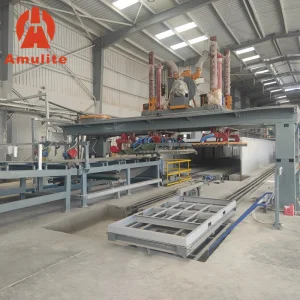
China Non-Asbestos/Asbestos Cement Corrugated Roof Sheets Production Line Company, Product
View System DetailsThe global manufacturing ecosystem for perforated materials is undergoing a profound paradigm shift driven by automation, material science innovations, and stringent acoustic-environmental regulations. A Perforated Punch Machine Manufacturer stands at the nexus of structural engineering, industrial automation, and materials processing. Modern perforated punching systems have evolved far beyond rudimentary mechanical presses into multi-axis CNC-controlled, hydraulic servo-driven, high-speed matrix punching lines capable of processing diverse substrates ranging from heavy-gauge stainless steel to delicate fiber cement boards, calcium silicate panels, and magnesium oxide (MGO) fireproof sheets.
In modern architectural acoustical engineering, interior noise reduction coefficient (NRC) requirements necessitate precise micro and macro-perforations. Concurrently, industrial filtration, automotive thermal management, and decorative building facades demand sub-millimeter positioning accuracy, zero-burr edge finish, and extreme stroke-per-minute (SPM) efficiency. Choosing an established, high-capacity machinery manufacturer is paramount for enterprise buyers seeking to mitigate operational downtime, extend tool life, and maximize return on capital expenditure (CAPEX).
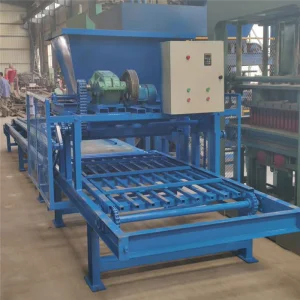
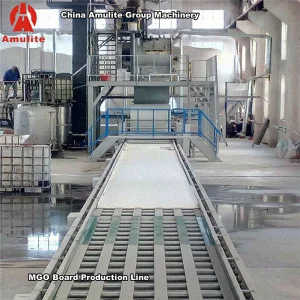
For modern production facilities, raw productivity relies heavily on full-line synchronization. Amulite's engineering team designs integrated turnkey systems where the perforated punch machine operates in direct harmony with feeding units, roller tables, online thickness scanners, dynamic leveling equipment, and robotic stackers. This continuous structural operational loop ensures that physical distortion, sheet bow, and micro-cracks—common issues in brittle materials like cementitious boards—are completely eliminated during continuous punching operations.
Industrial perforation requires an uncompromising structural frame designed to absorb extreme dynamic shockloads. Amulite perforated punch machines utilize a high-rigidity monoblock steel frame subjected to stress-relief annealing and precision CNC floor boring. This guarantees structural deflection ratios under 0.08 mm/m even at maximum nominal force operation.
Eliminates traditional mechanical flywheels. Direct-drive AC servo motors allow dynamic stroke adjustments, variable dwell times, and energy savings up to 40% compared to conventional friction clutch mechanisms.
Custom-engineered multi-needle die sets featuring tool steel inserts (SKD11 / Cr12MoV / Tungsten Carbide). Enables thousands of precise perforations in a single press cycle.
Integrated downstream multi-roll precision levelers counteract material stress relief deformation, ensuring dead-flat output ready for immediate coating or installation.
Determining the correct hydraulic or mechanical press capacity is critical to prevent die overload and premature tooling failure. The total punching force ($F$) required for a specific perforation pattern is calculated using the following engineering formulation:
For abrasive or non-metallic mineral substrates such as fiber cement boards or Calcium Silicate sheets, a material modification multiplier ($K_m = 1.25$ to $1.40$) is applied to account for dusting friction, structural shear resistance variability, and dynamic die wear factors.
| Parameter Class | High-Speed CNC Metal Puncher | Heavy Hydraulic Cement Board Line | Ultra-Micro Perforation System |
|---|---|---|---|
| Nominal Press Force | 800 kN - 2,500 kN | 3,000 kN - 12,000 kN | 500 kN - 1,500 kN |
| Max Sheet Thickness | 0.5 mm - 6.0 mm (Metal) | 4.0 mm - 25.0 mm (Board) | 0.2 mm - 2.0 mm (Foil/Sheet) |
| Hole Diameter Range | Ø 1.5 mm - Ø 100 mm | Ø 3.0 mm - Ø 30 mm | Ø 0.4 mm - Ø 2.0 mm |
| Max Stroke Rate (SPM) | 350 - 600 strokes/min | 60 - 150 strokes/min | 400 - 800 strokes/min |
| CNC Control Interface | Siemens S7-1500 / SCADA | Beckhoff Industrial PC / EtherCAT | Mitsubishi FX5U / Servo CNC |
| Die Change System | Quick Hydraulic Clamp (3 min) | Automated Rail Cart (8 min) | Manual / Cassette Quick Swap |
Enterprise procurement teams in North America, Europe, Southeast Asia, and the Middle East face multi-faceted evaluation criteria when selecting an industrial punch machine manufacturer. Beyond initial purchase price, total cost of ownership (TCO) dominates decision matrices. Procurement executives must evaluate vendor performance across four core vectors:
High-volume plants demand die sets engineered with vacuum heat-treated D2/SKD11 tool steels or tungsten carbide tips. Premium tooling supports over 2,000,000 punch cycles between resharpening routines.
Advanced proportional valve hydraulic loops equipped with closed-loop liquid chillers ensure oil viscosity remains stable during continuous 24/7 industrial production shifts.
Cement and mineral board perforation generates significant abrasive dust. Integrated under-bed pneumatic vacuum extractors suck away fine particulates instantly, preventing die jam and slide wear.
Operational financial modeling demonstrates that investing in an automated quick die change (QDC) system pays back investment capital within 14 months for factories experiencing frequent pattern changeovers. Amulite's standardized cassette-style die changing modules reduce tooling swap times from hours down to minutes, drastically maximizing overall equipment effectiveness (OEE).
The versatility of heavy-duty perforated punching technology enables cross-sector deployment across high-growth manufacturing sectors worldwide:
Production of micro-perforated sound-absorbing ceiling tiles, theater wall claddings, and stadium acoustic baffles made from non-combustible fiber cement, calcium silicate, or metal sheets.
Precision punching of heavy stainless steel strainers, centrifuge drums, grain drying screens, and chemical process separation plates requiring high open-area percentages without structural failure.
Custom CNC perforated exterior aluminum cladding panels, ventilated building envelopes, and solar shading screens created with variable pitch patterns and artistic graphic hole layouts.
Exporting complex industrial production lines demands strict adherence to international safety directives and technical standards. Amulite machinery designs fully conform with European Union CE Machinery Directive 2006/42/EC, Low Voltage Directive 2014/35/EU, and Electromagnetic Compatibility (EMC) Directive 2014/30/EU. North American installations are customized to meet NFPA 79 electrical standards and OSHA safety guidelines.
Equipped with Category 4 safety light curtains, dual-channel safety relay interlocks, key-trapped enclosure doors, and perimeter wire mesh guarding to ensure zero risk during operator intervention.
Secure cloud-connected PLC gateways enable Amulite field engineers to perform real-time diagnostic checks, firmware updates, and operational troubleshooting worldwide within minutes.
Dedicated multilingual service teams conduct complete physical installation, electrical hookup, tooling alignment, local operator training, and raw material calibration on location.
As smart manufacturing (Industry 4.0) permeates industrial machinery, the future of perforated punching machines centers on intelligent self-optimizing operation. key developmental milestones include:
1. AI Computer Vision Quality Control: Downstream high-resolution line-scan cameras integrated with deep learning vision models instantly verify 100% of hole dimensions, edge burr levels, and pitch spacing at full production speeds, automatically flagging tool wear before defect creation.
2. Adaptive Servo-Hydraulic Energy Management: Regenerative servo drive systems capture kinetic braking energy during ram reversal cycles, feeding power back into the DC bus to cut facility electricity draw by up to 35%.
3. Predictive Tooling Health Monitoring: Piezoelectric vibration sensors and acoustic emission transducers embedded directly inside the punch block measure micro-frequency shifts, providing automated alerts when pin sharpening is required before die chipping occurs.
Direct technical guidance from Amulite senior mechanical and software automation teams.
For metallic sheets (steel, aluminum), punch-to-die clearance typically ranges between 5% and 10% of material thickness. However, for brittle non-metallic mineral substrates like fiber cement boards or Calcium Silicate boards, die clearance must be held tighter (typically 2% to 4% of thickness) combined with positive pressure spring strippers to prevent edge breakout, delamination, and top surface chipping.
Punching hundreds of closely spaced holes releases internal material stresses, inducing sheet oil-canning or cambering. Amulite solves this by placing an inline heavy-duty 9-roll or 13-roll precision flattener/leveler downstream of the punch head. Hydraulic pressure rolls flex the board/sheet past its elastic yield point, guaranteeing flat finished sheets.
Yes. Amulite perforated punching systems are built with modular feed tables. They can be configured with pneumatic CNC gripper feeders for discrete sheet processing or coupled with a decoiler, loop pit, and servo-roll feeder for continuous coil-to-coil or coil-to-sheet production lines.
Using premium SKD11 tool steel dies on standard aluminum or mild steel, dies routinely reach 1,500,000 to 2,000,000 hits before resharpening is needed. When punching abrasive fiber cement, tool lifespan between regrinds ranges from 300,000 to 600,000 strokes. Total die shoe lifespan exceeds 15,000,000 cycles with proper maintenance.
Amulite die blocks incorporate hollow lower pin channels coupled with a high-flow vacuum ejector system beneath the bolster plate. Slugs are sucked down aggressively into a scrap conveyor, preventing slug pulling (where scrap rides back up with the punch pin and damages the sheet).
Standard model perforated punch machines are typically delivered within 60 to 75 days. Fully customized turnkey production lines including specialized multi-pin die tooling, automatic loading systems, and inline leveling equipment require 90 to 120 days from drawing sign-off to factory acceptance testing (FAT).
Explore integrated manufacturing plants engineered by China Amulite Group for heavy building supplies.
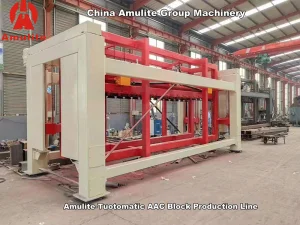
High-Quality Amulite Automatic AAC Block Production Line Manufacturers, Companies
View System Details