Gypsum Board Production Line Factory & Companies Serving Chicago

Industrial-Grade Machinery Engineering, Industry 4.0 Automated Plant Solutions & High-Efficiency Building Material Manufacturing Systems

Send Inquiry Now
Featured Gypsum & Board Equipment Solutions for Chicago Projects

Direct from factory engineering: Advanced automated drywall production equipment tailored to meet North American manufacturing standards, ASTM compliance, and Chicago regional industrial development needs.

Chicago Industrial & Commercial Drywall Ecosystem: Strategic Overview

The Greater Chicago metropolitan area—encompassing Cook County, the I-55 industrial corridor, and neighboring Midwestern logistics hubs—represents one of the most demanding commercial construction environments in North America. Driven by rigorous compliance standards under the Chicago Building Code (CBC), fire-resistance mandates (Type X and Type C gypsum boards), and sound transmission class (STC) ratings for dense urban high-rises, regional manufacturers and drywall suppliers are facing unprecedented demand for elevated production precision and throughput efficiency.

Operating a gypsum board production line factory serving the Chicago market requires deep alignment with localized architectural specs. Chicago's ongoing commercial revitalizations in Fulton Market, massive data center expansions in Elk Grove Village, and multi-family residential tower projects along the Chicago River require vast quantities of lightweight, fire-rated, moisture-resistant, and acoustic drywall products. To stay competitive, equipment operators cannot rely on legacy machinery; they require automated, energy-efficient, and highly scalable production lines engineered by top-tier global equipment manufacturers.

Chicago Building & Fire Performance Codes

Chicago’s strict fire codes demand consistent core density and synthetic glass fiber dispersion in Type X gypsum boards. Modern production lines must integrate high-precision micro-dosing systems for starch, foaming agents, and fiberglass to guarantee 1-hour and 2-hour structural fire ratings under ASTM C1396 testing conditions.

Regional Supply Chain Resilience

With proximity to major rail networks and Lake Michigan maritime freight, Chicago-focused wallboard facilities benefit from localized raw material sourcing—such as synthetic Flue-Gas Desulfurization (FGD) gypsum from regional power utilities and recycled paper liner. Continuous-line machinery must be adaptable to fluctuating raw gypsum purity without sacrificing board calcination quality.

China Industry 4.0: Manufacturing Resilience & Efficiency Advantages

How modern OEM engineering transforms capital investment economics for global and Midwest building material manufacturers through high automation, precise thermal engineering, and end-to-end supply chain integration.

30M+
Annual Capacity (m²/Year)
< 1.2%
Raw Material Waste Ratio
35%
Thermal Energy Recovery
100%
PLC SCADA Automation

Next-Gen Calcination & Fluidized Bed Tech

Modern Chinese gypsum machinery OEMs have pioneered low-temperature fluidized bed calcination furnaces capable of converting raw natural gypsum or industrial FGD gypsum into high-purity beta-hemihydrate plaster ($\text{CaSO}_4 \cdot 0.5\text{H}_2\text{O}$) with exceptional phase consistency. This ensures stable slurry setting times during high-speed board forming, minimizing scrap rates and lowering natural gas consumption per square meter of finished board.

Precision Edge Forming & Multi-Deck Drying

The drying stage accounts for over 60% of total operational thermal energy in a drywall factory. Chinese Industry 4.0 production lines utilize multi-deck, longitudinal horizontal air-circulation drying chambers integrated with heat exchangers. Automatic moisture sensors dynamically adjust zone temperatures to prevent paper burning while guaranteeing crisp, hardened square or tapered edges engineered to ASTM standards.

Localized Application Scenarios Across Chicago Construction Sectors

Gypsum wallboard and specialized concrete block units produced by our machinery lines cater directly to distinct real estate and civil development projects across Northern Illinois.

High-Rise Commercial Office Towers

In Chicago’s Loop and West Loop commercial districts, interior specs demand ultra-lightweight yet structurally rigid 5/8-inch Type X wallboard. Production lines fitted with high-efficiency foaming units produce boards with reduced core weight without sacrificing compressive strength, enabling faster crane rigging and lower dead-load calculations for structural engineers.

Logistics & Cold-Storage Facilities

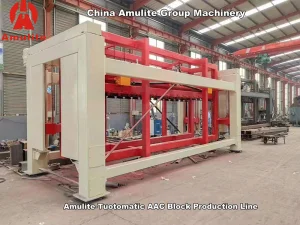
Surrounding O'Hare International Airport and Will County logistics corridors, large-scale industrial warehouses require cementitious AAC partition walls and heavy-duty exterior wall panel systems. Automated AAC block lines produce thermal-insulating, non-combustible block work essential for fire separation walls between logistics bays.

Urban Multi-Family & Modular Housing

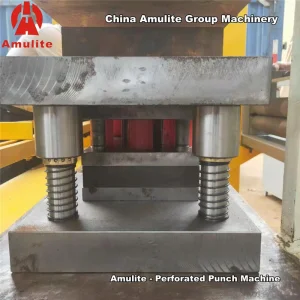
Residential loft conversions and high-density apartments near Lincoln Park and South Loop utilize soundproof perforated gypsum boards and moisture-resistant (green board) variants. Precision perforated punching equipment ensures high sound attenuation (STC 55+) across party walls and corridor enclosures.

Anatomy of a High-Capacity Gypsum Board Production System

Understanding the integrated engineering modules required to operate a profitable 10 million to 30 million square meter annual output factory.

1. Automated Dosing & Pin Mixer Station

Calculated volumetric feeding of stucco, dry additives (accelerators, starch, glass fiber), and liquid streams. The high-speed dynamic pin mixer ensures homogenous dispersion without breaking pre-generated micro-foam bubbles, maintaining core integrity and light weight.

  • Precision loss-in-weight screw feeders ($\pm 0.2\%$ accuracy)
  • Stainless steel mixer housing with tungsten carbide wear plates
  • Variable speed hydraulic/inverter drive system

2. Continuous Board Forming & Setting Belt

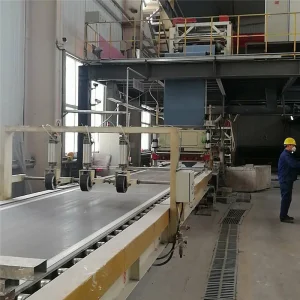
The liquid slurry is sandwiched between top and bottom paper sheets. The forming station controls board thickness (from 6.5mm up to 15mm or 5/8 inch), while a 400-meter vulcanized rubber setting belt allows controlled hydration of hemihydrate into gypsum crystals before cutting.

  • Pneumatic edge-creasing and scoring units
  • High-precision vibrating smoothing plates
  • High-speed rotary knife cutter with servo-gear box synchronization
Global Procurement Trends: Why Chicago Investors Partner with Advanced Machine OEMs

In today's globalized construction technology landscape, procurement directors and engineering management teams in Chicago and across North America evaluate board machine manufacturers based on total cost of ownership (TCO), long-term operational uptime, and modular upgrade capability. Partnering with experienced factory suppliers offers distinct strategic leverage:

Capital Cost Efficiency

Equipping a plant with machinery from established OEMs delivers 40% to 60% CAPEX savings compared to traditional European suppliers, allowing faster project payback (ROI within 24–36 months).

Customized Plant Layouts

Whether retrofitting an existing industrial warehouse in Cook County or building a greenfield plant along Midwest freight corridors, machinery layouts are engineered to exact space parameters.

Comprehensive Commissioning

Turnkey contracts include on-site mechanical erection supervision, PLC diagnostics setup, raw material trial testing, and local operator technical training.

Full Range of Building Material Production Lines & Machinery

Explore our complete catalog of automated production line solutions available for worldwide dispatch and Midwest US delivery.

Frequently Asked Questions: Gypsum Board Machinery & Plant Operations

Direct technical insights from our senior process engineering department regarding plant design, ROI, installation, and Chicago building compliance.

Q1 What annual production capacities are available for a new Gypsum Board Production Line?
Our standard production line configurations range from 2 million m² to 30 million m² per year. Small to medium lines (2M to 8M m²/year) are ideal for regional suppliers entering specific metropolitan markets, while high-speed fully automated lines (15M to 30M m²/year) utilize continuous twin-stream forming tables and multi-deck drying units engineered for maximum output.
Q2 Can the production line utilize synthetic FGD (Flue-Gas Desulfurization) gypsum instead of natural rock gypsum?
Yes. Our calcination systems can be tailored specifically to process 100% FGD synthetic gypsum derived from coal-fired power plants, chemical byproduct gypsum, or natural crude gypsum rock. The calcinator design is adjusted for moisture content and particle size to ensure complete conversion into high-quality plaster ($\beta\text{-CaSO}_4 \cdot 0.5\text{H}_2\text{O}$).
Q3 How do boards manufactured by your machines meet Chicago and US ASTM standard specifications?
Our machinery is engineered to produce boards that comply strictly with ASTM C1396 (Standard Specification for Gypsum Board). This includes accurate micro-dosing of fiberglass filaments for Type X fire-rated assemblies (UL/ULC designs), silicone additives for water-resistant boards (greenboard/sheathing), and core-density control to meet strict flexural strength and nail-pull resistance tests.
Q4 What is the typical energy consumption profile of an automated gypsum board manufacturing line?
Thermal drying and calcination represent the primary energy costs. Through our proprietary waste-heat recovery systems—which recycle hot exhaust gases from the calciner into the pre-heating zones of the board dryer—thermal consumption is reduced to approximately 2.2 – 2.6 Mcal per m² of standard board (12.5mm thickness), cutting fuel bills by up to 25%.
Q5 What lead time is required for equipment manufacturing, shipping, and installation in the North American region?
Equipment manufacturing and dry-testing at our base typically require 90 to 120 days. Logistics and ocean freight to US ports (such as ocean transport with rail connection to Chicago industrial depots) take approximately 30-40 days. On-site mechanical installation, civil alignment, and commissioning take 60 to 90 days under the guidance of our resident field engineers.

Ready to Plan Your Gypsum Board Plant Project?

Contact our senior process engineering consultants today for a comprehensive feasibility study, customized floor plant drawing, and detailed machinery cost quote tailored for Chicago and global operations.

Send Inquiry Now