



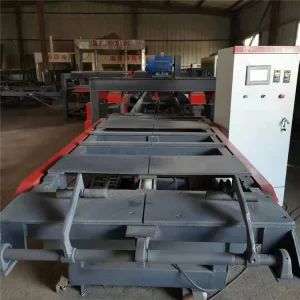
Heavy-duty, fully automated cutting equipment engineered for high throughput, zero edge-chipping, and dust-controlled environments across Saudi manufacturing facilities.
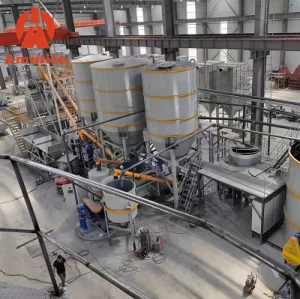
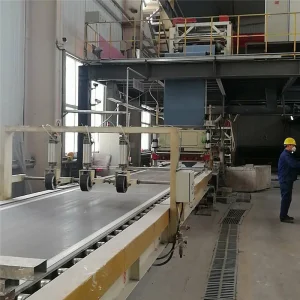
Strategic Insights into How Fully Automatic Cutting Systems Drive Industrial Efficiency Across KSA Giga-Projects
The Kingdom of Saudi Arabia is undergoing an unprecedented economic and industrial metamorphosis under the strategic framework of Saudi Vision 2030. Driven by the Public Investment Fund (PIF) and massive private investment, mega-developments such as NEOM, Qiddiya, the Red Sea Project, ROSHN, and Diriyah Gate have fundamentally shifted the regional construction paradigm. The traditional labor-intensive, cast-in-place concrete methodologies are rapidly yielding to Modern Methods of Construction (MMC), off-site prefabrication, advanced fiber cement paneling, calcium silicate siding, and Autoclaved Aerated Concrete (AAC) systems.
Within this accelerated construction ecosystem, the requirement for high-precision, high-throughput, and dust-controlled cutting machinery has reached a critical tipping point. A Fully Automatic Cutting Machine System serves as the fundamental bridge between raw board molding/curing operations and site-ready architectural components. In ambient operating temperatures that frequently exceed 45°C to 50°C in industrial corridors like Dammam, Riyadh Industrial City, and Jubail, manual edge finishing and legacy semi-automatic cutting lines suffer from severe thermal drift, high operator fatigue, excessive material wastage, and inconsistent dimensional tolerances.
Industrial building material producers in Saudi Arabia now demand advanced automated cutting solutions engineered with heavy-duty gantry structures, closed-loop servo positioning, optical alignment sensors, and active thermal compensation. As an established global machinery manufacturer and direct supplier to Saudi industrial entities, China Amulite Group delivers tailored cutting systems that meet strict international mechanical standards while ensuring full compliance with Saudi Arabia’s regulatory bodies, including SASO (Saudi Standards, Metrology and Quality Organization) and SABER certification frameworks.
Information Gain Insight: Modern automated cutting lines operating in the Gulf region must maintain structural rigidity under constant thermal cycles. Our 1300 II and custom multi-blade cutting platforms utilize heat-treated, stress-relieved steel frames coupled with IP65-sealed Siemens/Schneider control units, preventing thermal expansion mismatch and dust ingress during continuous 24/7 industrial runs.
Kinematic Precision, Multi-Axis Motion Control, and Integrated Dust Suppression Systems
Utilizes dual-gantry diamond saw station configurations to execute longitudinal rip cuts and transverse cross-cuts simultaneously, guaranteeing perfect 90-degree squareness on fiber cement, calcium silicate, and gypsum boards.
High-resolution optical laser sensors measure raw panel positioning in real-time, feeding positional adjustments to Panasonic/Yaskawa servo drivers to automatically correct skew before saw blade engagement.
Equipped with dual-stage cyclone hoods and pulse-jet baghouse filtration. Captures 99.4% of silica dust and calcium powder at the blade cutting zone, extending mechanical bearing life and protecting operator health.
Mechanical accuracy in automated cutting relies heavily on the design of the cutting bridge and spindle assembly. In Amulite’s high-capacity fully automatic cutting systems, saw arbors are mounted on dynamic balance-tested, precision-ground spindles operating at speeds up to 4,500 RPM. Blade height, depth, and chamfer angles can be digitally configured via an intuitive touch-screen SCADA interface, enabling rapid batch transitions between 4mm ceiling tiles, 12mm exterior cladding panels, and heavy 50mm insulating wall boards without manual tool restructuring.
Ensuring Seamless Equipment Importation, On-Site Installation, and Operational Reliability Across the Kingdom
Navigating the industrial machinery import landscape in Saudi Arabia requires strict adherence to institutional standards set forth by the Saudi Standards, Metrology and Quality Organization (SASO). All industrial automation, electrical control cabinets, pressure vessels (in autoclave-linked lines), and rotating machinery must be certified via the SABER platform prior to shipment arrival at Saudi ports such as King Abdulaziz Port in Dammam, Jeddah Islamic Port, or King Abdullah Port in KAEC.
Our standard electrical engineering packages for Saudi Arabia are pre-built to operate at 380V/400V 60Hz 3-Phase power configurations, utilizing CE-certified and UL-compliant components. Control panels incorporate tropicalized cooling systems to withstand ambient temperatures inside non-climate-controlled factory bays.
In line with Saudi Aramco's In-Kingdom Total Value Add (IKTVA) program and government local content requirements, China Amulite Group provides full technical documentation, spare-part cataloging, and comprehensive local workforce training modules to build long-term in-country technical self-reliance.
Beyond regulatory paperwork, mechanical equipment operated in Saudi Arabia must overcome environmental challenges. Ambient silica sand particles, dust storms (Haboobs), and high relative humidity in coastal regions like Dammam can severely compromise unsealed linear guides and optical sensors. Amulite cutting systems incorporate positive-pressure sealed linear bearings, double-lip dust wipers, and armored cable carriers to maintain high uptime and reduce routine maintenance stops.
Evaluating Capital Expenditure (CAPEX), Operational Efficiency (OPEX), and ROI for Saudi Industrial Purchasing Teams
When procurement heads and plant engineering managers evaluate suppliers for fully automatic cutting systems, the evaluation must extend far beyond the initial FOB machinery cost. A comprehensive Total Cost of Ownership (TCO) matrix incorporates four major operational vectors: Energy Consumption Efficiency, Blade and Wear-Part Longevity, Raw Material Yield Rate, and Unexpected Downtime Risk.
Precision servo positioning reduces trim edge width from the industry standard 25mm down to 8mm, resulting in a direct raw material savings of up to 4.2% across annual board production volumes.
Variable Frequency Drives (VFDs) dynamically adjust saw motor power based on material density and board thickness, reducing overall peak electrical demand by up to 22% during continuous shifts.
Integrated VPN/IoT gateways allow Amulite lead automation engineers to conduct remote real-time troubleshooting, code updates, and sensor calibration directly from our engineering center to plants in Saudi Arabia.
The Technological Roadmap of Autonomous Surface Defect Detection and Dynamic Edge Cutting
As industrial automation evolves towards fully autonomous Smart Factories (Lighthouse Manufacturing), cutting machinery is transforming from simple mechanical shearing devices into intelligent cyber-physical production nodes. The future of cutting machine systems in Saudi Arabia lies in the integration of AI-powered machine vision systems directly linked to multi-axis CNC cutting gantries.
China Amulite Group’s ongoing R&D initiatives focus on three core Industry 4.0 pillars designed to redefine board production economics:
High-speed line-scan cameras inspect the top and bottom surfaces of cured boards prior to saw engagement. If micro-cracks or density anomalies are detected, the system automatically alters the cutting pattern to isolate rejected segments, preserving prime material.
Vibration transducers and thermal acoustic sensors continuously monitor spindle bearing frequencies and blade tip friction profiles. Machine learning algorithms alert maintenance crews days before blade dulling causes edge chipping.
Post-cut boards are automatically sorted, vacuum-stacked onto heavy-duty pallets, wrapped, and transferred via Autonomous Guided Vehicles (AGVs) directly to warehouse storage, eliminating human touchpoints.
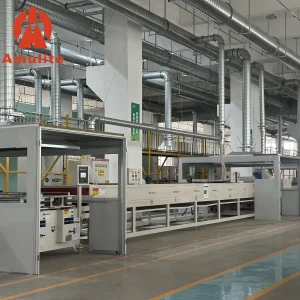
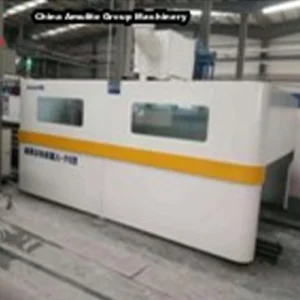
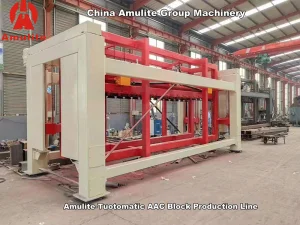
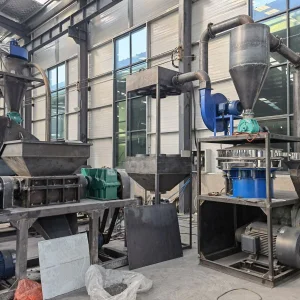
Explore Amulite’s Comprehensive Range of Fiber Cement, AAC Block, UV Coating, and Recycling Machinery Options
Engineering Clarifications, Customization Capability, Shipping Logistics, and Operational FAQs
Amulite fully automatic cutting machine systems achieve a linear precision tolerance of ±0.2mm and a diagonal squareness tolerance within 0.5mm across standard 1220x2440mm sheets. This is accomplished through dynamic laser-guided edge registration and zero-backlash ball screw gantry drives paired with precision servo motors.
Our machinery supplied to Saudi Arabia features heat-relieved structural steel frameworks and IP65/IP66 electrical enclosures outfitted with industrial thermostatic cooling/air-conditioning units. Cables are thermal-sheathed, and motors are rated Class H insulation to prevent overheating in 50°C+ ambient factory environments.
Yes. All Amulite export equipment destined for the Saudi market comes with comprehensive technical dossiers, factory acceptance test (FAT) documentation, and CE/ISO certifications required to issue SABER Product Certificate of Conformity (PCoC) and Shipment Certificate of Conformity (SCoC).
Manufacturing of a customized fully automatic cutting system takes approximately 45 to 60 days. Maritime shipping from China to Dammam or Jeddah ports takes 20 to 25 days. Upon site arrival, Amulite installation engineers deploy to Saudi Arabia to oversee mechanical assembly, electrical wiring, PLC setup, and operator training within 14 to 21 days.
Yes. Amulite cutting systems feature programmable SCADA recipes that allow operators to instantly switch speed, blade RPM, dust extraction airflow, and feed rate to accommodate Fiber Cement Board, Calcium Silicate Board, Gypsum Board, AAC Panels, or MGO Board with different density parameters.
Accelerate your plant throughput, eliminate material waste, and satisfy Saudi Vision 2030 building standards with custom-engineered industrial machinery.
Send Inquiry Now