



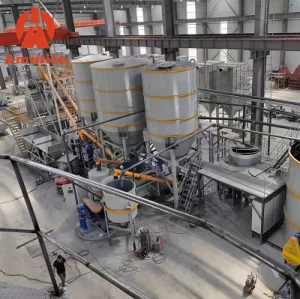
High-yield wall panel machinery and integrated auxiliary lines configured specifically for Horn of Africa raw materials, electrical specs, and ambient climatic conditions.
Analysing urban expansion, housing supply deficits, and structural masonry shifts in Addis Ababa, Hawassa, and regional industrial hubs.
Ethiopia stands as one of East Africa’s fastest-growing economies, driven by massive national infrastructure programs, urban migration, and expanding industrial parks such as Bole Lemi, Hawassa, and Adama. The Ministry of Urban Development and Construction (MUDCo) has consistently highlighted the acute deficit in residential units, commercial offices, and low-cost public housing across major urban centers.
Historically, Ethiopian construction relied heavily on Hollow Concrete Blocks (HCB) and traditional cast-in-place brickwork. However, HCB construction presents severe operational bottlenecks: high structural dead weight, excessive mortar consumption, slow installation velocity, and vulnerability to micro-seismic movement across the Great Rift Valley region.
The modern industrial solution is the localized manufacture of Expanded Polystyrene (EPS) Sandwich Cement Wall Panels. By replacing heavy HCB masonry with lightweight, pre-cured fiber cement EPS panels, contractors in Addis Ababa are reducing overall structural load by 35% to 40%, accelerating floor-to-floor erection speeds by up to 600%, and significantly lowering total project CAPEX.
Quantifiable performance indicators engineered into our heavy-duty automated production lines.
Custom-tailored EPS sandwich cement panel configurations optimized for Ethiopia’s varied altitudes and environmental zones.
In high-density commercial towers around Kazanchis and Financial District, 90mm and 120mm non-load bearing EPS sandwich panels replace double-layer drywall and heavy blocks, delivering superior acoustic separation (42dB to 48dB) and accelerating space handover.
Standardized 60mm and 75mm tongue-and-groove interlock panels engineered for rapid modular construction. Factory-made dimensional stability minimizes on-site wet plastering work, enabling local contractors to complete residential blocks in record turnaround schedules.
For processing centers in Hawassa and Kombolcha Industrial Parks, 150mm thick composite EPS cement panels provide essential thermal insulation against ambient daytime heat spikes, preventing interior climate drift and maintaining energy balance.
Direct physical and operational comparison matrix highlighting structural, economic, and logistical performance advantages.
| Performance Parameter | EPS Cement Sandwich Panel (Our Line) | Hollow Concrete Block (HCB) | Red Clay Kiln Bricks | Gypsum Board Drywall |
|---|---|---|---|---|
| Average Surface Weight (90mm) | 45 - 55 kg/m² | 160 - 200 kg/m² | 190 - 240 kg/m² | 25 - 35 kg/m² |
| Installation Speed (m²/worker/day) | 35 - 50 m² | 6 - 10 m² | 4 - 8 m² | 20 - 30 m² |
| Fire Endurance Standard | Non-combustible A1 Class (> 4 hrs) | 2 to 3 hrs | 3 to 4 hrs | 0.5 to 1 hr (Standard) |
| Sound Insulation Rating (STC) | 42 - 50 dB | 35 - 40 dB | 40 - 45 dB | 32 - 38 dB |
| Compressive Strength Range | 3.5 - 5.0 MPa | 2.0 - 3.5 MPa | 5.0 - 7.5 MPa | N/A (Non-structural) |
| Mortar & Plaster Demand | Zero Wet Plaster Required | Heavy Joint Mortar & 20mm Plaster | Heavy Joint Mortar & 20mm Plaster | Joint Compound Only |
| Moisture Resistance & Hydrophobicity | Water absorption < 8% (Waterproof) | High porosity water absorption | Moderate absorption | Extremely vulnerable to humidity |
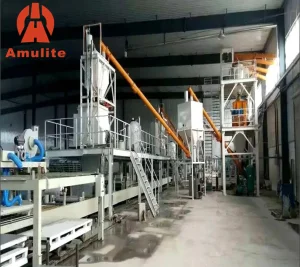
A turn-key automated process combining precise raw material batching, continuous core slurry injection, automated mold cars, and PLC process loops.
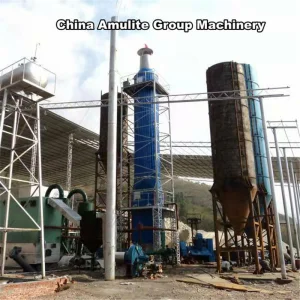
The line integrates multi-stage silos for locally sourced Ethiopian Ordinary Portland Cement (OPC grade 42.5N/R or PPC) and silica sand or processed fly ash. Intelligent load-cell dosing scales ensure sub-1% accuracy in component measurement. Water, foaming agents, and pre-expanded EPS beads (density 10-15 kg/m³) are fed into a specialized high-shear planetary mixer, generating a highly homogeneous mortar slurry without crushing the expanded polystyrene matrix.
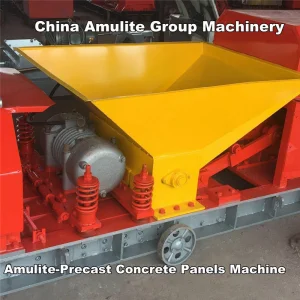
High-tensile steel vertical mold cars receive pre-cut calcium silicate or fiber cement face boards along their internal sidewalls. Hydraulic positioning clamps seal the mold car units, after which central pumping pipelines inject the slurry under pressure. The vertical design maximizes space footprint in the factory while assuring smooth 4-side tongue-and-groove profile formation.
Post-injection mold cars are routed into automated curing tunnels where temperature (40°C - 60°C) and moisture parameters are monitored via IoT sensors. This accelerated heat hydration process guarantees early-stage compressive strength development, preventing shrinkage cracks and ensuring dimensional tolerances within ±0.5mm across the 2440mm length.
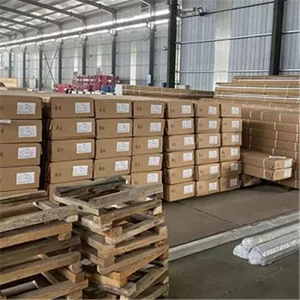
Once initial cure cycle completes (typically 3-4 hours depending on formulation), hydraulic demolding mechanisms open the vertical panels smoothly. Automated vacuum lifters strip the panels, transfer them to secondary curing racks or automated turn-over stackers, and shrink-wrap the final bundles for immediate flatbed transport via Djibouti-Addis logistics corridors.
Why Ethiopian project owners and manufacturing consortiums partner with our engineering teams for complete plant installations.
Our 100,000 m² state-of-the-art machinery fabrication plant produces critical components in-house: from heavy CNC machined mold cars and pressure-vessel autoclaves to Siemens-integrated PLC control cabinets. Nothing relies on unvetted sub-tier sourcing.
We possess deep experience handling containerized ocean freight to Djibouti Port, followed by heavy flatbed haulage into Dire Dawa, Hawassa, or Addis Ababa. Machine components are treated with rust-inhibitive marine coatings and packed in reinforced seaworthy cases.
Prior to shipment, our process engineers conduct trial mix runs using samples of your local Ethiopian aggregates, cement (Dangal, Derba, Habesha, etc.), and water. We provide proven chemical formulation recipes ensuring immediate target flexural strength on day one of trial output.
Get a comprehensive factory floorplan drawing, ROI financial model, and customized machine quotation from our senior process engineers.
Send Inquiry NowEnsuring your manufactured EPS wall panels pass local civil engineering inspection codes and structural compliance standards.
Finished panel output from our production line satisfies the strict quality criteria established by the Ethiopian Standards Agency (ESA) as well as international building norms (ASTM C1185, EN 12467). Panels engineered on our lines demonstrate:
We do not simply ship equipment and walk away. Our complete turnkey commitment includes:
Direct answers from our senior chief engineers addressing key CAPEX, operational, and raw material considerations in Ethiopia.
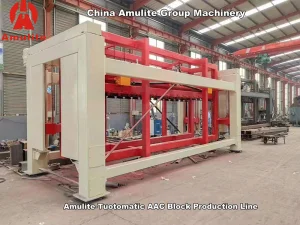
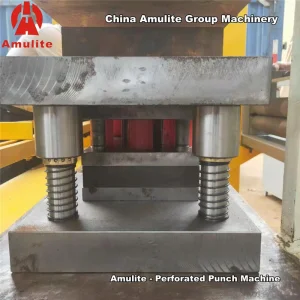
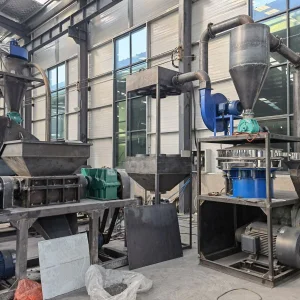
Expand your manufacturing portfolio with our specialized automated machinery range engineered for high durability and performance.
Connect directly with our Chief Senior Engineers today. We provide personalized technical proposals, complete plant layouts, local raw material formulation testing, and transparent factory direct pricing.
Send Inquiry Now