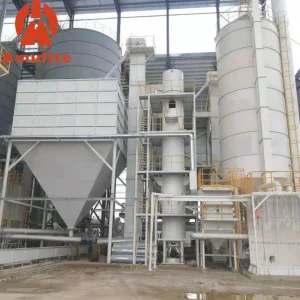
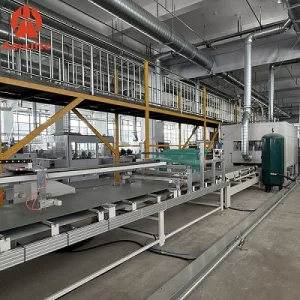
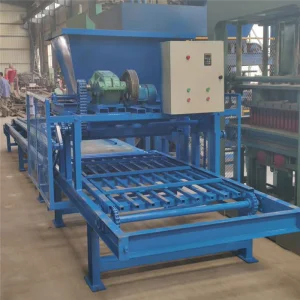
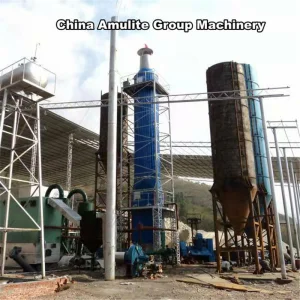
Explore our top-tier machinery configurations engineered for high-volume output, structural durability, and optimal raw material yield.
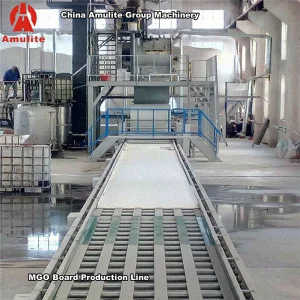
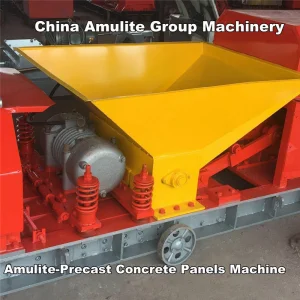
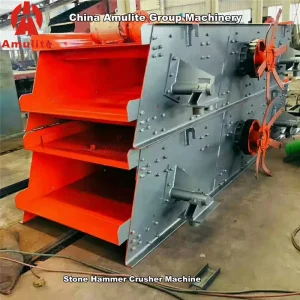
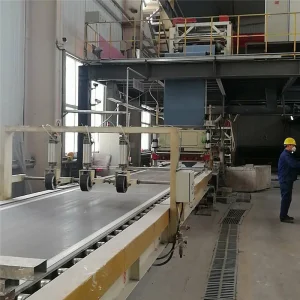
The global demand for non-combustible, structural, and weather-resistant building substrates has accelerated the shift toward advanced Fiber Cement Board (FCB) and Calcium Silicate Board (CSB) manufacturing solutions. Modern architectural standards require boards with elevated flexural strength (Class 1 to Class 5 under EN 12467), precise thickness tolerance (±0.2mm), and exceptional dimensional stability under severe environmental stress. Achieving these parameters requires an engineered synergy between raw material formulation, slurry rheology control, high-vacuum continuous film forming, high-pressure hydraulic consolidation, and hydrothermal autoclaving.
As a premiere OEM manufacturer based in China's industrial manufacturing core, our engineering philosophy focuses on delivering turnkey production lines that drastically minimize total cost of ownership (TCO) while maximizing operational uptime. From small-capacity lines generating 2 million square meters annually to massive 30-million-m² automated industrial complexes, our machinery integrates state-of-the-art European mechanical design with proprietary Chinese industrial manufacturing efficiency.
The cornerstone of high-volume fiber cement board manufacturing lies in the wet-forming method, predominantly dominated by the multi-vat Hatschek Process and the continuous Flow-on Process. The Hatschek system utilizes a series of revolving wire-mesh cylinders immersed in a homogenized slurry vat containing Portland cement, micro-silica sand, unbleached kraft pulp (bleached softwood/hardwood cellulose), and synthetic reinforcing fibers (PVA or PP).
Combining robust mechanical engineering, customized OEM flexibility, and deep supply chain integration to deliver unmatched ROI for building material plants.
Forming cylinders machined from high-grade SUS304/SUS316 stainless steel, frame structures built with heavy structural steel, and Hardox wear-resistant liners ensure 24/7 continuous operation for 20+ years.
Siemens S7-1500 PLC systems, SCADA supervisory management, integrated laser thickness sensors, and automated slurry density meters ensure precise recipe management and automated line control.
Custom OEM line engineering configured to utilize locally available silica sand, quartz powder, fly ash, blast furnace slag, and recycled agricultural fiber matrices without compromising final board ASTM/EN standards.
Achieve equivalent or superior output metrics to Western European machinery vendors at 40% to 60% lower initial capital expenditure, dramatically shortening project payback periods to under 2.5 years.
Standard manufacturing cycles completed within 90–120 days. Standardized modular design allows rapid containerization, fast ocean freight shipping, and streamlined on-site assembly.
From initial geological sand testing and civil building layout design to on-site commissioning, operator training, and lifetime remote diagnostic support, our service team ensures continuous productivity.
Comprehensive engineering benchmarks for standard OEM production line models. Custom parameters tailored upon request.
| Plant Configuration | Annual Capacity (m²) | Sheet Width / Length | Board Density Range | Autoclave Requirement | Total Connected Power |
|---|---|---|---|---|---|
| FCB-MINI-3M | 3,000,000 m² / year | 1220 x 2440 mm (4'x8') | 1.20 - 1.40 g/cm³ | 2 Sets (Ø2.0m x 31m) | ~650 kW |
| FCB-MID-5M | 5,000,000 m² / year | 1220 x 2440 / 3050 mm | 1.25 - 1.55 g/cm³ | 3 Sets (Ø2.5m x 31m) | ~980 kW |
| FCB-HIGH-10M | 10,000,000 m² / year | 1220 x 2440 / 3660 mm | 1.30 - 1.70 g/cm³ | 5 Sets (Ø2.8m x 36m) | ~1,850 kW |
| FCB-MEGA-20M+ | 20,000,000+ m² / year | Multi-width Tandem Line | 1.30 - 1.80 g/cm³ | 8+ Sets (Ø2.8m x 42m) | ~3,400 kW |
The versatility of fiber cement board machinery stems from its ability to produce substrates tailored to localized architectural demands across distinct geographic regions. By adjusting raw material formulations and hydrothermal autoclave temperature-pressure profiles, our machinery produces specialized board types suited for demanding environments:
Common in North America, Northern Europe, and Australasia. High-density autoclaved boards (density >1.6 g/cm³) are treated with deep 3D surface embossing rollers during the green sheet stage to mimic natural cedar wood grain or raw linear concrete textures. Outstanding freeze-thaw resistance (tested beyond 100 cycles) and Class A1 fire rating make it the ideal wood alternative.
Widely deployed in Middle Eastern and South Asian commercial sky-scrapers. Calcium Silicate Boards produced with high silica-to-lime ratios undergo hydrothermal synthesis to form Tobermorite crystalline structures (C5S6H5). These lightweight panels (0.8–1.1 g/cm³) provide up to 4 hours of structural integrity under fire exposure up to 1200°C.
Utilized heavily in Western European residential construction. Mid-density boards (1.3–1.4 g/cm³) integrated with hydrophobic silicon additives prevent moisture absorption (water absorption rates maintained below 25%), preventing tile delamination in bathrooms, kitchens, and industrial cleanrooms.
Rapid deployment across Latin America and Africa for social housing and emergency infrastructure. Fiber cement sheets serve as the high-strength outer skins for EPS cement sandwich wall panels or hollow-core partitions, accelerating building construction times by up to 70%.
The modern fiber cement board manufacturing landscape is undergoing a technological revolution driven by strict environmental ESG targets. Leading global buyers now mandate low-carbon production methodologies:
From initial site survey to commercial mass production hand-over, our 6-stage engineering protocol guarantees seamless execution.
Rigorous XRF/XRD chemical analysis of client sand, cement, and lime samples to calculate optimum silica-calcium ratio formulations.
Custom 3D CAD factory layout design optimizing raw material silos, production line footprint, boiler house, and curing yards.
CNC machining of forming cylinders, laser cutting of structural frames, and panel wiring under ISO 9001:2015 quality control.
Heavy-duty sea packaging, containerized shipping, and field dispatch of senior installation engineers for mechanical assembly.
System wet testing, slurry flow optimization, autoclave steam curve programming, and trial board production.
Comprehensive operator safety training, lab test routine setup, maintenance protocol establishment, and final certification.
Expert answers from our senior chief process engineer to help your investment committee make informed decisions.
While both boards use similar wet-forming machinery (Hatschek/Flow-on), the chemical reaction and raw material ratios differ. Fiber Cement Board relies primarily on Portland cement hydration (C-S-H gel formation) and air curing or short autoclaving, yielding high density and flexural strength ideal for exterior siding. Calcium Silicate Board uses a precise SiO₂ to CaO molecular ratio (approx. 1:1) subjected to high-pressure steam autoclaving (10–12 bar, 180°C–190°C for 12–14 hours) to synthesize Tobermorite crystals, creating ultra-lightweight, highly fireproof boards for interior ceiling and partition systems.
Local raw materials vary in silicon purity, cement hydration speed, and fiber pulp freeness. Our OEM team conducts laboratory crucible testing on your local silica sand (analyzing SiO₂ percentage and grain mesh size) and cement. We then adjust the hydro-pulper motor torque, slurry vat agitator speeds, vacuum dewatering pressure levels, and autoclave steam curing curves to guarantee your final boards meet international standards like ASTM C1186 or EN 12467.
A standard 5 million m²/year line requires a covered workshop space of approximately 180 meters in length by 24 meters in width (4,320 m²), plus raw material storage silos and outdoor cured board stacking yards (total plot size around 15,000–20,000 m²). Utility demands average ~980 kW of installed electrical power, 6 to 8 tons/hour of saturated steam (at 1.25 MPa), and a continuous water supply of 15 m³/hour (with 98% recycled through our clarification loop).
Yes. Our programmable accumulation cylinder system features auto-counting revolute controls linked to dynamic waterjet cutting knives. By modifying the revolution count on the accumulation drum via the Siemens PLC touch panel, the line seamlessly switches between 4mm ceiling panels, 8mm cladding boards, and 20mm heavy-duty floor substrates without stopping the primary slurry vats.
We provide a comprehensive 12-month mechanical warranty covering all manufactured equipment components. Every line shipment includes a 2-year wearable spare parts package (forming felt, wire mesh cylinders, vacuum seals, high-pressure nozzles). Furthermore, our remote SCADA diagnostic module allows our software engineers in China to assist your factory team in real-time for PLC troubleshooting, software upgrades, and process tuning.
Discover our comprehensive suite of non-metallic mineral processing and building board automated manufacturing lines.