Examining the structural migration toward off-site prefabrication, automated non-metallic building material lines, and high-efficiency capital machinery worldwide.
The global construction equipment manufacturing ecosystem is undergoing a fundamental structural transformation. Driven by stringent international carbon neutrality mandates, escalating jobsite labor overheads, and the imperative for rapid structural deployment, regional developers and EPC (Engineering, Procurement, and Construction) conglomerates are shifting away from traditional in-situ casting toward industrialized, automated off-site building material production.
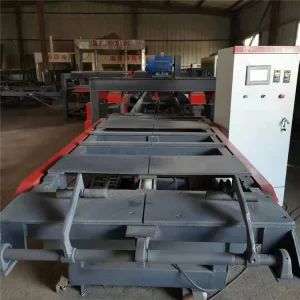
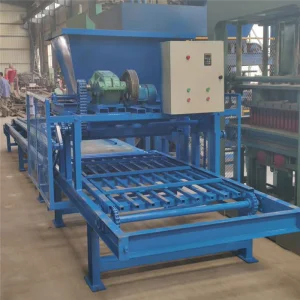
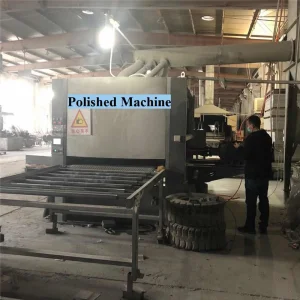
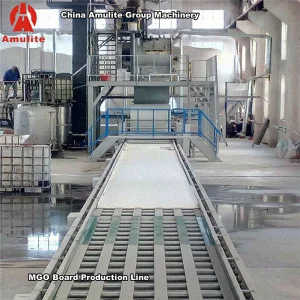
At the center of this transformation lies high-precision production machinery for non-metallic building boards and precast elements—specifically fiber cement boards, calcium silicate panels, autoclaved aerated concrete (AAC) blocks, EPS sandwich panels, and magnesium oxide (MGO) fireproof boards. Equipment manufacturers are no longer merely assembling mechanical components; they function as holistic process engineering partners responsible for chemical slurry formulation, hydrothermal reaction stability, thermal recovery, and end-to-end line automation.
According to empirical data from major engineering firms, the global demand for automated board and panel production machinery is accelerating across distinct commercial vectors:
Why Tier-1 Chinese machinery OEMs lead global market share through vertical integration, rigorous quality assurance, and superior ROI.
Industrial clusters in Hebei and regional manufacturing hubs house concentrated supply networks for heavy steel fabrication, CNC lathe processing, hydraulic valve blocks, and electrical controls within a 50 km radius, reducing component sourcing lead times by up to 60%.
Every critical sub-assembly—from 1,600 mm width Hatschek sheet forming cylinders to 3.8-meter diameter autoclave pressure vessels—is machined, assembled, and wet-tested in factory test bays prior to export packaging.
Tier-1 Chinese capital machinery delivers equal or superior throughput performance relative to legacy Western brands at 35% to 50% lower capital outlay (CapEx), accelerating full project paybacks to under 2.5 operational years.
"Manufacturing efficiency is not merely lower cost; it represents the systematic integration of raw material chemical profiling, high-speed automated mechanical handling, and strict quality control protocols that operate continuously under demanding operational conditions."
| Performance Vector | Traditional Standard Plants | Amulite Integrated Smart Line | Operational Gain |
|---|---|---|---|
| Sheet Forming Precision | ± 0.8 mm manual control | ± 0.15 mm auto hydraulic gauge | 81% Reduction in dimensional variance |
| Energy Consumption (kWh/m³) | 42 - 48 kWh/m³ | 28 - 32 kWh/m³ (Heat Recovered) | 33% Reduction in power draw |
| Formulation Adaptability | Strict virgin raw materials | Up to 45% Fly Ash / Slag substitution | 25% Raw material cost saving |
| Line Automation Level | 18-24 Operators per shift | 4-6 Operators (PLC Centric) | 75% Direct labor optimization |
An in-depth evaluation of chemical phase synthesis, mechanical slurry dewatering, and geographic deployment models.
The manufacturing of premium non-asbestos fiber cement boards and calcium silicate boards relies on advanced mechanical slurry processing. The slurry batching system precise measures Portland cement, crystalline silica quartz sand (ground to a specific surface area of 350–400 m²/kg), cellulose fiber pulp (refined to 30–35° SR freeness), and performance additives.
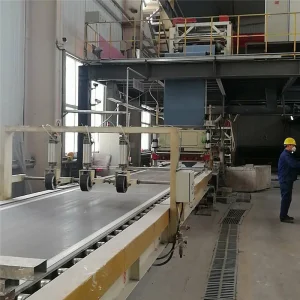
During the sheet-forming stage inside multi-vat Hatschek units, rotary sieve cylinders extract homogeneous film layers with a thickness of 0.2–0.3 mm from slurry suspensions containing 8% to 12% solid content. These ultra-thin films are continuously transferred onto a high-tension felt, passed over multi-stage vacuum dewatering boxes to strip free water content down to 28%, and wrapped around a forming drum until the specified board thickness (4 mm to 30 mm) is achieved.
Autoclaving Hydrothermal Reaction (Tobermorite Synthesis): High-strength calcium silicate boards undergo 10 to 12 hours of hydrothermal curing inside saturated steam autoclaves at 1.2 MPa pressure and 185°C. Under these thermodynamic conditions, reactive silica and calcium hydroxide synthesize into C-S-H (I) and crystalline Tobermorite ($5CaO \cdot 6SiO_2 \cdot 5H_2O$), granting the final board complete fire immunity (Class A1), non-combustibility, low moisture movement (<0.12%), and extreme flexural strength (>16 MPa).
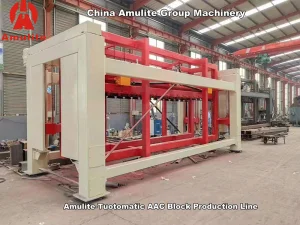
AAC manufacturing is defined by precise gas-foaming reactions and precise mechanical cutting geometry. Raw materials—slurry ground quartz sand or fly ash combined with quicklime, cement, and gypsum—are mixed in automated dosage tanks. Micro-fine aluminum powder paste is injected as a chemical blowing agent immediately prior to mould pouring.
The chemical reaction between aluminum powder and calcium hydroxide generates microscopic hydrogen gas bubbles ($2Al + 3Ca(OH)_2 + 6H_2O \rightarrow 3CaO \cdot Al_2O_3 \cdot 6H_2O + 3H_2 \uparrow$), expanding the mass to twice its original volume and creating a uniform porous structure. Once green strength is attained via pre-curing tunnels (35–45°C), high-precision tilting cutting machines execute longitudinal and cross wire cuts with tolerances within ±1.0 mm, eliminating edge degradation prior to autoclave curing.
Engineered for high-speed residential prefabrication, automatic EPS (Expanded Polystyrene) sandwich panel lines produce compound wall elements featuring high-density calcium silicate facings bonded to a lightweight concrete core composed of EPS beads, Portland cement, sand, and foaming agents.
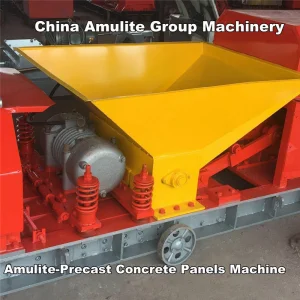
Advanced vertical or horizontal automatic mould cars feature automated core slurry injection, continuous vibration compaction to eliminate internal air voids, and temperature-controlled curing tracks. The resulting wall panels exhibit high acoustic insulation ratings (STC ≥ 45 dB), excellent thermal insulation, and rapid tongue-and-groove interlocking speed on job sites.
A structured evaluation framework for factory owners, investment groups, and project developers procuring capital machinery.
Before final machine dimensioning, local raw material samples (quartz sand, local cement, fly ash, cellulosic fibers) must undergo X-ray fluorescence (XRF) and particle size distribution (PSD) analysis to calibrate the water-to-binder ratio and autoclave curing cycles.
Inspect core steel frame thickness (Q355B structural grade steel minimum), forming cylinder surface chrome plating depth (≥ 0.08 mm), and PLC automation hardware (Siemens S7-1500 / Schneider Electric ecosystem integration).
Ensure the vendor contract mandates resident field engineer deployment for civil foundation oversight, mechanical installation, electrical commissioning, and operator training until certified nominal output is reached.
| CapEx & OpEx Component | Cost Share (%) | Key Optimization Lever | Target Standard |
|---|---|---|---|
| Machinery Procurement (CapEx) | 30% - 40% (Initial Year) | Modular plant design & integrated pre-assembly | CE Marking / ISO 9001:2015 |
| Raw Materials (OpEx) | 45% - 55% (Annual) | Industrial fly ash substitution & automated slurry recovery | Zero slurry waste discharge |
| Thermal & Electric Power (OpEx) | 15% - 22% (Annual) | Autoclave condensate flash-steam recovery boilers | Heat efficiency ≥ 88% |
| Maintenance & Wear Parts (OpEx) | 3% - 5% (Annual) | High-abrasion alloy cutting edges & synthetic felts | Mean Time Between Failures > 2400 hrs |
Answers to essential technical and commercial questions compiled by our senior engineering team.