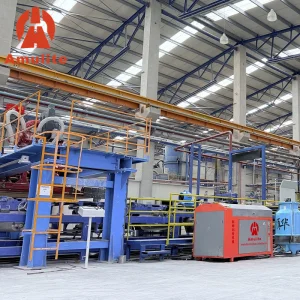
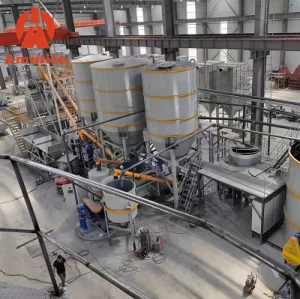
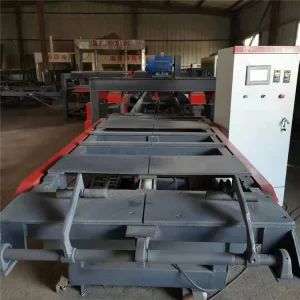
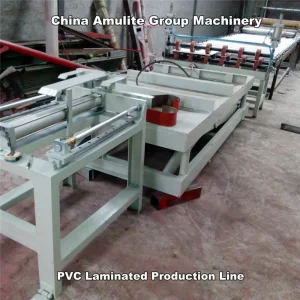
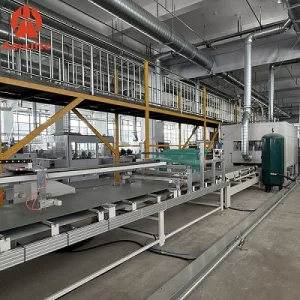
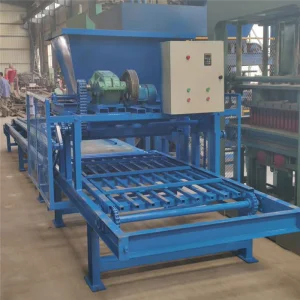
State-of-the-art building material manufacturing systems engineered for high productivity, thermal efficiency, and mechanical resilience.
An authoritative engineering breakdown of slurry hydration, Tobermorite crystalline matrix formation, and equipment selection criteria for tier-one manufacturers.
The global demand for non-combustible, high-strength, and dimensionally stable building elements has positioned calcium silicate plates (boards) at the forefront of modern architectural cladding, passive fire protection systems, and high-performance partition technologies. As premier industrial plant designers and equipment manufacturers, leading machinery providers have shifted from legacy batching techniques to fully automated, continuous-process lines capable of producing boards ranging from ultralight ceiling tiles (0.8 g/cm³) to ultra-dense exterior structural facades (up to 1.7 g/cm³).
Pioneering the transition from manual, energy-intensive plants to AI-driven, zero-waste smart factories.
Integration of real-time ultrasonic density meters and automated mass-flow controllers. This ensures that the solid-to-liquid ratio of siliceous sand (mesh size 200–320), quicklime, and Portland cement remains within a strict $\pm 0.5\%$ margin, eliminating variation in board density.
Modern 3-to-5 vat wet-process sheet machines feature dynamic wire-tensioning, automatic felt washing using high-pressure micro-jets (25–35 bar), and continuous multi-stage vacuum dewatering systems that optimize moisture content prior to pre-curing.
Closed-loop thermal fluid and steam management networks capture flash steam during autoclave depressurization. Energy recycled into raw material pre-heating tanks reduces boiler fuel consumption by up to 28% per metric ton of cured board.
Line-integrated machine vision systems inspect surface topography, edge squareness, and micro-fissures immediately post-trimming. Sub-millimeter laser sensors ensure panel thickness uniformity across width profiles up to 1300mm.
| Performance Vector | Legacy Production Equipment | Next-Gen Amulite Smart Machinery | Impact on ROI & Board Quality |
|---|---|---|---|
| Raw Slurry Homogeneity | Manual batch weighing; $\pm 3.5\%$ variance | PLC-SCADA Automated Dosing; $\pm 0.3\%$ variance | Eliminates internal delamination and weak cores. |
| Pre-Curing Cycle Time | 12 – 16 Hours in static rooms | 4 – 6 Hours in humidity-controlled tunnels | Reduces work-in-progress inventory footprint by 60%. |
| Autoclave Hydrothermal Cycle | Manual valve actuation; uneven steam distribution | Multi-zone automated ramp-up, dwell, & blowdown | Ensures 100% Tobermorite conversion; prevents warping. |
| Edge Profile Precision | Standard mechanical saws ($\pm 1.5\text{ mm}$) | High-speed carbide 4-side trimming ($\pm 0.2\text{ mm}$) | Allows direct installation without site-edge grinding. |
| Raw Material Adaptability | Restricted to high-grade virgin pulp | Multi-fiber input (recycled pulp, mineral wool, glass fiber) | Lowers raw material cost by 15–22% annually. |
Configuring board machinery tailored for diverse architectural, industrial, and civil infrastructure demands.
Requires high-density boards ($>1.4\text{ g/cm}^3$) subjected to post-autoclave hydraulic pressing (3000–5000 ton press). The equipment must incorporate automated pressing sheets and de-stackers engineered for heavy load cycles.
Lines configured for low-to-medium density plates enriched with vermiculite or mica. Equipment includes specialized dusting and slurry dosing systems capable of handling low-specific-gravity additives without phase separation.
Requires smooth-surface, zero-dusting boards. The machinery integrates online UV-curing coating sections and anti-bacterial sealers directly onto the board line after calibration sanding.
Why leading global cement product conglomerates choose Chinese heavy machinery manufacturing clusters for plant engineering.
The manufacturing ecosystem in China for heavy building material machinery offers unparalleled vertical integration. From large-scale casting of 1.6-meter diameter forming cylinders to in-house precision CNC machining of autoclave doors and pressure shells, key components are produced with complete control over quality and lead times. This integrated cluster approach prevents bottlenecks and significantly reduces capital expenditures compared to European machinery equivalents.
Eliminating subcontracting delays by maintaining heavy vertical boring mills, portal CNC gantries, and automated robotic welding cells under one 100,000 m² industrial facility.
All pressure vessels, autoclaves, and steam boilers strictly adhere to international codes (ASME Section VIII Div 1, EU PED 2014/68/EU), complete with X-ray weld diagnostics and hydraulic pressure testing certificates.
Strategic partnerships with international automation providers (Siemens, Schneider, ABB, SEW-Eurodrive) ensure electrical components can be serviced locally anywhere across 60+ export markets.
A transparent, risk-mitigated pathway for multi-national building material groups investing in capital equipment.
Before equipment specification, client-provided quartz sand, lime, cement, and local pulp samples undergo chemical composition (XRF), particle size distribution (PSD), and reactiveness testing in our R&D laboratories.
Delivery of detailed 3D BIM models, foundation load schematics, steam pipeline routing, electrical loading diagrams, and compressed air distribution plans to local engineering partners.
Deployment of resident mechanical, electrical, and chemical engineers for 60 to 90 days on-site. Complete operational training for client crews covering machine operation, preventative maintenance, and formulation tuning.
Every plant control cabinet comes equipped with secure IoT gateway systems, enabling real-time remote PLC troubleshooting, software upgrades, and process optimizations from our headquarters.
Direct answers from our senior project engineering team regarding production setup, operational costs, and machine selection.
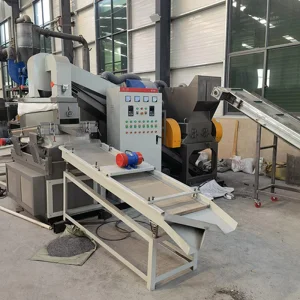
Explore our extended series of board trimming, recycling, block machinery, and specialized panel production lines.