High-throughput, fully automated machinery engineered for structural board, lightweight block, and advanced building material processing.
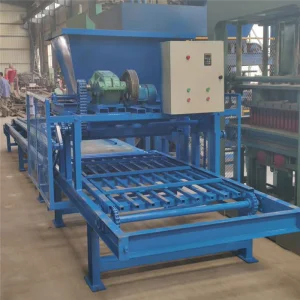
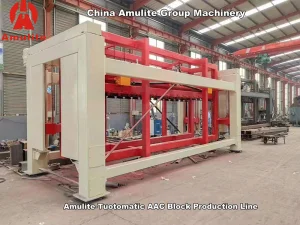
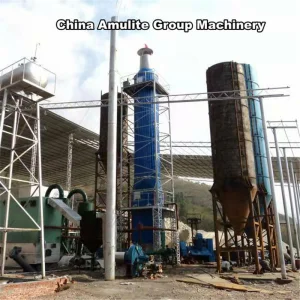
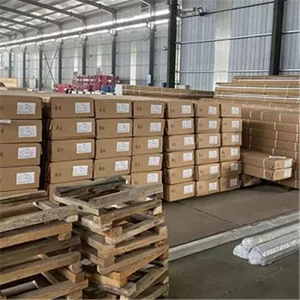
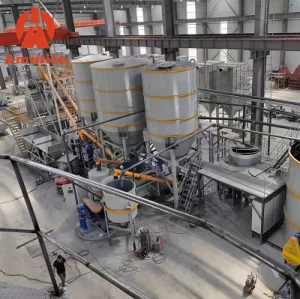
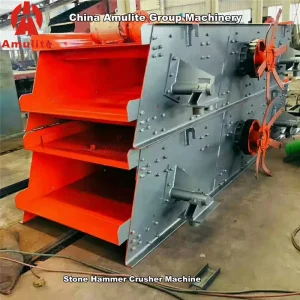
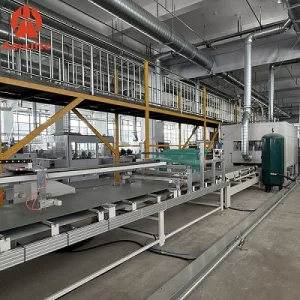
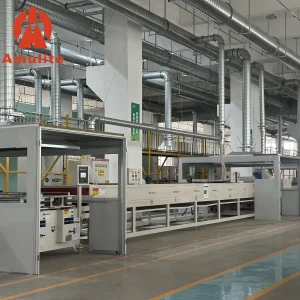
Understanding the global paradigm shift toward fire-resistant, non-asbestos, eco-friendly composite building panels in modern architecture.
The global construction and building material industry is undergoing a structural transition. Accelerated by stringent environmental regulations, updating regional fire codes, and the urgent demand for modular pre-fabrication, fibre cement plates (boards) have emerged as the premier replacement for traditional gypsum plasterboard, plywood, and asbestos-based sheeting. Operating at the intersection of structural durability and lightweight versatility, autoclaved fibre cement plates deliver Class A1 fire rating, exceptional flexural strength (MOR > 16 MPa), and complete immunity to moisture degradation.
From a macro-economic perspective, the global market for fibre cement products is projected to expand significantly over the next decade. Key growth drivers include large-scale urban infrastructure developments in Southeast Asia and Latin America, high demand for ventilated curtain-wall facades across Europe, and rapid adoption of exterior rain-screen cladding systems in North America. To meet these industrial requirements, factory operators and project developers require high-precision, turnkey Fibre Cement Plate Production Lines capable of continuous multi-shift production with low energy consumption and precise density calibration.
| Market Region | Primary Industrial Applications | Dominant Plate Density Class | Compliance & Regulatory Standard |
|---|---|---|---|
| North America | Exterior Siding, Architectural Cladding, Tile Backer Boards | Medium to High Density (> 1.30 g/cm³) | ASTM C1186 Standard Specification |
| European Union | Ventilated Rain-screen Facades, Fire Shaft Walls | High Density Class A (> 1.45 g/cm³) | EN 12467 / CE European Conformity |
| Asia-Pacific & Middle East | Internal Partitioning, Ceiling Systems, Modular Modular Prefab | Standard to Medium Density (1.00 - 1.25 g/cm³) | ISO 8336 / Local Municipal Standards |
An end-to-end breakdown of the wet-process slurry preparation, Hatschek sheet accumulation, heavy hydraulic pressing, and hydrothermal curing kinetics.
Designing a high-yield Fibre Cement Plate Production Line demands a total balance between slurry rheology, fiber dispersion, dewatering dynamics, and chemical crystallization. China Amulite Group utilizes advanced engineering principles to optimize every stage of the manufacturing sequence, ensuring minimum raw material waste and maximum structural performance.
Unbleached kraft wood pulp or synthetic fibers are hydrated and processed through a high-consistency hydrapulper and disc refiner until reaching a freeness level of 20–30°SR. Concurrently, Ordinary Portland Cement (OPC) and finely ground silica quartz sand (milled to Blaine fineness > 3800 cm²/g) are precisely batch-weighed using loss-in-weight feeders and combined in a slurry mixing chest.
The homogeneous dilute slurry is continuously fed into 3 to 4 stainless steel vat assemblies. Rotating wire-mesh cylinder moulds pick up a micro-thin layer of fiber-binder film (0.2–0.3 mm thickness per revolution) and transfer it onto an endless synthetic felt belt. Vacuum dewatering boxes extract excess moisture before the continuous green layer is wound around a motorized forming drum to achieve the exact target plate thickness (from 4 mm up to 30 mm).
For high-density exterior cladding applications, the stacked green boards enter an automated 3,000 to 5,000-ton multi-daylight hydraulic press. This process removes inter-pore water, increases particle compaction, and boosts board density from 1.2 g/cm³ to over 1.65 g/cm³, raising flexural strength and freeze-thaw resistance significantly.
Plates undergo pre-curing for 8–12 hours before loading into heavy-duty pressure vessel autoclaves. Under 1.2 MPa of saturated steam at 185°C to 190°C for 10–12 hours, the fine quartz silica reacts with calcium hydroxide in the cement to synthesize 1.1 nm Tobermorite crystalline structures [Ca₅Si₆O₁₆(OH)₂·4H₂O]. This reaction eliminates moisture expansion and grants complete dimensional stability.
Post-autoclave plates pass through automated drying chambers, twin-face calibrating sanders, edge trimming systems, and hydrophobic seal coating units. Automated vacuum robot stackers sort, stack, and shrink-wrap finished pallets for global transit.
Autoclaved boards achieve complete hydrothermal synthesis within 24 hours, converting free lime into inert Tobermorite crystals. This completely eliminates carbonation shrinkage and efflorescence—a common failure point in traditional air-cured cement products stored in outdoor humidity.
Variable-speed frequency drive agitators prevent fiber settling and guarantee consistent weight distribution across 1,300mm–1,600mm sheet widths.
Integrating multi-stage settling tanks and clarifiers ensures up to 95% of process water is filtered and recirculated back into slurry mixing chests.
Siemens S7-1500 PLC architecture paired with industrial IoT sensors permits real-time monitoring of slurry density, belt tension, and steam pressure curves.
Decades of heavy machinery manufacturing, proprietary process formulas, and worldwide turnkey project execution support.
Our dedicated civil, mechanical, electrical, and chemical engineers handle complete plant layout design, utility sizing, and localized raw material formulation trials.
From heavy structural steel fabrication and CNC cylinder machining to control cabinet assembly, all core machinery is manufactured and dry-tested in-house.
We enforce strict contract-defined performance metrics covering board yield rate (>98%), energy consumption per square meter, and mechanical tolerance guarantees.
Pioneering low-carbon binder formulations, AI vision quality assurance, and high-efficiency thermal recovery systems.
Replacing traditional OPC with blast furnace slag, metakaolin, and calcined clays to produce zero-clinker fiber cement plates with 70% lower embodied carbon.
High-resolution line-scan cameras integrated at the post-stacking section continuously analyze surface texture, micro-cracks, and dimensional tolerances with sub-millimeter precision.
Capturing high-pressure exhaust steam from depressurizing autoclaves to pre-heat boiler feedwater, lowering thermal energy consumption by up to 22% per cycle.
Customizing plant parameters to meet localized building standards and extreme climatic conditions worldwide.
Fibre cement plates manufactured via Amulite engineering systems are engineered to satisfy stringent localized building codes across multiple continents. By adjusting raw material formulation ratios (such as cellulose-to-silica proportions and hydraulic compaction pressure), our clients produce tailored board grades for specific commercial environments:
High-density boards (>1.5 g/cm³) with low water absorption (<20%) compliant with ASTM C1186 Type A Class 4 and EN 12467 Category A for severe outdoor weather exposure.
Medium-density moisture-resistant boards ideal for high-humidity environments like hospital operating rooms, commercial kitchens, and bathroom backer tiles.
Thick non-combustible panels (12mm–25mm) achieving 2 to 4 hours of fire resistance rating under ISO 834 / UL 263 fire test procedures for elevator shafts and emergency stairwells.
Technical clarity on plant footprint, raw material sourcing, production capacities, and equipment payback timelines.
Amulite lines are customized to produce from 2 million to 30 million square meters per year (based on a standard 6mm plate thickness basis). Capacity is scaled by altering sheet machine width (1,300mm to 1,600mm), adding cylinder vats (3 to 4 vats), expanding autoclave vessel capacity, and introducing automated stackers.
Yes. Prior to contract finalizing, our chemical engineering lab analyzes your local cement (OPC 42.5/52.5), quartz sand deposits, fly ash, and available paper pulps. We adjust the batching ratio to ensure your local raw materials meet international strength standards (EN 12467 / ASTM C1186) without relying on expensive imported additives.
Equipment manufacturing and pre-assembly testing at our plant take 90 to 120 days. Site civil foundation preparation occurs concurrently. On-site mechanical and electrical installation takes 45 to 60 days, followed by 20 days of commissioning and operator training under resident Amulite engineers.
Autoclaving subjects plates to 1.2 MPa high-pressure saturated steam at ~185°C. This forces a chemical reaction between silica quartz sand and cement lime to synthesize Tobermorite crystals. Autoclaved plates achieve maximum strength in hours, exhibit negligible moisture movement, and do not effloresce compared to air-cured boards.
We supply a comprehensive 2-year operational spare parts kit with each line. Furthermore, all PLC cabinets feature encrypted remote diagnostic modules for real-time troubleshooting via network link, supported by local service teams and fast-dispatch global spare parts warehouses.
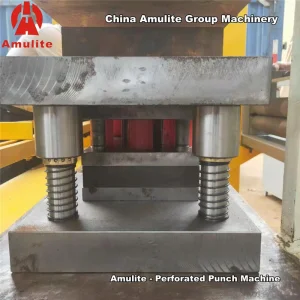
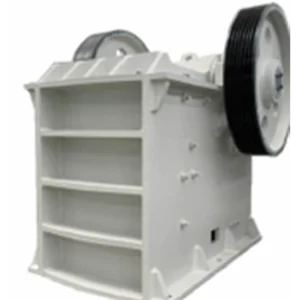
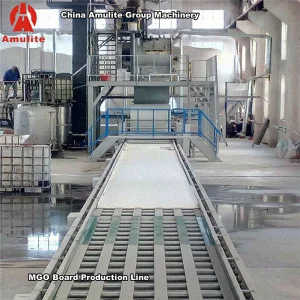
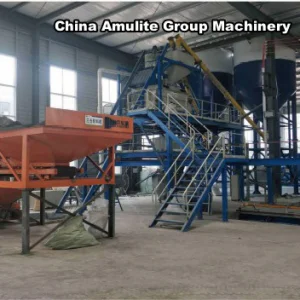
Explore our full line of non-metallic panel production systems, material crushing units, and high-precision processing machinery.
Contact China Amulite Group today to receive a complete engineering proposal, plant layout drawing, civil foundation data, and customized raw material formulation quote.